• You can now help support WorldwideDX when you shop on Amazon at no additional cost to you! Simply follow this Shop on Amazon link first and a portion of any purchase is sent to WorldwideDX to help with site costs.
  • A Winner has been selected for the 2025 Radioddity Cyber Monday giveaway! Click Here to see who won!

EZNEC help please

Crawdad

Down in the mud invasive species
I Support WorldwideDX.com!
Nov 11, 2016
1,648
3,155
273
Modeling a 3 element Yagi and having trouble adding a Hairpin matching inductor to the Driven Element feedpoint. Any help much appreciated.

7 3

RIP Marconi (SK)
 
Last edited:

Screenshot (78).png


This is the Featherweight and I know the dimensions of the Hairpin. My issue is adding it to the model. Still learning EZNEC.
 
  • Like
Reactions: AudioShockwav
View attachment 71545

This is the Featherweight and I know the dimensions of the Hairpin. My issue is adding it to the model. Still learning EZNEC.

I'm more of a 4nec2 user, although I have used eznec, and the method is basically the same.

The recommended way to add the hairpin match is to break the driven element up into three separate wires. From one tip to where one side of the hairpin attaches, the area between the two points the hairpin attaches, and then from there to the other tip. Of course the feed point will be on the middle of those three wires so you will need to make sure that is set. Then put the hairpin dimensions in with their wires connecting to said attachment points.

There are other ways, but I wouldn't recommend them here.

Good luck, and once you get it working don't be afraid to play around with the model, try it at different heights, and try different earths below it and see how it changes things, not just the radiation pattern, but the match, and see what and how how much it takes to re-tune the antenna under said conditions. Its just a file so you can always save the working models you want to keep before playing with it. You might also adjust the distance between the elements, and slightly adjust said element lengths. There are a lot of things you can do, and a lot of information about an antenna you can gain by doing these things.

One model of an antenna, any antenna, never tells the whole story, yet people look at one model and think they have that antenna figured out.

One other piece of advice, if you are doing to to measure gain, pay close attention to the models AGT. If your not sure what that is read up on it.

If there is one more piece of advice if you wish to look at/make multiple antenna models over time, once you get used to eznec, play with 4nec2 and mmana-gal as well. They have their differences and quirks, and having knowledge of all of them will only help you over time.

I also had no idea that Marconi passed away, although I knew he was getting up there. If it was posted here I must have missed it, although I have had my own issues for the past half a year as well... Rest in Peace my old discussion partner, source of frustration, curious experimentalist, or however he came across that day. He was a good guy, but if you challenged his beliefs or he misunderstood what you said, he wouldn't hesitate to throw you under the bus sometimes...


The DB
 
Last edited:
I'm more of a 4nec2 user, although I have used eznec, and the method is basically the same.

The recommended way to add the hairpin match is to break the driven element up into three separate wires. From one tip to where one side of the hairpin attaches, the area between the two points the hairpin attaches, and then from there to the other tip. Of course the feed point will be on the middle of those three wires so you will need to make sure that is set. Then put the hairpin dimensions in with their wires connecting to said attachment points.

There are other ways, but I wouldn't recommend them here.

Good luck, and once you get it working don't be afraid to play around with the model, try it at different heights, and try different earths below it and see how it changes things, not just the radiation pattern, but the match, and see what and how how much it takes to re-tune the antenna under said conditions. Its just a file so you can always save the working models you want to keep before playing with it. You might also adjust the distance between the elements, and slightly adjust said element lengths. There are a lot of things you can do, and a lot of information about an antenna you can gain by doing these things.

One model of an antenna, any antenna, never tells the whole story, yet people look at one model and think they have that antenna figured out.

One other piece of advice, if you are doing to to measure gain, pay close attention to the models AGT. If your not sure what that is read up on it.

If there is one more piece of advice if you wish to look at/make multiple antenna models over time, once you get used to eznec, play with 4nec2 and mmana-gal as well. They have their differences and quirks, and having knowledge of all of them will only help you over time.

I also had no idea that Marconi passed away, although I knew he was getting up there. If it was posted here I must have missed it, although I have had my own issues for the past half a year as well... Rest in Peace my old discussion partner, source of frustration, curious experimentalist, or however he came across that day. He was a good guy, but if you challenged his beliefs or he misunderstood what you said, he wouldn't hesitate to throw you under the bus sometimes...


The DB
Thanks much for the advice. I think I have the basics down pretty well and I have been playing with 3 or 4 different iterations, changing element spacing, element length and diameter. My goal is a balance between gain and F/B while keeping within the boom length and weight limits that I want to stay with. I think I've found the combination I'm looking for but can't run a valid SWR sweep until I get the Hairpin into the model since the Z= ~20ohms without it.

AGT is a new one on me so I'll chase that info down before I finalize a design. I've got a lot to learn.

And yeah I'm aware of the differences between models and reality, not expecting any analyzer results to look exactly like the model. Just something in the ballpark. And I do enjoy playing around modeling these things.

Thanks much for your help and I'll probably be back with more questions.

7 3
 
AGT is a new one on me so I'll chase that info down before I finalize a design. I've got a lot to learn.

I would suggest reading the EZnec user manual, (that is a link) they have a very good description in there, and if you search for average gain, it comes up a lot all though out said manual. If you want accurate gain results, it really is important to pay attention to.

Essentially what Average Gain Test is is a way to measure the accuracy of a model's output. The software removes all losses from the model, runs the model, and averages all the gain outputs and gives a result. The closer to 1 that result, the more accurate the model's output is. While this is the main use of said AGT, there are others as well, as described in said manual. Further, if your result is to far off of 1, the manual offers suggestions on how to correct it, I can also offer suggestions if they don't help.

Yea, modeling can bee as deep as you want to take it. You don't need to know everything to get accurate models though. When it comes to AGT, or as said manual puts it "Average Gain", to many people don't know it exists, post models with bs results, and believe them to the point that they refuse to question them.

There is another piece of advice, don't hesitate to question your results, especially if you see something that you don't expect. As stated above, the modelsing software isn't perfect, and has its good points and bad points.

Of course if you have questions I'm happy to answer them the best I can. That being said, my life was turned upside down in December (and really the three months before that as well), and hasn't fully recovered, so it may take me some time sometimes...


The DB
 
Thanks for the manual link, no doubt that will help this feeble brain. No chance to play with models today, I'll read the manual tomorrow and get back to it.

I wish you a speedy recovery from whatever rocked your world.

Thanks again
7 3
 
I would suggest reading the EZnec user manual, (that is a link) they have a very good description in there, and if you search for average gain, it comes up a lot all though out said manual. If you want accurate gain results, it really is important to pay attention to.

Essentially what Average Gain Test is is a way to measure the accuracy of a model's output. The software removes all losses from the model, runs the model, and averages all the gain outputs and gives a result. The closer to 1 that result, the more accurate the model's output is. While this is the main use of said AGT, there are others as well, as described in said manual. Further, if your result is to far off of 1, the manual offers suggestions on how to correct it, I can also offer suggestions if they don't help.

Yea, modeling can bee as deep as you want to take it. You don't need to know everything to get accurate models though. When it comes to AGT, or as said manual puts it "Average Gain", to many people don't know it exists, post models with bs results, and believe them to the point that they refuse to question them.

There is another piece of advice, don't hesitate to question your results, especially if you see something that you don't expect. As stated above, the modelsing software isn't perfect, and has its good points and bad points.

Of course if you have questions I'm happy to answer them the best I can. That being said, my life was turned upside down in December (and really the three months before that as well), and hasn't fully recovered, so it may take me some time sometimes...


The DB
Have you ever played with the Boom Correction formula stuff?
 
Have you ever played with the Boom Correction formula stuff?

There is a stepped diameter correction built into 4nec2. I don't know if its the same as the one in EZnec. I played with it once or twice, but even going from the entire element being the smallest diameter in the element to the largest diameter in said element hasn't made much of a difference in any of the results, to the point of being well below any margin of error, so I don't normally bother with it.

That being said. most of my models were of CB antennas, so if you go outside of that range, it is possible that it will have more effect on some other antennas.

Also most of my models were testing and comparing various antenna designs, not specific antennas themselves, so there was even less of a need to use said feature. Although there are exceptions where I specifically modeled specific antennas, such as the Astroplane, or the Shockwave (and its predecessor), the v4k ect. (all these including matching circuits).


The DB
 
  • Like
Reactions: Crawdad
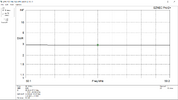
Here is a SWR sweep of the antenna without the Hairpin Match in place:
Screenshot (85).png

Here's the Driven Element with the Hairpin Match in place. Initially I just added the three wires of the Hairpin to the wire chart, but EZNEC gave me a geometry warning and asked if I would like it to correct the geometry. This the result:
Screenshot (84).png

Screenshot (83).png
 
  • Like
Reactions: Captain Kilowatt
Looks like you have it dialed in perfectly. I used a hairpin match on my 6m yagi as well. I used a halfway coaxial balun along with it and the match was similar to what you show. My configuration is six elements on a 17 foot boom but it an OWA design...... Optimal Wideband Array......so it just fits in that 17 foot boom. Reflector to driver spacing is only about 27 inches and driver to the first director is about 16 inches. This assures heavy coupling and creates a nice tight pattern on a 17 foot boom. I used an old Wilson Shooting Star for parts so it is really heavy duty for 6m.
 
  • Like
Reactions: Crawdad

dxChat
Help Users
  • No one is chatting at the moment.