I just noticed that when TR24 was removed, that the solder was also removed from one leg of D59 and C208. The legs were still in the holes, but were loose. I re-soldered those. Unfortunately this didn't affect the function of the radio, and TP9 voltage is still 6.76.

You are using an out of date browser. It may not display this or other websites correctly.
You should upgrade or use an alternative browser.
You should upgrade or use an alternative browser.
-
You can now help support WorldwideDX when you shop on Amazon at no additional cost to you! Simply follow this Shop on Amazon link first and a portion of any purchase is sent to WorldwideDX to help with site costs.
-
A Winner has been selected for the 2025 Radioddity Cyber Monday giveaway! Click Here to see who won!
Help needed with Old President Grant PC409AB Issues
- Thread starter bigtoyboy01
- Start date
@MKwrench
Just so you are aware, the 148GTL Schematic, By Rick Jackson (dated March 11, 2008) .............has many mistakes (close to 20), a few examples; the lack of LED indicator and related parts for TX and RX not there, at FET2 there are two R33 resistors, R55 (100Ω) does not go to ground. The more you look the more you will find.
I stopped using that schematic, relying only on the originals that came with the radios that share the same board ..... to include the Cobra 2010GTL (base radio that came after the 2000GTL) it has an LCD liquid display, and weather channels.
@bigtoyboy01
* The one thing I haven't heard mentioned ..... What power supply are you using to run that radio? (Volts and Amps (or watts).)
* Test for a voltage (or voltage drop) right at the power supply with the radio on, and let us know.
***Do not use or go by the above schematic that was posted by MKwrench, you may end up with more problems than you have now.
Go to the following to find the schematic:
I'm sure you can find the Service Manuals for that radio, in this forum also, located in the "Sam's PhotoFacts Collection" section (by danmcclain) just ask, if it's not already there or try this forum search for it.
Your best bet is to use the Grant schematic for your radio, most of the part location numbers are the same as the 148, 2000, or 2010 GTLs .... but there are a few minor differences, and it's not the same as the 140, 142 GTLs, or Washington 8719 base.
As far as you repairing this radio, you should wait until you recap the radio as
@AudioShockwav stated, before you start making any adjustments or other parts replacement.
Your last question was the 2nd time you asked it, it was answered at the top of page two by CSA1863. They are the Driver and Final transistors.
I don't know what experience you have working on any transmitter, but there are a few people here that started the same way .... Due to the lack of a techs (or Golden Screwdrivers) near by to work on them.
Learning to read a radio's schematic is a must no matter what, "Where is this or that" is all in the service manual.
Having the right test gear and the proper tools to make adjustments helps too, not just a Digital Multi Meter (DMM), but an oscilloscope, a frequency counter, good soldering and de-soldering equipment and the proper solder, transistor tester, Capacitance and Inductor meter(s), a good size power supply to be able to run any radio you work on (13.8V at 30 Amps is a good start, and if possible a spectrum analyzer.
If you just want to get this radio working without the frequency counter, you will pull hairs.
You may find out the reason you were told to just buy a new radio was because it would cost less than the repairs of that old one. Unless the money is no object to you.
In the future a lot of people will be liking their old radio's, or so and so' old radio that was left to them.
At your age now, learning what you can about radio repair, you could end up becoming one of our future techs (due to most of us being in our 60's and
over (I'm 76 and been at it since 1974 (I was just like you), but i was in my 20's).
73
Just so you are aware, the 148GTL Schematic, By Rick Jackson (dated March 11, 2008) .............has many mistakes (close to 20), a few examples; the lack of LED indicator and related parts for TX and RX not there, at FET2 there are two R33 resistors, R55 (100Ω) does not go to ground. The more you look the more you will find.
I stopped using that schematic, relying only on the originals that came with the radios that share the same board ..... to include the Cobra 2010GTL (base radio that came after the 2000GTL) it has an LCD liquid display, and weather channels.
@bigtoyboy01
* The one thing I haven't heard mentioned ..... What power supply are you using to run that radio? (Volts and Amps (or watts).)
* Test for a voltage (or voltage drop) right at the power supply with the radio on, and let us know.
***Do not use or go by the above schematic that was posted by MKwrench, you may end up with more problems than you have now.
Go to the following to find the schematic:
I'm sure you can find the Service Manuals for that radio, in this forum also, located in the "Sam's PhotoFacts Collection" section (by danmcclain) just ask, if it's not already there or try this forum search for it.
Your best bet is to use the Grant schematic for your radio, most of the part location numbers are the same as the 148, 2000, or 2010 GTLs .... but there are a few minor differences, and it's not the same as the 140, 142 GTLs, or Washington 8719 base.
As far as you repairing this radio, you should wait until you recap the radio as
@AudioShockwav stated, before you start making any adjustments or other parts replacement.
Your last question was the 2nd time you asked it, it was answered at the top of page two by CSA1863. They are the Driver and Final transistors.
I don't know what experience you have working on any transmitter, but there are a few people here that started the same way .... Due to the lack of a techs (or Golden Screwdrivers) near by to work on them.
Learning to read a radio's schematic is a must no matter what, "Where is this or that" is all in the service manual.
Having the right test gear and the proper tools to make adjustments helps too, not just a Digital Multi Meter (DMM), but an oscilloscope, a frequency counter, good soldering and de-soldering equipment and the proper solder, transistor tester, Capacitance and Inductor meter(s), a good size power supply to be able to run any radio you work on (13.8V at 30 Amps is a good start, and if possible a spectrum analyzer.
If you just want to get this radio working without the frequency counter, you will pull hairs.
You may find out the reason you were told to just buy a new radio was because it would cost less than the repairs of that old one. Unless the money is no object to you.
In the future a lot of people will be liking their old radio's, or so and so' old radio that was left to them.
At your age now, learning what you can about radio repair, you could end up becoming one of our future techs (due to most of us being in our 60's and
over (I'm 76 and been at it since 1974 (I was just like you), but i was in my 20's).
73


Ya, I noticed the missing LED a while back... Haven't noticed the other issues yet. Thanks for the heads up!@MKwrench
Just so you are aware, the 148GTL Schematic, By Rick Jackson (dated March 11, 2008) .............has many mistakes (close to 20), a few examples; the lack of LED indicator and related parts for TX and RX not there, at FET2 there are two R33 resistors, R55 (100Ω) does not go to ground. The more you look the more you will find.
I stopped using that schematic, relying only on the originals that came with the radios that share the same board ..... to include the Cobra 2010GTL (base radio that came after the 2000GTL) it has an LCD liquid display, and weather channels.
@bigtoyboy01
* The one thing I haven't heard mentioned ..... What power supply are you using to run that radio? (Volts and Amps (or watts).)
* Test for a voltage (or voltage drop) right at the power supply with the radio on, and let us know.
***Do not use or go by the above schematic that was posted by MKwrench, you may end up with more problems than you have now.
Go to the following to find the schematic:
I'm sure you can find the Service Manuals for that radio, in this forum also, located in the "Sam's PhotoFacts Collection" section (by danmcclain) just ask, if it's not already there or try this forum search for it.
Your best bet is to use the Grant schematic for your radio, most of the part location numbers are the same as the 148, 2000, or 2010 GTLs .... but there are a few minor differences, and it's not the same as the 140, 142 GTLs, or Washington 8719 base.
As far as you repairing this radio, you should wait until you recap the radio as
@AudioShockwav stated, before you start making any adjustments or other parts replacement.
Your last question was the 2nd time you asked it, it was answered at the top of page two by CSA1863. They are the Driver and Final transistors.
I don't know what experience you have working on any transmitter, but there are a few people here that started the same way .... Due to the lack of a techs (or Golden Screwdrivers) near by to work on them.
Learning to read a radio's schematic is a must no matter what, "Where is this or that" is all in the service manual.
Having the right test gear and the proper tools to make adjustments helps too, not just a Digital Multi Meter (DMM), but an oscilloscope, a frequency counter, good soldering and de-soldering equipment and the proper solder, transistor tester, Capacitance and Inductor meter(s), a good size power supply to be able to run any radio you work on (13.8V at 30 Amps is a good start, and if possible a spectrum analyzer.
If you just want to get this radio working without the frequency counter, you will pull hairs.
You may find out the reason you were told to just buy a new radio was because it would cost less than the repairs of that old one. Unless the money is no object to you.
In the future a lot of people will be liking their old radio's, or so and so' old radio that was left to them.
At your age now, learning what you can about radio repair, you could end up becoming one of our future techs (due to most of us being in our 60's and
over (I'm 76 and been at it since 1974 (I was just like you), but i was in my 20's).
73
I am using an adjustable voltage bench power supply that I purchased for dabbling in other electronics troublshooting. I have it set at 13.8v and 10 amps. It is currently drawing 0.355 amps with the grant powered up. It operates my Uniden P300 just fine. With the grant powered up, I read 13.76v with my dmm.
The Grant that I'm working on is back to the problem of losing voltage on pin 1 of the voltage regulator, unless I back feed it from the 13.6 volts at pin 2 by momentarily shorting pins 1 and 2...then pin 1 comes alive and powers the channel display...but the radio still does not transmit or receive. as MKwrench suggested, I think it would make sense that a capacitor could be bogging it down. Should I remove and check every capacitor that is in the same circuit as pin 1?
I have access to a frequency counter...the type with an antenna, not a wired one...and that's all, besides DMM.
I appreciate you guys taking the time to share your knowledge with me. I'm learning, although it may not seem like it. I have alot of respect for you guys.
The Grant that I'm working on is back to the problem of losing voltage on pin 1 of the voltage regulator, unless I back feed it from the 13.6 volts at pin 2 by momentarily shorting pins 1 and 2...then pin 1 comes alive and powers the channel display...but the radio still does not transmit or receive. as MKwrench suggested, I think it would make sense that a capacitor could be bogging it down. Should I remove and check every capacitor that is in the same circuit as pin 1?
I have access to a frequency counter...the type with an antenna, not a wired one...and that's all, besides DMM.
I appreciate you guys taking the time to share your knowledge with me. I'm learning, although it may not seem like it. I have alot of respect for you guys.
You say you "Jumped Pin2 to Pin 1 of the voltage regulator" ........... Oh no!
You just may have found your problem, that the regulator is bad ............. but that you also may have more problems now.
You asked on Page 1 about 8V going to the PLL .....................
Pin 1 from the regulator is the 8V output that goes to the PLL at pin 9..
*** By jumping pin 2 (13V) to pin1 on the regulator, you may have also burned out the PLL (that is meant to run on 8V) and hopefully nothing else on that 8V circuit from pin 1 is bad.
If there is a cap that might be dragging down the 8V from pin 1 of the regulator, then it could be C84.
This is why there are schematics and Service Manuals to trace these things before making mistakes.
You just may have found your problem, that the regulator is bad ............. but that you also may have more problems now.
You asked on Page 1 about 8V going to the PLL .....................
Pin 1 from the regulator is the 8V output that goes to the PLL at pin 9..
*** By jumping pin 2 (13V) to pin1 on the regulator, you may have also burned out the PLL (that is meant to run on 8V) and hopefully nothing else on that 8V circuit from pin 1 is bad.
If there is a cap that might be dragging down the 8V from pin 1 of the regulator, then it could be C84.
This is why there are schematics and Service Manuals to trace these things before making mistakes.
Is there a service manual available online that you know of?You say you "Jumped Pin2 to Pin 1 of the voltage regulator" ........... Oh no!
You just may have found your problem, that the regulator is bad ............. but that you also may have more problems now.
You asked on Page 1 about 8V going to the PLL .....................
Pin 1 from the regulator is the 8V output that goes to the PLL at pin 9..
*** By jumping pin 2 (13V) to pin1 on the regulator, you may have also burned out the PLL (that is meant to run on 8V) and hopefully nothing else on that 8V circuit from pin 1 is bad.
If there is a cap that might be dragging down the 8V from pin 1 of the regulator, then it could be C84.
This is why there are schematics and Service Manuals to trace these things before making mistakes.
This is what I said a few posts back:
I'm sure you can find the Service Manuals for that radio, in this forum also, located in the "Sam's PhotoFacts Collection" section (by danmcclain) just ask, if it's not already there or try this forum search for it.
I'm sure you can find the Service Manuals for that radio, in this forum also, located in the "Sam's PhotoFacts Collection" section (by danmcclain) just ask, if it's not already there or try this forum search for it.

I can't read the part numbers on the schematic but the electrolytic at the emitter of TR25, the supply pin of IC3 and the one at pin 9 of the PLL are all 10v according to the schematic, so plan on swapping those. IC3 itself should be good for 14.4v max, IC2 is just some discrete parts which would be fine, but I cannot find a spec for the PLL supply rating. Maybe you could lift L# whatever it is at pin 9 (schematic shows a bead) to isolate the PLL from the rest of the 8v rail for further testing.
And C90 at pin 5 of IC2 because who knows what the PLL was doing. It probably got more than its share too.
And C90 at pin 5 of IC2 because who knows what the PLL was doing. It probably got more than its share too.
Last edited:
My apologies. I found a service manual and excellent schematic here:This is what I said a few posts back:
I'm sure you can find the Service Manuals for that radio, in this forum also, located in the "Sam's PhotoFacts Collection" section (by danmcclain) just ask, if it's not already there or try this forum search for it.

This is my enhanced President Grant PDF with separate JPG schematic. It has been spliced together for viewing on a large monitor.
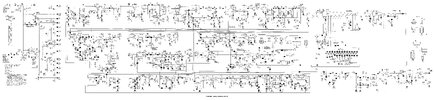

Could someone please explain this. What are the solid black squares with white numbers in the schematic? Do they just represent a common rail that is all connected? For instance, the #4 close to the voltage regulator connected to PIN 1... There is also a 4 on PIN 9 of the PLL and PIN 6 of the PLL. Does that that mean PLL PIN 6 and PLL PIN 9 and VR PIN 1 are all connected? Thanks.

That is called CircuitTrace a feature of Sams service manuals and yes they are connected at where the number is shown on the schematic.

buy the caps from digikey. write them all down and log in to digikey and make a shopping list. do not trust ebay. nichicon, united chemicon are good brands, panasonic 3rdThanks for the reply Jeff. I found a cap kit for my radio at Klondike mikes, but it would cost me $51 after shipping and taxes, that seems high.. what's the most economical way to buy quality caps? Any certain brands to look for?
Dont get any under 25V, like if the radio has a 10v cap, replace it with 25v of the same uF
pulled C18 and C109 - at the emitter of TR25I can't read the part numbers on the schematic but the electrolytic at the emitter of TR25, the supply pin of IC3 and the one at pin 9 of the PLL are all 10v according to the schematic, so plan on swapping those. IC3 itself should be good for 14.4v max, IC2 is just some discrete parts which would be fine, but I cannot find a spec for the PLL supply rating. Maybe you could lift L# whatever it is at pin 9 (schematic shows a bead) to isolate the PLL from the rest of the 8v rail for further testing.
And C90 at pin 5 of IC2 because who knows what the PLL was doing. It probably got more than its share too.
pulled C95 - Supply pin of IC3
Pulled C84 - PIN 9 of PLL
Did not pull C90 yet, it's really small.
removed the bead at PIN 9 of PLL to isolate PLL.
I powered on the radio with all of those caps removed and none of this made a difference, Pin 1 of the VR still was not putting out enough voltage (.6v).
I lifted PIN 1 of the VR, and without anything connected to it, it had 8v on it. Soldered it back down and it was back to bogging down at .6v.
I used a jumper wire to momentarily touch PIN 6 (also 8v) to Pin 1, and it's like it jump starts it and and PIN 1 starts making 8 volts at that time. I can turn the radio off and back on, and it will still output 8v (channel display works), but if I leave it off overnight, and turn it on the next morning, it will start acting up again and PIN 1 will not have 8v.
Is it possible that the VR is bad?