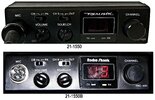

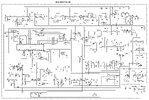
I just finished restoring a Radio Shack TRC-481. There are actually two versions of this radio. The one labeled “Radio Shack” is the 21-1550B version, and the one labeled “Realistic” is the plain 21-1550 version. I never seen the inside of the Realistic version, but I’m showing the front side of a stock photo for comparison. It’s fortunate that CBTricks had the original service manual. For clarity sake, it gave me something to enhance while I worked on this radio. Initially this radio had several issues. The up and down buttons on the mic didn’t function. That problem was related to corrosive glue on the mic’s internal circuit board. Corrosive glue also ate the legs off of the 10.240 crystal. Several of the large electrolytic caps also had that glue under them.
As usual, I planned on replacing the DIN jack with a 4 pin jack wired for Cobra mics. Of course having the up and down function on the mic would require 5 pins, but for me it was more important to go with the versatility of having a 4 pin connection. Anyway, channel selection is easily controlled with the radio’s rotary knob. I also found that this radio will accept both dynamic and condenser microphones without any degradation.
For an AM only radio, this model had the most electrolytic caps that I have ever replaced, 28 in all. There’s also a massive amount of SMD components on the print side. Fortunately I didn’t need to replace any of those. Most of the electrolytic caps and many of the transistors were originally mounted crooked. I like to keep everything neat and upright as possible. Afterwards, to provide room for the speaker magnet, there was only one cap that really needed to be mounted on its side.
After tune-up this radio has a great receiver, 4 watts power, but a little restrictive on modulation (about 70%), regardless of all the different mics I tried. There’s no modulation adjustment on this model, but it’s easily modifiable if one wishes.
I love the smooth yet sensitive squelch action on this radio. That seems typical of many later Realistic SMD models. I attribute this to the numerous components involved that helped tailor that response.
So far this radio has been problem free for the past two weeks. Running barefoot, it has also worked many skip stations.
As usual, I planned on replacing the DIN jack with a 4 pin jack wired for Cobra mics. Of course having the up and down function on the mic would require 5 pins, but for me it was more important to go with the versatility of having a 4 pin connection. Anyway, channel selection is easily controlled with the radio’s rotary knob. I also found that this radio will accept both dynamic and condenser microphones without any degradation.
For an AM only radio, this model had the most electrolytic caps that I have ever replaced, 28 in all. There’s also a massive amount of SMD components on the print side. Fortunately I didn’t need to replace any of those. Most of the electrolytic caps and many of the transistors were originally mounted crooked. I like to keep everything neat and upright as possible. Afterwards, to provide room for the speaker magnet, there was only one cap that really needed to be mounted on its side.
After tune-up this radio has a great receiver, 4 watts power, but a little restrictive on modulation (about 70%), regardless of all the different mics I tried. There’s no modulation adjustment on this model, but it’s easily modifiable if one wishes.
I love the smooth yet sensitive squelch action on this radio. That seems typical of many later Realistic SMD models. I attribute this to the numerous components involved that helped tailor that response.
So far this radio has been problem free for the past two weeks. Running barefoot, it has also worked many skip stations.