B

You are using an out of date browser. It may not display this or other websites correctly.
You should upgrade or use an alternative browser.
You should upgrade or use an alternative browser.
-
You can now help support WorldwideDX when you shop on Amazon at no additional cost to you! Simply follow this Shop on Amazon link first and a portion of any purchase is sent to WorldwideDX to help with site costs.
-
Retevis is giving away THREE radios for their 16th Anniversary! Click Here to enter!
Newbie Base Station Setup diagram
- Thread starter will85w4
- Start date


Several things that might help since you are on a sort of limited budget.
The important things to remember about coaxial feed lines is the characteristic impedance should be the same as the radio's, 50 ohms. Depending on the length of that feed line, the average loss per 100 foot can be important, but only if that run is a fairly long one. Fractions of a 'dB' of loss mean very, very little. So, if the coaxial cable is of decent quality, dang near any coax will work just fine. Make it light on yourself ($$$).
Will your proposed antenna installation work? Yep, sure will. More higher is more better, but it should work just dandy if it was at ground level. That 'ground level' thingy has some 'catches', but not ones that I'd waste a lot of worry on (not too good if people touch antennas when you're transmitting, you know?).
Any/all antennas require tuning unless you are very, very, lucky! I wouldn't count on that too much, the lucky part. That means that you will need some kind of meter to do that tuning with. If your radio has an SWR meter built into it, it'll 'work'. They have a reputation of not being the most reliable things in the world, but it should at least get you into the ball-park. And external SWR meter is sort of nice to have. Can't afford one? Borrow one. Who ever you might borrow one from might also be willing to help with that tuning too.
Will all this result in a 'miraculously' fabulous radio set up? I sort of doubt that, but it will certainly be usable. How usable might surprise you. At the very least, it'll give you an idea of what's possible, you'll find out if you want to stay with it or not. The idea is to have fun with it. So...
Have fun.
- 'Doc
The important things to remember about coaxial feed lines is the characteristic impedance should be the same as the radio's, 50 ohms. Depending on the length of that feed line, the average loss per 100 foot can be important, but only if that run is a fairly long one. Fractions of a 'dB' of loss mean very, very little. So, if the coaxial cable is of decent quality, dang near any coax will work just fine. Make it light on yourself ($$$).
Will your proposed antenna installation work? Yep, sure will. More higher is more better, but it should work just dandy if it was at ground level. That 'ground level' thingy has some 'catches', but not ones that I'd waste a lot of worry on (not too good if people touch antennas when you're transmitting, you know?).
Any/all antennas require tuning unless you are very, very, lucky! I wouldn't count on that too much, the lucky part. That means that you will need some kind of meter to do that tuning with. If your radio has an SWR meter built into it, it'll 'work'. They have a reputation of not being the most reliable things in the world, but it should at least get you into the ball-park. And external SWR meter is sort of nice to have. Can't afford one? Borrow one. Who ever you might borrow one from might also be willing to help with that tuning too.
Will all this result in a 'miraculously' fabulous radio set up? I sort of doubt that, but it will certainly be usable. How usable might surprise you. At the very least, it'll give you an idea of what's possible, you'll find out if you want to stay with it or not. The idea is to have fun with it. So...
Have fun.
- 'Doc

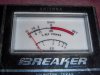
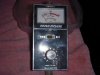
That means that you will need some kind of meter to do that tuning with. If your radio has an SWR meter built into it, it'll 'work'. They have a reputation of not being the most reliable things in the world, but it should at least get you into the ball-park. And external SWR meter is sort of nice to have.
Will this work? I was told this is an SWR meter.
-will85w4
Attachments

Thank you for the advice guys, I will exercise extreme caution during the installation process.
I will set everything up on the ground first, then raise the complete setup (mast and antenna) and secure it to the the clothesline pole. That way I avoid using ladders and reduce the potential risk for more hazards.
I was looking @ that power line too. Just be very careful Will. Last year a whole family was lost tryin to install a base antenna and it fell onto a near by power line.
Snap some pics of the setup when your done installing. Good luck, Aloha. Jim....
Snap some pics of the setup when your done installing. Good luck, Aloha. Jim....
I most definitely will be taking some pictures of my setup once it's complete.
I am going to be getting a 21' long, 1" diameter pole today that I will be using in place of the existing antenna mast I have. I'll put pics up as I complete.
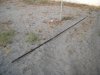

i hate to keep being a fly in the ointment here, but im not sure that pole has a large enough diameter to work for you.
think about how you are going to raise it.
are you going to assemble the antenna on it while its laying on the ground and then stand it up?
have you thought about how much its going to bend with the weight of the antenna on it?
it might just fold on you while you are holding it halfway up.
that can be VERY dangerous.
even if you do get it vertical without folding the mast, how well do you think its going to stay up while you tug on it trying to get all the guy wires tied off?
what you are planning sounds dangerous.
also you should not be mounting it to that clothesline.
it is just too close to those power lines to be safe.
think about it this way.
after you get that antenna up, do you want to worry about it every time you leave the house?
you will. trust me.
you will wonder every time the wind picks up if that antenna has fallen across your neighbor's roof, your power lines, etc...
you will worry that you might come home to a neighbor with a crushed car roof, or worse, a fire.
IMO you need to re-think your entire approach to this.
otherwise you will be stressed everytime you see the wind blowing through the trees.
the worst thing you can do is get halfway through your antenna install, and realise you are stuck in a dangerous situation that you cant get out of.
if anyone told you that installing a CB base station was easy and cheap, they lied to you, or dont know better.
how about some pics of your house and yard from different angles?
maybe we can help come up with some ideas that are safe and will work well for you.
the first thing you should be searching around for, or figuring out how to make is a telescoping mast.
LC
think about how you are going to raise it.
are you going to assemble the antenna on it while its laying on the ground and then stand it up?
have you thought about how much its going to bend with the weight of the antenna on it?
it might just fold on you while you are holding it halfway up.
that can be VERY dangerous.
even if you do get it vertical without folding the mast, how well do you think its going to stay up while you tug on it trying to get all the guy wires tied off?
what you are planning sounds dangerous.
also you should not be mounting it to that clothesline.
it is just too close to those power lines to be safe.
think about it this way.
after you get that antenna up, do you want to worry about it every time you leave the house?
you will. trust me.
you will wonder every time the wind picks up if that antenna has fallen across your neighbor's roof, your power lines, etc...
you will worry that you might come home to a neighbor with a crushed car roof, or worse, a fire.
IMO you need to re-think your entire approach to this.
otherwise you will be stressed everytime you see the wind blowing through the trees.
the worst thing you can do is get halfway through your antenna install, and realise you are stuck in a dangerous situation that you cant get out of.
if anyone told you that installing a CB base station was easy and cheap, they lied to you, or dont know better.
how about some pics of your house and yard from different angles?
maybe we can help come up with some ideas that are safe and will work well for you.
the first thing you should be searching around for, or figuring out how to make is a telescoping mast.
LC
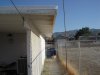
How about this location? It is away from the power lines and on the side of my house. Closest wire is a cable wire, that is about 10 feet away on the back side of the house. There is an empty dirt lot next to me, so nothing to worry about there.
The first picture is the pole just leaning against where it is now clamped on.
I was able to raise it by myself with no problem, no concerns. I am setting it up here now without the antenna on it because I want to see how the pole does in the wind first. This will be my determining factor of whether or not I'm going to use guy wires to support this. As of right now, it is very stable and is secure.
The first picture is the pole just leaning against where it is now clamped on.
I was able to raise it by myself with no problem, no concerns. I am setting it up here now without the antenna on it because I want to see how the pole does in the wind first. This will be my determining factor of whether or not I'm going to use guy wires to support this. As of right now, it is very stable and is secure.
Attachments
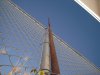
If I were to use guy wires, where would I secure them to based on this picture? Yes, I can see two on the roof or eves of the house, but what about for the fence side? I cannot attach anything in, to, or on the dirt lot due to the electric and cable companies needing access to the power pole behind my house. The power pole is directly behind where I was standing when I took this picture.
Attachments
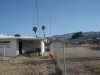
I think those guys are not going to be possible with that pole on the fence. Hopefully, you wont need them.
- 'Doc
I'm figuring out a way to make a brace for it instead of guy wires. Anchor the other 10' pole I have to my roof using some kind of swiveling/hinged coupler in a very strong spot and secure it to the antenna mast about 5 feet from the top of the antenna mast. The wind generally blows West to East here, so it should work perfectly.
It's a desert.
Enough water is wasted down here watering all the exclusive golf courses as it is...
Plus, it's easier to take care of
Enough water is wasted down here watering all the exclusive golf courses as it is...
Plus, it's easier to take care of
Guy wire setup.
Ok, so I have the location for my antenna mast now. Now I set it up yesterday morning so I could see how much it will move in the wind. It sways maybe 1-3 feet at the most, however, this is without the antenna on it. So I figure it will sway at least double that once I get the antenna up. Here is a quick diagram of my ideas for some guy wires. I am not able to secure any guys in the dirt lot where this picture was taken from due to the cable and electric companies needing access to the power pole behind my yard. The green lines are possible spots for guys, don't know if they would work very well there though. The red lines are my first choice for guys.
Any other ideas or suggestions?
Ok, so I have the location for my antenna mast now. Now I set it up yesterday morning so I could see how much it will move in the wind. It sways maybe 1-3 feet at the most, however, this is without the antenna on it. So I figure it will sway at least double that once I get the antenna up. Here is a quick diagram of my ideas for some guy wires. I am not able to secure any guys in the dirt lot where this picture was taken from due to the cable and electric companies needing access to the power pole behind my yard. The green lines are possible spots for guys, don't know if they would work very well there though. The red lines are my first choice for guys.
Any other ideas or suggestions?