• You can now help support WorldwideDX when you shop on Amazon at no additional cost to you! Simply follow this Shop on Amazon link first and a portion of any purchase is sent to WorldwideDX to help with site costs.
  • A Winner has been selected for the 2025 Radioddity Cyber Monday giveaway! Click Here to see who won!

ISO oscilloscope

Brandon, my old scope has a Chan B signal out port on the back which I kept connected to my frequency counter, utilizing the low noise, high bandwidth vertical amplifier inside the scope to read very small signal frequencies that the counter alone couldn't decipher. The new scope has a built in frequency counter, but with less resolution. There is an aux out port on the new scope, but idk if it works like that. Do you know if this is possible? It is supposed to be a trigger out or pass/fail out port.
 
I don't think it works that way, but I could be wrong. Mine also has that port and I will look more into it when I get back from town, but a quick search in the manual didn't suggest that it would. When I get home, I will put 20MHz or whatever into the front and see what comes out of the back using the USB scope.

I am now in a similar position. The active probes I made with the MAR4 amplifiers inside worked great for my cheap FC-7015U counter, but the only way I get stable 1Hz resolution above 10MHz is to use the 10s gate time (which sucks) so I think it's time to abandon it.

My little sig gen's built in counter is now accurate with the GPSDO connected and I get full resolution with 1s gate time, only problem is that it takes almost 2v of signal to count. I was thinking about building another amplifier for it later tonight as I have a 959B to align.
 
  • Like
Reactions: Cable Guy
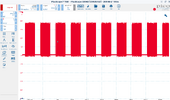
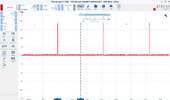
Doesn't work on mine. It outputs a trigger indicator, or a pass fail if a mask test is enabled. This is what I get, bursts of pulses as a 32kHz rate. Thats putting 27MHz into the scope with edge triggering1767485769279.png
1767485823974.png
 
  • Like
Reactions: Cable Guy
The search continues...
External amplifier?

I figure I will just cut my probe coax in the middle somewhere and solder in a little board with a couple more of those mar4's, maybe tack some sort of can over it.

Any idea how much gain you need?

I need to figure that out for mine. I will have to measure a known voltage and raise it until the counter sees it, then measure what I get out of the probe while probing my radio, then design the amp to make up the difference. Each MAR4 is good for about 8dB, or 2.5x the voltage.
 
External amplifier?

I figure I will just cut my probe coax in the middle somewhere and solder in a little board with a couple more of those mar4's, maybe tack some sort of can over it.

Any idea how much gain you need?

I need to figure that out for mine. I will have to measure a known voltage and raise it until the counter sees it, then measure what I get out of the probe while probing my radio, then design the amp to make up the difference. Each MAR4 is good for about 8dB, or 2.5x the voltage.
I can use the small lna I built some time ago but it's not as good as the vertical amp in the scope. Idk how much gain I need really, I have to think about it, I think the active probe is something like -15db out, I can align most everything I do with it and the lna which boosts around 20db but some things even with the amp, just can't get a grip.
 
Looks like I need 2 amps. I had the active probe connected to a 50ohm passthrough, that connected to a BNC tee, the tee on the FC input, and a 10x scope probe in the other side of the tee. A sig gen was connected to the active probe tip and increased until the counter counted. At about 430mV RMS, it counted, so I am calling it 500mV (thought it was higher). The sig gen was unhooked from the probe tip and the active probe used in my washington. The scope showed over 500mV for the reference osc, 122mV at the VCO and 165mV at the LO. These values are not the actual circuit voltages, rather what my probe outputs into 50ohm (and the counter EXT input). Going by the lowest one, I know I need at least 2 MAR4 amps.

This is probably going to really mess up the frequency response more, but all I need to do is count with this one.
 

dxChat
Help Users
  • No one is chatting at the moment.