Recently acquired this radio. Worked for a very short time then I went to power it up one day and had nothing. I did find some burnt components. TR52 R243 C193 to name a few. Can someone point me in the right direction to figure out what caused this. Thanks

You are using an out of date browser. It may not display this or other websites correctly.
You should upgrade or use an alternative browser.
You should upgrade or use an alternative browser.
-
You can now help support WorldwideDX when you shop on Amazon at no additional cost to you! Simply follow this Shop on Amazon link first and a portion of any purchase is sent to WorldwideDX to help with site costs.
-
A Winner has been selected for the 2025 Radioddity Cyber Monday giveaway! Click Here to see who won!
General Stonewall Jackson Help
- Thread starter Redbeard190
- Start date
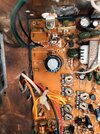

If I had to guess I'd say the capacitor took a dump on the board in spectacular fashion.
I would test the transistor so see if it survived and replace what died.
It's hard to say if there was any external cause, or if the cap just decided that it was it's time.
I would test the transistor so see if it survived and replace what died.
It's hard to say if there was any external cause, or if the cap just decided that it was it's time.


TR52 gets 8v from the mode switch in SSB to turn on TR51. I noticed you have TR51 out. My guess is that the passthrough regulator failed and then when it was switched to SSB, TR52 and R243 got more than they asked for.
On a good day, when the mode switch is set to SSB, 8v is sent to the base of TR52 via R251. This saturates TR52 (turns it on hard) which turns on the passthrough by pulling its base down so SSB has the full supply voltage.
If that passthrough shorted (meaning the base current is more than beta would suggest). This would send 13v unhindered through TR52 (since it is on) and then through R243. In that case, both TR52 and R243 would go up in smoke. I am guessing the cap was an unknowing victim nestled between those two hot parts.
May as well check TR50 and the finals while you are in there, and if the finals are bad, check their bias networks too.
On a good day, when the mode switch is set to SSB, 8v is sent to the base of TR52 via R251. This saturates TR52 (turns it on hard) which turns on the passthrough by pulling its base down so SSB has the full supply voltage.
If that passthrough shorted (meaning the base current is more than beta would suggest). This would send 13v unhindered through TR52 (since it is on) and then through R243. In that case, both TR52 and R243 would go up in smoke. I am guessing the cap was an unknowing victim nestled between those two hot parts.
May as well check TR50 and the finals while you are in there, and if the finals are bad, check their bias networks too.

The factory power supply in that radio was suicidal. Typical failure was a shorted pass transistor in the regulator circuit. Would cause 22 Volts DC or more fed to the radio circuit board. Might want to check that before powering it up for longer than it takes to get a meter reading. Poofed audio chips are a typical result.
We remove the heavy copper and iron power transformer, rectifiers and filters. A chinesium switchmode "brick" power supply rated for 360 Watts will do the job and has both overvoltage and overcurrent protection.
Oh, and one other small detail. A fuse block should be added to put a fuse in line with the power wire feeding the circuit board. You wouldn't hook a 6-Amp mobile radio directly to a 30-Amp power supply with no fuse would you? That's what the factory sold you.
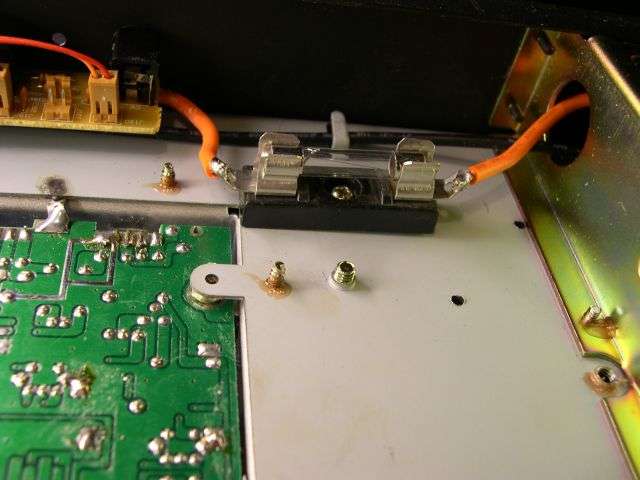
Makes life safer for the radio. If a final takes a dump, this minimizes the other parts that get overloaded and fail along with it.
73
We remove the heavy copper and iron power transformer, rectifiers and filters. A chinesium switchmode "brick" power supply rated for 360 Watts will do the job and has both overvoltage and overcurrent protection.
Oh, and one other small detail. A fuse block should be added to put a fuse in line with the power wire feeding the circuit board. You wouldn't hook a 6-Amp mobile radio directly to a 30-Amp power supply with no fuse would you? That's what the factory sold you.
Makes life safer for the radio. If a final takes a dump, this minimizes the other parts that get overloaded and fail along with it.
73
Power supply was replaced not too long before it died. Have went over that with a fine tooth comb. Voltage is stable a 12.8v.The factory power supply in that radio was suicidal. Typical failure was a shorted pass transistor in the regulator circuit. Would cause 22 Volts DC or more fed to the radio circuit board. Might want to check that before powering it up for longer than it takes to get a meter reading. Poofed audio chips are a typical result.
We remove the heavy copper and iron power transformer, rectifiers and filters. A chinesium switchmode "brick" power supply rated for 360 Watts will do the job and has both overvoltage and overcurrent protection.
Oh, and one other small detail. A fuse block should be added to put a fuse in line with the power wire feeding the circuit board. You wouldn't hook a 6-Amp mobile radio directly to a 30-Amp power supply with no fuse would you? That's what the factory sold you.
Makes life safer for the radio. If a final takes a dump, this minimizes the other parts that get overloaded and fail along with it.
73
Also 5 amp fuse in line.Power supply was replaced not too long before it died. Have went over that with a fine tooth comb. Voltage is stable a 12.8v.
C193 which should be 2.2uf is reading 93pf. TR-50 a1869 seems to check out ok along with TR-51. TR-52 is reading as N channel JFET. So pretty sure that is toasted. C190 100uf reading at 79uf.TR52 gets 8v from the mode switch in SSB to turn on TR51. I noticed you have TR51 out. My guess is that the passthrough regulator failed and then when it was switched to SSB, TR52 and R243 got more than they asked for.
On a good day, when the mode switch is set to SSB, 8v is sent to the base of TR52 via R251. This saturates TR52 (turns it on hard) which turns on the passthrough by pulling its base down so SSB has the full supply voltage.
If that passthrough shorted (meaning the base current is more than beta would suggest). This would send 13v unhindered through TR52 (since it is on) and then through R243. In that case, both TR52 and R243 would go up in smoke. I am guessing the cap was an unknowing victim nestled between those two hot parts.
May as well check TR50 and the finals while you are in there, and if the finals are bad, check their bias networks too.
You should consider recapping the entire radio.
Already have a pile of capacitors laid out. Upgrading all the 10 volt caps too.You should consider recapping the entire radio.
Before I left for work this morning I decide to take a quick glance at the trace side.
The orange wire goes to spkr2 @ ext. Spkr jack.
The red wire goes to PA2 at the PA jack.
I am in no way a technician, but should those to be bridged like that?
The orange wire goes to spkr2 @ ext. Spkr jack.
The red wire goes to PA2 at the PA jack.
I am in no way a technician, but should those to be bridged like that?
Attachments
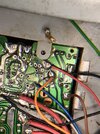
Also where the 12vdc ties into the board there is a black wire with it that goes to the center pin of the REC RCA jack
Pretty sure that's the location of the external speaker jack when this circuit board is used in a mobile model. Since the external speaker jack is on the rear panel away from the circuit board, this jumper is probably legit.should those to be bridged like that?
73