I think I figured out how this bugger works.
IC608 is a divide by 2^14, so with 3.2768MHz in, we get 200Hz out of pin 3.
IC606 has two dividers chained together and its function is to divide that 200Hz by 16 (outputting 12.5Hz on pin 6), and by 80 (outputting 2.5Hz on pin 3).
IC603 is a hex gate (4 inverters, a nor, and a nand) and it took modeling to figure this one out. Its function is three-fold. 1-the NAND and one inverter combine the 12.5Hz and 2.5Hz signals to produce a 40ms reset pulse that occurs at a rate of 12.5Hz (skipping one cycle for every 5 cycles of the 12.5kHz inputs). 2-the loop with the inverter-two resistors-diode-inverter is a pulse-shaping network that turns a 40ms high pulse into a very fast transfer pulse. 3-the nor gate combines the signal from IC605 and the 12.5Hz signal to produce a gated version of IC605's signal effectively reducing its duty cycle to 50%. I will come back to this.
IC604 is the input prescaler and divides the VCO by 4, so on ch19, 16.49MHz in produces 4.1225MHz out and sends it to the mixer IC607
IC607 mixes this 4.1225 MHz signal with the 2.67375MHz signal to produce the sum of 6.796250MHz.
IC605 takes this 6.796250MHz and divides it by 10 to produce 679.625kHz and sends this to IC603
Now that we are back to IC603, what happens when you take a 679.625kHz signal and pass it through a 40ms gate? only 27185 counts come through

The counter IC will transfer the count to the multiplexer on the rising edge of transfer and latches the display to that number when transfer goes low. For 4 of the 5 transfer pulses, a reset is sent with transfer, but for that one instance where transfer is not followed by a reset, that value is sent to the display driver IC601 (a BCD to LCD converter)
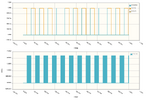
Here is the circuit I made in circuitlab simulating IC606 and IC603 and the resulting waveforms. Note that the 679.625kHz signal was replaced by 10k for the sole purpose of faster modeling because circuitlab is slow as molasses with time bases required for RF analysis. The change has no effect on the illustration.
I do not know if I got this right but I doubt there exists too many wrong ways that produce the right result. IDK.