• You can now help support WorldwideDX when you shop on Amazon at no additional cost to you! Simply follow this Shop on Amazon link first and a portion of any purchase is sent to WorldwideDX to help with site costs.
  • The Winners of the three Retevis radios 16 Anniversary giveaway are announced!! Click Here to find out if you won!

Good info about grounding.


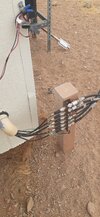
Here's what I do currently (pun intended). I only had two lightning arrestors on hand, and didn't have the cash to buy a bunch more. So only the top two have lightning arrestors on them because they're my most expensive radios. I'm in a low lightning area. Between 5 to10 events a year. So I manually disconnect the coax on the Shack side of the bracket if I'm aware there's going to be a thunderstorm. Disconnecting the shack is the only true lightning protection!! No grounding in the world will save your equipment if you take a direct hit!! All of this helps with RFI, static discharge, and turns the odds in your favor during a thunderstorm. Please don't ever think you are lightning proof though, unless you have disconnected the shack. I don't think you can see the ground rods but they are connected to the bracket and each other with solid core copper numbers 6 or 8 AWG I think. The copper line is buried between the ground rods. This is just for the coaxes and the radio chassis. The towers are grounded separately individually.
 

Attachments

  • 20261010_131135.jpg
    20261010_131135.jpg
    2 MB · Views: 11
Disconnecting the shack is the only true lightning protection!! No grounding in the world will save your equipment if you take a direct hit!! All of this helps with RFI, static discharge, and turns the odds in your favor during a thunderstorm. Please don't ever think you are lightning proof though, unless you have disconnected the shack.

Having worked in commercial broadcasting for 22 years I disagree. All of our main AM/FM stations were connected to the antenna systems at all times, 24/7/365. All of out VHF/UHF repeater STL systems were as well. Many times they were hit and received no damage. One well know ham, W8JI maintains several 200 foot towers that he NEVER disconnects and he has had several direct hits without any damage. The problem is not so much the cost of doing it right as that is minimal actually,but rather KNOWING HOW to do it right. It is more an excercise in workmanship than needing deep pockets. I suggest you look at W8JI's website for some solid grounding ideas.
 

dxChat
Help Users
  • No one is chatting at the moment.