• You can now help support WorldwideDX when you shop on Amazon at no additional cost to you! Simply follow this Shop on Amazon link first and a portion of any purchase is sent to WorldwideDX to help with site costs.

Boom grounding

Jim5570091

297 Red Dog North Alabama
I Support WorldwideDX.com!
Oct 9, 2016
108
64
38
54
Guntersville AL
My L6 lightning quad is mounted on a hazer with non conductive wheels. How critical is it to have a direct ground connection to the boom?
 

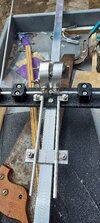
My homebrew 3el Yagi is grounded to the boom. Used a Hairpin/Beta match making for an easy place to ground to the boom. From my reading grounding the boom should help with noise reduction and help to bleed-off static charges. Don't believe grounding is imperative to operation though for the typical Yagi.

7 320250303_130203.jpg
 
Last edited:
I Googled "ground cubical quad to the boom" and concensus said DO NOT ground a cubical quad to the boom.
 
The Lightning quad antennas using the "SFS" feed method connect the coax braid directly to the boom. The back-country Lightning clone on my tower is built that way.

73
Kinda late to the conversation. But SFS feed system on this quad antenna benefits from a well grounded boom. This type of feed system needs a good reference to ground to perform correctly.
At this point the only ground you have is coming from your coax braid from the shack. This is where most operators have trouble with this antenna. This feed line also needs stay the correct distance from boom also.
 
I did discover a counterintuitive quirk of this antenna. The RG213 coax on my "Stinger Four" clone was tied alongside the strut wire to increase the radius between the feed point, and where it gets strapped to the tower. Bad idea. Turns out there's significant RF voltage on the surface of that strut wire. Only took a 2000 Watt carrier to discover that the jacket on RG213 has a breakdown voltage low enough to arc between the coax braid and the strut wire. Burned right through from the outside until the center wire opened. It was an unintended test of how stout that amplifier was. First hint was the color of all four 3-500Z anodes darkened all at once. A glance at reflected power told the tale and I dropped it back to receive as soon as I spotted it. No arc, no apparent damage. Big sigh of relief, since it wasn't my amplifier.

The coax takes a different route now, no longer strapped to the strut wire. Pretty sure I still have the burned section of 213 somewhere. A reminder that the coax jacket is not terribly RF friendly like the inner dielectric.

73
 

dxChat
Help Users
  • No one is chatting at the moment.
  • @ 357:
    holy man no activity or what?
  • dxBot:
    357 has left the room.