
The Browning Golden Eagle Mark 3 SSB transmitter has frustrated any number of folks trying to get one back on the air. If someone has already twisted every tuning slug in the radio hoping to get lucky, you'll have an uphill climb ahead of you. Doing that just muddies the water. And if you have a frequency counter in line with a transmitter that reads around 21 MHz when you key it on AM, someone has already done the slug-tweaking ahead of you.
But we'll stick with one narrow circumstance. A transmitter that has been "hot wired" for AM mode only, bypassing the mode selector altogether.
Say what? That selector has a failure issue with the brown plastic insulation breaking down after 30 years or so. And for a radio that could be close to 50 years old, the risk factor is high. Replacing the selector is expensive if you do it yourself, and really expensive if you hire someone. And what would be the point? You'll never use it for sideband more than about once.
A radio that cuts out or dies *after* this has been done may very well have one or more worn-out crystals. We'll assume for the moment you checked tubes, cleaned out noisy tube sockets, and replaced the bad relay. Each of those can shut down this transmitter.
The Mark 3 has three crystal oscillators. All three must be running before you will see any output power. Here's where it gets a little odd. The channel crystal may be running, or not. But you're bound to have at least one or two channel crystals that are not worn out yet.
Worn out? Yep. A quartz crystal is a moving part. Doesn't move very far, but it moves really fast. And like any and all other moving parts it will wear out eventually. One of the three oscillators has 23 channel crystals on a selector. If you have a receiver that can tune in the 16 MHz channel crystals, use it to eavesdrop on the crystal that's selected. Click the channel selector around until you find a crystal that runs steadily and won't cut out. You did already clean the black schmoo from the channel selector's rotary contact, didn't you?
One of the three oscillators generates a carrier for the balanced modulator. There are three carrier crystals. One for each mode. One crystal is just above the "window" of frequencies that will squeeze through the crystal filter. This is the 5.648 MHz LSB carrier crystal. Another one is below the filter's pass band, 5.645 MHz. This one gets you the upper sideband. And one crystal is dead center of the passband so you'll have a carrier for AM mode at 5.6465 MHz.
This would create a problem if we simply mixed the frequency of this crystal with the channel crystal. The transmit frequency would be different on each mode. To keep the radio on the channel's center frequency we have a third oscillator with three crystals. It will mix with the 16 MHz channel crystal that's selected. When the carrier crystal's frequency moves up or down when changing modes, this set of crystals bumps the radio's frequency up or down the opposite amount. 5.050 MHz for USB, 5.047 MHz for LSB and 5.0485 MHz for AM.
The crystal oscillators in the transmitter are running *all* the time. A radio that was used for 5000 hours and was never keyed up once the whole time will still wear out the crystals for the mode and channel it was set to. Odds are that mode was AM. And a worn-out crystal for AM carrier and AM offset can be fixed by ordering replacements. Definitely the simplest approach.
But there's a cheaper way. You have two pairs of crystals in the radio that are not worn out yet. The USB pair and the LSB pair. For simplicity, this example uses the two USB crystals. Keeps the frequency arithmetic simpler.
First we bypass the crystal filter altogether. The radio has been hot wired for AM mode, so it's not really needed any longer. A bare wire leads from T2 into the filter's input pin. A gray shielded wire with the shield trimmed away has its center wire soldered to the filter's output pin. Remove each wire from the filter's pins. Add a short insulated wire to the shielded gray wire's center conductor so it will reach the pin on T2 that was unhooked from the crystal filter.
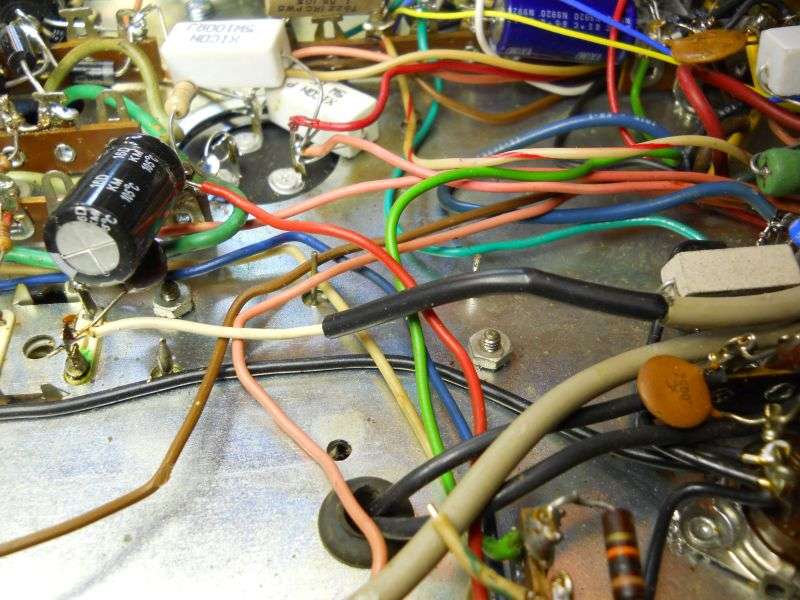
Not the clearest possible pic, but should get the idea across.
There are six crystals behind the mode selector. The outer two have no trimmer cap, only a disc cap visible connected to them. The inner four crystals each have a trimmer cap alongside it. We'll be removing the 5.6465 crystal that is alongside the outer rail of the chassis. This crystal provides the AM carrier. The 5.6450 USB crystal gets removed from its trimmer cap hookup and gets soldered in its place. Be very gentle, the lead wires will easily snap right off this kind of crystal if you're too rough with it.
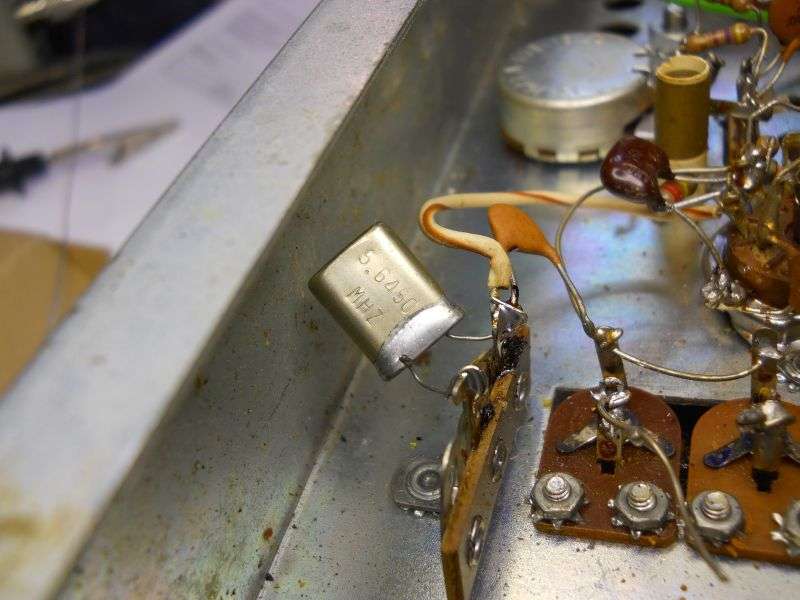
The offset crystal for AM is marked 5.0485 MHz and it's located on a tie strip on the inboard side of the mode selector. It gets removed and the USB offset crystal gets unsoldered from its trimmer cap. Solder the 5.050 MHz cystal to the tie strip in place of the original AM crystal.
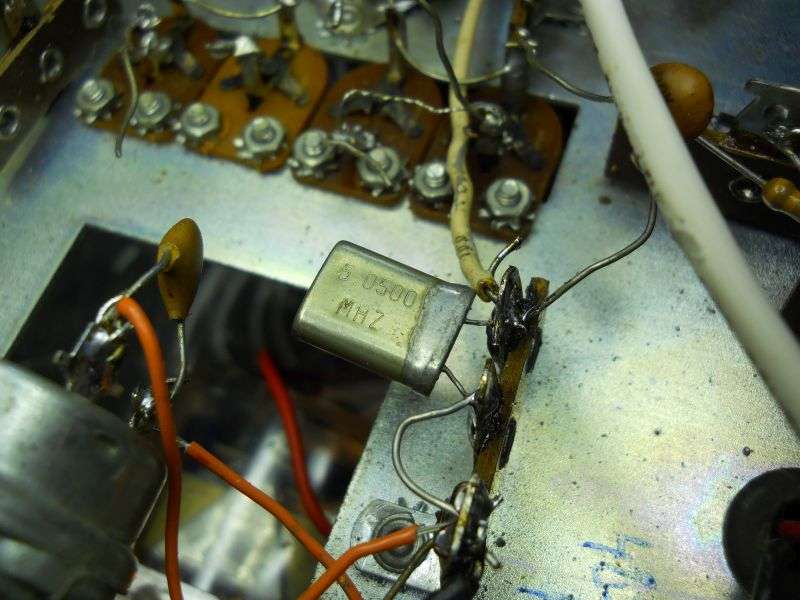
Odds are that the two USB crystals have no mileage on them at all, and should not wear out for a long while.
Yes, there are lots of other things that can prevent a Mark 3 SSB transmitter from producing power, but this one just comes up more and more often every year that goes by. Probably a worthwhile preventive measure for a radio that has a lot of miles on it.
73
But we'll stick with one narrow circumstance. A transmitter that has been "hot wired" for AM mode only, bypassing the mode selector altogether.
Say what? That selector has a failure issue with the brown plastic insulation breaking down after 30 years or so. And for a radio that could be close to 50 years old, the risk factor is high. Replacing the selector is expensive if you do it yourself, and really expensive if you hire someone. And what would be the point? You'll never use it for sideband more than about once.
A radio that cuts out or dies *after* this has been done may very well have one or more worn-out crystals. We'll assume for the moment you checked tubes, cleaned out noisy tube sockets, and replaced the bad relay. Each of those can shut down this transmitter.
The Mark 3 has three crystal oscillators. All three must be running before you will see any output power. Here's where it gets a little odd. The channel crystal may be running, or not. But you're bound to have at least one or two channel crystals that are not worn out yet.
Worn out? Yep. A quartz crystal is a moving part. Doesn't move very far, but it moves really fast. And like any and all other moving parts it will wear out eventually. One of the three oscillators has 23 channel crystals on a selector. If you have a receiver that can tune in the 16 MHz channel crystals, use it to eavesdrop on the crystal that's selected. Click the channel selector around until you find a crystal that runs steadily and won't cut out. You did already clean the black schmoo from the channel selector's rotary contact, didn't you?
One of the three oscillators generates a carrier for the balanced modulator. There are three carrier crystals. One for each mode. One crystal is just above the "window" of frequencies that will squeeze through the crystal filter. This is the 5.648 MHz LSB carrier crystal. Another one is below the filter's pass band, 5.645 MHz. This one gets you the upper sideband. And one crystal is dead center of the passband so you'll have a carrier for AM mode at 5.6465 MHz.
This would create a problem if we simply mixed the frequency of this crystal with the channel crystal. The transmit frequency would be different on each mode. To keep the radio on the channel's center frequency we have a third oscillator with three crystals. It will mix with the 16 MHz channel crystal that's selected. When the carrier crystal's frequency moves up or down when changing modes, this set of crystals bumps the radio's frequency up or down the opposite amount. 5.050 MHz for USB, 5.047 MHz for LSB and 5.0485 MHz for AM.
The crystal oscillators in the transmitter are running *all* the time. A radio that was used for 5000 hours and was never keyed up once the whole time will still wear out the crystals for the mode and channel it was set to. Odds are that mode was AM. And a worn-out crystal for AM carrier and AM offset can be fixed by ordering replacements. Definitely the simplest approach.
But there's a cheaper way. You have two pairs of crystals in the radio that are not worn out yet. The USB pair and the LSB pair. For simplicity, this example uses the two USB crystals. Keeps the frequency arithmetic simpler.
First we bypass the crystal filter altogether. The radio has been hot wired for AM mode, so it's not really needed any longer. A bare wire leads from T2 into the filter's input pin. A gray shielded wire with the shield trimmed away has its center wire soldered to the filter's output pin. Remove each wire from the filter's pins. Add a short insulated wire to the shielded gray wire's center conductor so it will reach the pin on T2 that was unhooked from the crystal filter.
Not the clearest possible pic, but should get the idea across.
There are six crystals behind the mode selector. The outer two have no trimmer cap, only a disc cap visible connected to them. The inner four crystals each have a trimmer cap alongside it. We'll be removing the 5.6465 crystal that is alongside the outer rail of the chassis. This crystal provides the AM carrier. The 5.6450 USB crystal gets removed from its trimmer cap hookup and gets soldered in its place. Be very gentle, the lead wires will easily snap right off this kind of crystal if you're too rough with it.
The offset crystal for AM is marked 5.0485 MHz and it's located on a tie strip on the inboard side of the mode selector. It gets removed and the USB offset crystal gets unsoldered from its trimmer cap. Solder the 5.050 MHz cystal to the tie strip in place of the original AM crystal.
Odds are that the two USB crystals have no mileage on them at all, and should not wear out for a long while.
Yes, there are lots of other things that can prevent a Mark 3 SSB transmitter from producing power, but this one just comes up more and more often every year that goes by. Probably a worthwhile preventive measure for a radio that has a lot of miles on it.
73