• You can now help support WorldwideDX when you shop on Amazon at no additional cost to you! Simply follow this Shop on Amazon link first and a portion of any purchase is sent to WorldwideDX to help with site costs.
  • A Winner has been selected for the 2025 Radioddity Cyber Monday giveaway! Click Here to see who won!

Cobra 29LTD channel mod questions/help

Time for my slice of humble pie.
Honestly I thought the S kit and the A Kit worked along the same principle, a new crystal and an oscillator.

I thought the only difference was the crystal cut, being determined by what model radio it goes in and what direction you want the new 40.

Are all Expo 100 boards the same, and the letter designates what model they work in?
I'm going to buy Lou's book, the one I mentioned.
I don't have a copy, and I'd like to read more about CB frequency synthesizing + mixing schemes.
 
Last edited:
The "S" plus or minus kit is unique to that particular PLL chip.

Early Expo 100 kits included versions that had only resistors, wires and diodes for unlocked chips like the uPD858 and PLL02A.

Those disappeared in the early 80s, and only the models with either two crystals or two crystals and an oscillator circuit remained in the product line until they ceased production altogether.

73
 
Not all hope is lost.

CBPhreaker kinda touched on this before - but only in passing...

Dealing with a 148GTL Receive change...

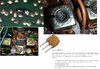
I went back and located the board that pic montage came from ...

Yeah, 9106 but the other issue of the "IF Filter" may seem odd but these things are nothing like a Xtal you'd find these days for narrow filter stuff.

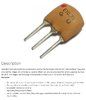
These units the one pic'd below - we used to sell at Radio Shack anyways, they were simpler resonate filters - similar to Xtal but without a lot of "poles" to trim, pare-down or otherwise narrow the response curve. They are quite broadbanded. They were called Ceramic Filters - not Crystal.

They are three legged yes, but they were not very selective - to even use them in a radio - you could only get by with about 20kHz spacing in FM use for the radio platforms at the time.

Radio Electronics did up articles in their hey-days using off the shelf parts - this was one of them. Always used them to help some guy lost or had broken equipment - kinda like MacGyver - only with old spare parts from old radios and they needed to build something fast...one of the articles was to convert an older FM radio to use WX and some TV band - so they elaborated on the issues of Ceramic versus Crystal and how one can be used to obtain a signal while the other you took out and swapped in this ....

CeramicFilterReplace.jpg
 

Attachments

  • CeramicFilter.jpg
    CeramicFilter.jpg
    83.3 KB · Views: 12
Why the above, because the radio that kit came out of is using one of those.

So to have that in there, the performance is not a requirement - you need to make a triad of caps to finish this job. The coil and a dropping resistor(s) then can be used to obtain the image you seek - it'll be crappy and not as clean as with a resonator - but you can use a set of caps, and some input and output resistors to make a filter to obtain the bandwidth...
 
  • Like
Reactions: Shadetree Mechanic
The Expo 100 kit type "A" or "A+" works by injecting a crystal frequency into a mixer chip in the radio's PLL. The mixer chip's output feeds into the PLL input. Has a crystal for each new band, and a one-transistor oscillator circuit.

Pin 4 of the mixer chip has 15.36 Mhz coming from a single slug-tuned coil that has a 5.12 MHz 5-Volt square wave feeding into it. This gets you a half-Volt or a Volt of the third harmonic, 15.360 MHz.

The Expo kit has a crystal oscillator with an output level several times the level of the radio's internal 15.36 Mhz source.

The Expo kit's output overpowers the PLL input, moving all 40 channels up or down. The radio's stock 15.36 MHz signal is still there at pin 4 of the TA7310 mixer chip, but the stronger level from the Expo kit drowns it out. The PLL locks to the stronger one.

To go 45 channels up, the crystal is 15.810 MHz. Down 45 is 14.91 MHz.

The Expo kits were sold and designed before the first "export" radios showed up. Those radios move 45 channels per band, so that the lower band gives you 26.955 on channel 40, and the upper band starts at 27.415 on channel 1.

But the original Expo kits only moved you up or down 44 channels. This caused channel 1 to show up twice. Once where it should be, and again with the selector on 40 with the lower band selected.

Likewise, channel 1 on the uppers wasn't channel 41, it was channel 40.

Not sure why they were built with overlap. When they hit the market, nobody cared.

Later "A" and "A+" kits used a dirty trick to get that '45 channel' jump from the same, old crystals. Must have figured it would sell better if the channel display on your Cobra 29 would read the same lower channels as your buddy's Galaxy.

They put a disc capacitor in parallel with the lower-band crystal to pull it down from 14.92 to 14.91 MHz

And they put a capacitor in series with the upper-channel crystal to pull it up from 15.80 to 15.81 MHz.

Just one problem. This screwed up the feedback in the crystal oscillator circuit. It would reduce the output so much that a radio might "kick in" and get the lower channels when selected, then randomly "kick back" to the normal 40 channels as the radio warmed up. If the output level from the Expo kit isn't big enough, the PLL may have trouble making up its mind which one it will lock onto.

Using the old crystals was probably a LOT cheaper than getting new ones made.

One of these days, someone needs to find a copy of the original early-80s instruction sheet. Shows the correct hookup for the "A" kits. Any newer instructions that show the white wire connected to one pin of a tuneable coil are just wrong.

73

Is C87 the correct injection point for the EXPO 100 A in a 29 GTL/LTD?
 
The routine the 1980s instruction sheet recommended is what we use. C163 gets removed. One lead of C87 is pulled out of the pcb, the end leading to IC2. A 22pf disc goes in the hole left by C87. The free ends of C87 and the new cap get lap-soldered together. The kit's white wire is the output. It goes to the junction of the two disc caps. This makes the peak position of the slug in L22 far less critical. Most of the time it won't have to be disturbed at all. Simply soldering the white wire to the output of L22 just causes headaches.

73
 

dxChat
Help Users
  • No one is chatting at the moment.