Here is the description:
Modulation Sciences CP803 Composite Processor - Price Reduced Significantly.
Product Description
The CP-803 has become the industry standard baseband processor. It is an economical processor that gives stations a brighter, louder and more open sound. The CP-803 operates completely differently from conventional processors in several important ways and also avoids the distortion produced by baseband clippers.
The CP-803 eliminates overshoots which exist in all stereo generators and audio limiters. Preventing overshoots increases modulation while preserving the integrity of the signal. It also controls high-frequency peaks present in program material that can cause over-modulation and thus makes greater average modulation possible.
The CP-803's patented design deals with the composite signal that comes from the stereo generator--the baseband signal. This includes the L+R, L-R and 19 kHz stereo pilot. By working with this composite signal instead of the left and right audio other processors deal with, the CP-803 avoids many processing pitfalls.
Thirdly, unlike a distortion-generating baseband clipper, the CP-803 does not clip the 19 kHz pilot and will not create the "spectral garbage" or the dynamic loss of stereo separation that baseband clippers generate. Because the CP-803 doesn't clip the pilot, stations can increase signal clipping for extra loudness in competitive markets without distorting their sound. Many stations--even those using stereo generators with baseband clippers built-in have added the CP-803 to their processing chain and increased clarity, maintained stereo separation and maintained the loudness desired.
The CP-803 is easy to set up, install, and operate. Its reliability and economy have made it a necessity in the audio chain of FM stations in all size markets with all types of formats, worldwide.
The first AGC and peak limiter amps for broadcast audio were designed to maintain a station's modulation within FCC limits. Starting in the mid-1960s, they evolved into tools to create a unique 'sound', and to win loudness wars. By 1980, it seemed that audio had been squeezed and squashed as much as possible, and listener fatigue was a common topic for articles and discussions. Then, the composite processor appeared on the scene, and new heights of loudness seemed possible for FM broadcasters. This installment of Found in the Attic contains a brief history of composite processors, and discusses the Modulation Sciences Inc. CP-803 in particular.
In the 1970s, FM stations often used composite STLs to get their signal to the transmitter. This scheme had the advantage of keeping the stereo generator and processor at the studio. Adjustment and monitoring was easier in this noise-free environment, and issues of RF interference largely disappeared. The disadvantage was with analog 1970s-vintage gear, composite STLs could exhibit modulation overshoots, making it necessary to back off the level slightly. In a competitive major market situation, this could cause a noticeable drop in loudness. If other stations were running discrete STLs, where the processing and stereo generator were at the transmitter, you were at a distinct disadvantage in any ongoing loudness wars.
A composite processor was located at the transmitter site, and sat between the composite output of the STL and the input to the exciter. It acted as a brick wall limiter, allowing stations to recover the signal loss due to overshoot. With a tightly-run system, about 1 or 2 dB of limiting was all that was needed. Used in that fashion, it had minimal effect on the audio quality.
The first composite limiter on the market was Chris Hood's STA MAX M1050, which appeared in 1980. The heart of its circuit was an array of sixteen matched 1N914 diodes in parallel, configured in two pairs of eight diodes. A trimpot was used to adjust the clip point.
Soon, other players jumped into the composite processor market. CRL unveiled a similar device, the CC-300. Jim Somich's company, Processing Solutions, released the FM Flexi Mod.
It wasn't long before engineers began using composite processors not only as overshoot correction devices, but as another tool in the FM loudness wars. When used aggressively, they have an adverse effect on the L-R signal, causing a degradation in the stereo image. Then the FCC got involved.
The Commission didn't really care about composite processing per se. What they did care about were the rules regarding protection of the 19 Khz stereo pilot, and hard composite clipping did bad things to the pilot. One of the reasons for that rule concerned how FM receivers of the day switched from stereo to mono.
Whereas today's FM receivers have some sort of damped pilot detection circuit which delays the switching from stereo to mono, most 1970s FM radios did not. With their circuitry, the moment the pilot disappeared, switching to mono took place. Composite clipping would cause these receivers to switch between stereo and mono at the rate of the audio.
In 1981, Modulation Sciences released the CP-803. It was designed by Eric Small, co-developer of the Orban Optimod 8000. The genius of Small's design was that he found a way to route the pilot around the clipping function, ensuring a means of composite clipping without risking a violation of FCC rules. If the 803 was driven really hard, there was some clipping content that fell into the pilot region, but never enough to put a station in the crosshairs of the FCC.
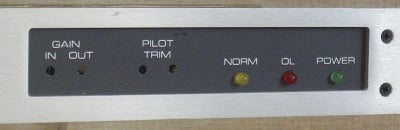
The 803 provided a visual means of knowing how far you were pushing the clip function. There were green and red LEDs on the front panel. As long as the green NORM LED was lit, you were doing no harm. When the RED OL LED came on, you were in the danger zone, although the industry joke was that OL really stood for 'Operating Level'. The 803 was undoubtedly the best-selling composite processor throughout the 1980s.
Now that broadcasters could clip with impunity, the splatter above 53 Khz reached a point that it could interfere with SCA and RDS signals. Frank Foti, then president of Cutting Edge Technologies, designed the Dividend Composite Filter. It was the complimentary tool to a composite clipper, as it delivered a clean spectrum above 53 Khz, providing a safe zone for those subcarrier signals.
Today's audio processors run on DSP, and composite processing is executed in code. Usually that code includes distortion masking algorithms. Pilot protection is on the order of 90 dB or better, approaching theoretical limits.
While modern audio processors such as the Omnia.11 and Omnia.9 have the option of composite clipping in their menus, the main clippers on these devices are so powerful and clean that most users never put the composite options on line.
The CP-803 is a premium device. The quality of construction, both metal work and circuit board, is excellent. To ensure RF integrity, the top cover is secured with 21screws. The bipolar 13-volt power supply is isolated in its own enclosure.