• You can now help support WorldwideDX when you shop on Amazon at no additional cost to you! Simply follow this Shop on Amazon link first and a portion of any purchase is sent to WorldwideDX to help with site costs.

Did I miss a memo or something??? (GE 3-5811B related)

Maybe doing a continuity check on the mic audio line and ground line, with the mic open and the radio open, checking from the mic, thru the mic connector, into the radio for continuity. Ive experienced poor or no connections thru mic connectors before (even antenna connectors).
 
  • Like
Reactions: guitar_199
Okay... I only woke this one up to let you all know the final answer. The final act occurred today (Sat, April 4).

The original complaint of low modulation was really indeed the two factory resistors that were swapped in their locations. And yes... it cam from the factory that way. The solder had not been touched. In addition... one of the two swapped resistors was a 5.6k in the radio... BUT it is a 1K on the schematics. The way this is configured:

With the 5.6K and 33K swapped the mic signal coming in would be severely attenuated. Add to that.... the one that the schematic says should be 1k but is actually a 5.6K .... would kill the mic audio even MORE!!!!!!

Needless to say, I put the 33K back where the 33K should be and I put a 1K where the 5.6 K would have been.... NOW it matches the schematic!!!

The modulation did come up as high as about 63% (measured on a scope)...but any pushing of mic audio beyond a certain point caused a very ugly and spiky distortion in the audio waveform. Also the AMC adjust had surprisingly little effect on the audio level.

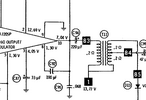
THAT was tracked down today. A bad C4 (220uF 16v) that was the main output cap out of the audio amp.

What is weird..... when I removed the old one I tested it on my component tester:

in ONE direction... it showed a 26 pF cap.
turn it around to the OTHER direction.... it showed a 47 uF cap.
This is weird behavior for an electrolytic cap... especially a 220 uF one!!!!

The new cap tested 227 uF in both directions so I felt good about that.

Put it in and the modulation envelope was beautiful!!!!
AND.... NOW the AMC control worked.
Set the AMC for about 97% and now I can yell into the mic and not clip or pinch.

So, at the end of the day, all is good!!!!!

XMT: about 3 watts carrier, fwd mod present (dont have a peak reading meter!)

RCV: I could hear the tone WELL down to -120 dBm and that is as low as my 2040 goes on the dial.

So..... ignore my original starting topic!!!!!
It is up and alive.
 
Too damn awesome! And a GREAT job you kept at it! I was wanting that exact radio a couple years ago, but was afraid to buy it as it isnt one that reads a "power mic" in the label in the front....

Now I will keep an eye out for the radio you fixed, and do the necessary changes to it. :) I always dislike I have to yell into a mic to get it to modulate. :D
 
Just like that, found one in decent shape (At least on the pictures) on eBay for a whopping $25 free shipping (not including taxes.) Purchased. :)

With that being said, was a bad capacitor the main culprit this entire time? would leaving the resistors alone still be ok after a recap?
 
Last edited:
Now I am on the hunt. The powered mic versions of the General Electric radio can sound good, but one has to basically be up very close to the mic. The one I do have now is a GE 3-5813B.

I dont have a schematic on hand or know what exactly I am looking for, but I wonder if it has the same issue that you had as far as the schematic calling for a 1k resistor vs the 5.6k one you found that was in there. Maybe that is what's going on with this one?

Ill ask over in the appropriate thread for a Schematic. :)
 
Just like that, found one in decent shape (At least on the pictures) on eBay for a whopping $25 free shipping (not including taxes.) Purchased. :)

With that being said, was a bad capacitor the main culprit this entire time? would leaving the resistors alone still be ok after a recap?
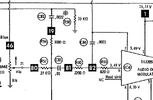
The actual "first" problem I found is covered in the MicCircuit image below.


RCV was great to the ears to begin with.
XMT carrier was great on the scope and spectrum analyzer.
But modulation was "non existent". Seriously.... I would say no more than 5%.

R58 (33K) and R59(5.6K) were swapped on the board from the factory. The solder was original. The 33K was in R59's spot and the 5.6K was in R58's spot. THAT MISTAKE ALONE accounted for super low mic audio. And then... on the schematic R59 is a 1K and the factory put in a 5.6K which would reduce it SOME after they were put back in the right places. SO I also changed out the 5.6K for the 1K indicated in the schematic.

After THAT I got the modulation up to about 63% measured but if I pushed it ANY HARDER the modulation envelope (audio) broke into a horribly jagged/sharp/spiky distortion on the scope.

THAT problem was C94 (220 uF 16v). When I pulled it out and put it on a parts checker.... ONE DIRECTION was 26 pF.... the OTHER DIRECTION (flipped it physically) measured 47 uF!!! The new cap measured 227 uF no matter which way I put it in!!!!! So I soldered it in and the deed was done.

After that.... the AMC control let me tweak the measured modulation up to about 97% and I just stopped there. But that modulation envelope was sweet looking. Speech looked good on the scope and, as I said, barking into it really hard would not make it distort!!!
 

Attachments

  • MicCircuit.png
    MicCircuit.png
    49.7 KB · Views: 4
  • OutputCap.png
    OutputCap.png
    42.2 KB · Views: 4
The actual "first" problem I found is covered in the MicCircuit image below.


RCV was great to the ears to begin with.
XMT carrier was great on the scope and spectrum analyzer.
But modulation was "non existent". Seriously.... I would say no more than 5%.

R58 (33K) and R59(5.6K) were swapped on the board from the factory. The solder was original. The 33K was in R59's spot and the 5.6K was in R58's spot. THAT MISTAKE ALONE accounted for super low mic audio. And then... on the schematic R59 is a 1K and the factory put in a 5.6K which would reduce it SOME after they were put back in the right places. SO I also changed out the 5.6K for the 1K indicated in the schematic.

After THAT I got the modulation up to about 63% measured but if I pushed it ANY HARDER the modulation envelope (audio) broke into a horribly jagged/sharp/spiky distortion on the scope.

THAT problem was C94 (220 uF 16v). When I pulled it out and put it on a parts checker.... ONE DIRECTION was 26 pF.... the OTHER DIRECTION (flipped it physically) measured 47 uF!!! The new cap measured 227 uF no matter which way I put it in!!!!! So I soldered it in and the deed was done.

After that.... the AMC control let me tweak the measured modulation up to about 97% and I just stopped there. But that modulation envelope was sweet looking. Speech looked good on the scope and, as I said, barking into it really hard would not make it distort!!!
That is pretty neat! Do you know what Cybernet board number is in that radio? I was going to try and compare it to other radios.

From what I understand, most Cybernet boards need a power mic behind it. Otherwise, there is almost no modulation without literally yelling up close into the mic before it even goes. Talk in a normal voice and about 2 inches away from the mic, it barely can be heard and only a watt or so swing. With a power mic behind it, it goes to what I had the AMC set to, which was 8 watts. (It might be a bit much but otherwise sounded good on the other radio with no distortion.)
 
Last edited:
That is pretty neat! Do you know what Cybernet board number is in that radio? I was going to try and compare it to other radios.

From what I understand, most Cybernet boards need a power mic behind it. Otherwise, there is almost no modulation without literally yelling up close into the mic before it even goes. Talk in a normal voice and about 2 inches away from the mic, it barely can be heard and only a watt or so swing. With a power mic behind it, it goes to what I had the AMC set to, which was 8 watts. (It might be a bit much but otherwise sounded good on the other radio with no distortion.)
Don;'t know the board number and the SAMS doesn't show it....
I'll have to crack it back open and take a look......

Well... for one... there is not a single mic audio amplification stage before the audio chip. Literally.... passive components.... no gain....... anywhere in the path on the 3-5811B. But after I set the AMC.... it seemed very sensitive!!!!
 

dxChat
Help Users
  • No one is chatting at the moment.