
I am submitting, for thoughts and opinions, an idea I had today for a dual purpose Dipole antenna.
For reference, I have been getting ready to build a wire antenna that I can stuff into a sack and take with me for camping and field day purposes. I have already decided on feeding the dipole with 450 ohm ladder line to enable me to use it on multiple bands with a tuner.
Originally, I had planned to make a simple dipole cut for the 40 meter band. This antenna would be suspended as an inverted vee and supported by military surplus fiberglass masts.
After surveying a potential field day site close to my home this week, I found that I have ample room to put up a dipole cut for 80 meters if I chose to. HOWEVER: the spots I normally camp do NOT have room for a full size 80m dipole... thus the modification at hand:
What I plan to do is construct the 40 meter dipole just as one normally would. However, instead of just clipping the tag end of the dipole ends at the insulator, I plan to leave 2 or 3 inches of free play after winding and soldering the connection and soldering a quick disconnect plug either spade or round to the short tag end.
When space only allows for a 40m dipole, this antenna could quickly be erected and the dipole end insulators secured with dacron rope and connected to their corresponding supports.
When space allows for, and the situation necessitates, a full size 80m dipole, two additional dipole legs can be connected each roughly 32 feet long. These wires would be strung through the other hole in the existing dipole insulators (the ones used for dacron rope while in 40m configuration) wrapped securely, and a corresponding quick disconnect connected to the 40m leg thus allowing currents to flow into the lengthened section without any trouble.
The extension legs will also terminate in end insulators to which dacron rope can be secured.
I looked around for awhile today but didn't see anything similar to this, though I would highly doubt I'm the first to try it.
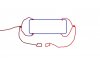
If you can excuse my poor windows paint illustrations, I believe they will help to show my intention. The 40m dipole legs are drawn in red, with the extension legs shown in brown. The green lines are the support masts. Obviously this is nowhere close to being drawn to scale.
I would appreciate any comments, negative or positive, from other members. Thank You
For reference, I have been getting ready to build a wire antenna that I can stuff into a sack and take with me for camping and field day purposes. I have already decided on feeding the dipole with 450 ohm ladder line to enable me to use it on multiple bands with a tuner.
Originally, I had planned to make a simple dipole cut for the 40 meter band. This antenna would be suspended as an inverted vee and supported by military surplus fiberglass masts.
After surveying a potential field day site close to my home this week, I found that I have ample room to put up a dipole cut for 80 meters if I chose to. HOWEVER: the spots I normally camp do NOT have room for a full size 80m dipole... thus the modification at hand:
What I plan to do is construct the 40 meter dipole just as one normally would. However, instead of just clipping the tag end of the dipole ends at the insulator, I plan to leave 2 or 3 inches of free play after winding and soldering the connection and soldering a quick disconnect plug either spade or round to the short tag end.
When space only allows for a 40m dipole, this antenna could quickly be erected and the dipole end insulators secured with dacron rope and connected to their corresponding supports.
When space allows for, and the situation necessitates, a full size 80m dipole, two additional dipole legs can be connected each roughly 32 feet long. These wires would be strung through the other hole in the existing dipole insulators (the ones used for dacron rope while in 40m configuration) wrapped securely, and a corresponding quick disconnect connected to the 40m leg thus allowing currents to flow into the lengthened section without any trouble.
The extension legs will also terminate in end insulators to which dacron rope can be secured.
I looked around for awhile today but didn't see anything similar to this, though I would highly doubt I'm the first to try it.
If you can excuse my poor windows paint illustrations, I believe they will help to show my intention. The 40m dipole legs are drawn in red, with the extension legs shown in brown. The green lines are the support masts. Obviously this is nowhere close to being drawn to scale.
I would appreciate any comments, negative or positive, from other members. Thank You



 )
)