• You can now help support WorldwideDX when you shop on Amazon at no additional cost to you! Simply follow this Shop on Amazon link first and a portion of any purchase is sent to WorldwideDX to help with site costs.
  • A Winner has been selected for the 2025 Radioddity Cyber Monday giveaway! Click Here to see who won!

Galaxy dx99V2 off 4K on various channels

Chris Lawrence

Active Member
Jul 9, 2021
111
52
38
Various channels are off by 40kHz, if my math is right.

This is the 690011D board like the dx959 and 98vhp, not like the old 99v 3600 board.

The following channels read 40,000hz high. Example: 36=27.4050 instead of 27.3650
1.5,6,7,12,13,18,19,20,23,26,27,28,33,34,35,36.

The only channels that are on frequency are 2,3,3,8,9,10,11,14,15,16,17,21,22,24,25,29,20,31,32,37,38,39,40.

*Channel 20
TP3 = 16.5500 instead of 16.5100
*Ant Jack @ 27.2450

Before getting too deap, maybe someone knows what’s wrong just by the above info.

Alignment of PLL done according to 98vhp.
Note: 99V2 has a vr5 and 98vhp does not.
 

If my PLL calc is right, all those channels that are off have one PLL input in common, P2. I would guess that either someone did a mod switch, or the channel selector isn't pulling that pin low.

Edit: thats input P2, not pin 2. P2 is pin 15 on the 18-pin version and pin 16 on the 20-pin version.
 
Last edited:
Various channels are off by 40kHz, if my math is right.

This is the 690011D board like the dx959 and 98vhp, not like the old 99v 3600 board.

The following channels read 40,000hz high. Example: 36=27.4050 instead of 27.3650
1.5,6,7,12,13,18,19,20,23,26,27,28,33,34,35,36.

The only channels that are on frequency are 2,3,3,8,9,10,11,14,15,16,17,21,22,24,25,29,20,31,32,37,38,39,40.

*Channel 20
TP3 = 16.5500 instead of 16.5100
*Ant Jack @ 27.2450

Before getting too deap, maybe someone knows what’s wrong just by the above info.

Alignment of PLL done according to 98vhp.
Note: 99V2 has a vr5 and 98vhp does not.
No mod was done
If my PLL calc is right, all those channels that are off have one PLL input in common, P2. I would guess that either someone did a mod switch, or the channel selector isn't pulling that pin low.

Edit: thats input P2, not pin 2. P2 is pin 15 on the 18-pin version and pin 16 on the 20-pin version.
No mod has been done. Shouldn’t be looking at the channel selector?
 
I just realized that one uses the adders for the band switch. Not sure how that changes things, I will have to pick a channel and work through the logic to be sure. The 145106 pll calc I made was for straight 40 ch radio with no band switch.
 
  • Like
Reactions: Chris Lawrence
So, what I wrote above would apply to that channel selector in a radio with the same PLL using a 15.36MHz loop mix crystal, but with the band switch option, 13.56MHz crystal, and the binary adders, the N-codes change. Instead of N=91 directly from the selector to the PLL, the N=91 is combined with the band data in the adders and N changes to 271 for the same channel (ch1). Same selector, different data to the PLL.
 
Last edited:
Here is what happens on ch1 with the channel selector and band switch.

The channel selector and band switch each send their data to the adders. Lets consider the band switch on the standard 40 channels, which is position E. In E, the adders see this for the band inputs:
1765439132366.png
Now we need to know what the channel selector is feeding in, and without one (my situation) or with a broken one (your situation), we figure out what it would expect for a given channel. Let's reverse engineer the channel selector data.

We know the VCO outputs 16.27MHz on ch1. We also know that the loop mix is 13.56MHz. The difference, 2.71MHz, is what goes into the PLL divider. Since pin 6 is floating (read as high), we know the PLL is making 10kHz for the reference. 2.71MHz/10kHz=N=271. This, in binary, is what the PLL inputs need to see.
1765439944426.png
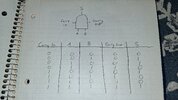
Now, with the truth table, we can figure out what the band switch should be doing.
20251211_013504.jpg
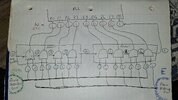
For each block that looks like an AND gate, there are two inputs, a carry input, a carry output, and a signal output. Starting on the left, the first adder gets its carry input from the 10kHz switch. Lets set that to 0. The rest of the carry outputs go to the next carry input until the last one that goes to P8.
20251211_013437.jpg
Ignore the green numbers, we are pretending like we don't know them. Starting on the left, we have a 0 carry in and a 1 out, and using the truth table, we see there can only be two possible solutions. Both have carry out as 0, and A and B are opposite. Knowing the first band digit is 0, we therefore know the first channel selector bit is a 1. Continuing this process for the rest of the inputs, we end up with N=91, the same thing the PLL would want if the mix crystal was 15.36MHz.

With this information, it should be possible to find the problem by checking for the expected logic levels.
 
Last edited:
  • Like
Reactions: Shadetree Mechanic
And the calc confirms P2 is still the common denominator, although it was obvious with the band switch not changing.
1765442162561.png
 
I have on many occasions seen the 4008 adders fail unexpectedly. I rarely find a faulty channel switch, and it was usually obvious it had failed. Figuring the logic values is the only way I have verified a failed adder. It is very time consuming. Now, if I suspect an adder, I replace it.
 
  • Like
Reactions: brandon7861
I have on many occasions seen the 4008 adders fail unexpectedly. I rarely find a faulty channel switch, and it was usually obvious it had failed. Figuring the logic values is the only way I have verified a failed adder. It is very time consuming. Now, if I suspect an adder, I replace it.
I appreciate the work you’ve done. It’s a bit over my understanding. Essentially, it sounds like I need to test or replace the “added” but until to know what they are. Are you referring to a diode? (Ie1n4008)?
[edit] I responded prematurely from my lazy boy. When I get back to the bench, it’ll make more sense. :)
 
I appreciate the work you’ve done. It’s a bit over my understanding. Essentially, it sounds like I need to test or replace the “added” but until to know what they are. Are you referring to a diode? (Ie1n4008)?
It's a CD4008 binary adder.

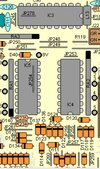
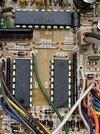
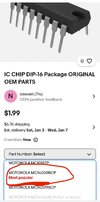
There are 2 adders in this radio, near the pll chip. They are identical chips. I found some Soviet era chips on fleabay that seem to work well and we're cheap. Whenever I replace them or any chip I install a socket.
 
It's a CD4008 binary adder.

There are 2 adders in this radio, near the pll chip. They are identical chips. I found some Soviet era chips on fleabay that seem to work well and we're cheap. Whenever I replace them or any chip I install a socket.
 
Same part, different manufacturer, different number. As long as the pin out is correct, which it is. If you do replace them, consider that the orientation is opposite from ic4 and ic5 as indicated by the dot noting pin 1. You could replace just the one, but I will replace both. Also, verify the chip is in fact faulty by logic check of the pins as Brandon pointed out.

For channel 1, E band, If P2 (PLL pin 15) stays low always, <5v, and pins 3 is low and 2 is hi on the affected adder, the adder is bad. If you get anything other than that on pins 2 and 3 of the adder, the adder could still be bad (pulling or floating the pin) or the channel switch is bad or the band switch is bad or wired wrong. It really depends on what voltages you are seeing at the adder pins and pll pins.
 

dxChat
Help Users
  • No one is chatting at the moment.