

You are using an out of date browser. It may not display this or other websites correctly.
You should upgrade or use an alternative browser.
You should upgrade or use an alternative browser.
-
You can now help support WorldwideDX when you shop on Amazon at no additional cost to you! Simply follow this Shop on Amazon link first and a portion of any purchase is sent to WorldwideDX to help with site costs.
-
A Winner has been selected for the 2025 Radioddity Cyber Monday giveaway! Click Here to see who won!
Is there a Siltronics VFO that will work with a Messenger 1 or 2?
- Thread starter danmcclain
- Start date

Those radios use discreet tx and rx crystals. The Siltronix was designed for "synthesized" crystal radios, so no, they did not.I have searched the internet and haven't found much info... Help please... Thanks, Dan

Dan -
The Messsenger I and II use crystals that oscillate at the operating frequency. VFOs like the siltronix and the PAL are designed to operate in CBs where they replace one of the two crystal frequencies that are mixed together to produce the operating freq. Small programmable microcomputers like the rasberry PI, At Tiny series or the Arduino can be made to produce 27mhz programmable outputs that can be made to work with the Johnson I and II in place of the plug- in crystals. These are easy to construct and program. Cheap too. Check them out.
- 399
The Messsenger I and II use crystals that oscillate at the operating frequency. VFOs like the siltronix and the PAL are designed to operate in CBs where they replace one of the two crystal frequencies that are mixed together to produce the operating freq. Small programmable microcomputers like the rasberry PI, At Tiny series or the Arduino can be made to produce 27mhz programmable outputs that can be made to work with the Johnson I and II in place of the plug- in crystals. These are easy to construct and program. Cheap too. Check them out.
- 399


I'm waiting for someone (else) to come up with a plan to use two of the three outputs on the Si5351 DDS modules that are so popular, one for the transmit crystal, one for the receiver.
Hard part is the program code to run it all.
Would probably work.
73
Hard part is the program code to run it all.
Would probably work.
73
Thank you for the info... DanDan -
The Messsenger I and II use crystals that oscillate at the operating frequency. VFOs like the siltronix and the PAL are designed to operate in CBs where they replace one of the two crystal frequencies that are mixed together to produce the operating freq. Small programmable microcomputers like the rasberry PI, At Tiny series or the Arduino can be made to produce 27mhz programmable outputs that can be made to work with the Johnson I and II in place of the plug- in crystals. These are easy to construct and program. Cheap too. Check them out.
- 399

Wouldn't that need to be reprogrammed via PC every time you want to change the frequency? It looks like that one can put out 8 different signals, but once those 8 are programmed in, thats the 8 you have until it is reprogrammed (i think).I'm waiting for someone (else) to come up with a plan to use two of the three outputs on the Si5351 DDS modules that are so popular, one for the transmit crystal, one for the receiver.
Hard part is the program code to run it all.
Would probably work.
73
It may be easier reinvent the viagra board with a modern PLL and divider and connect it to an arduino nano with display and rotary contol.
I think this will work. I ordered one to try with my Johnson Messenger II.
- 399 J.J.
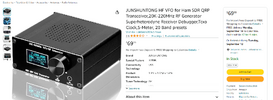

- 399 J.J.
I don't have a Messneger II, but according to the block diagram in the service manual, it looks like there are two crystal oscillators, but they not mixed together. One is for TX and one is for RX. The RX crystals are 455kHz less than the signal frequency so it lands within the 455kHz RX IF filter. If I am understanding that right, you would need to have two of those signal generators or a way to feed the signal to both tubes and shift down 455kHz on RX only,I think this will work. I ordered one to try with my Johnson Messenger II.
- 399 J.J.
View attachment 65244
View attachment 65245
When operating the TX/RX button, it shifts the TX output freq down by 455 khz. So,it seems that once you program in a tx freq to replace the TX xtal in the Messenger II, pressing the tx/rx button will drop the output by 455 khz making it suitable for receive crystal replacement. A relay will be necessare to allow the vfo's ouput to be switched between the tx xtal's holder and the recv xtal's holder. No big deal. Setting the tuning steps to 10 khz will allow scanning through the 40 channel cb spectrum and more.
We'll see if it works when I get it.
- 399
We'll see if it works when I get it.
- 399
Not sure I follow what you are saying...When operating the TX/RX button, it shifts the TX output freq down by 455 khz. So,it seems that once you program in a tx freq to replace the TX xtal in the Messenger II, pressing the tx/rx button will drop the output by 455 khz making it suitable for receive crystal replacement. A relay will be necessare to allow the vfo's ouput to be switched between the tx xtal's holder and the recv xtal's holder. No big deal. Setting the tuning steps to 10 khz will allow scanning through the 40 channel cb spectrum and more.
We'll see if it works when I get it.
- 399
The Messenger II TX and RX use separate crystal oscillators. The radio does not "shift" the same oscillator for both TX and RX, it simply turns off one and turns on the other. The 27MHz TX is directly synthesized via crystals and the RX has its own lineup of crystals 455kHz lower than the signal.
There are two other issues with that as well. Even if you could pull or "shift" a crystal oscillator by 455kHz, which is not possible, the circuitry doing the shifting wouldn't shift the signal generator you connect to the crystal socket.
Last edited:
What you could do is take a signal generator with the ability to do FSK on an external trigger and wire that to your PTT button. Set it to output 455kHz less than the desired freq and set the offset to 455kHz. When you key down, the sig gen switches to the carrier frequency and when you let off it jumps back to the rx freq.
That is why I said that a relay will be needed to switch the VFO's output freq between the TX and RX oscillators. When the Mess II is transmitting, the VFO's TX output is fed through the relay to the transmit oscillator. When the Mess II is in receive, the VFO's tx/rx switch is operated, the relay is switched and the VFO's RX output (which is 455khz lower) is fed to the radio's receive oscillator. So, only one vfo box is needed.Not sure I follow what you are saying...
The Messenger II TX and RX use separate crystal oscillators. The radio does not "shift" the same oscillator for both TX and RX, it simply turns off one and turns on the other. The 27MHz TX is directly synthesized via crystals and the RX has its own lineup of crystals 455kHz lower than the signal.
- 399
My idea hinges on the Si5351 clock generator chip's ability to deliver three separate outputs. Two of them are pretty well independent, the third output has some restrictions I'm not on top of. Just feeing one output to the receiver mixer and the other one to the transmitter would simplify hookup.
Of course you could just take advantage of the chip's near-instantaneous ability to change frequency and use one output that delivers one frequency for receive and the other on while transmitting. Switching that one output between the receiver and transmitter circuits would have to be part of that picture.
The solution that uses fewer parts usually appeals to me. In this case you would be substituting program code for hardware.
Not a new angle in the world of embedded electronics/computer design.
73
Of course you could just take advantage of the chip's near-instantaneous ability to change frequency and use one output that delivers one frequency for receive and the other on while transmitting. Switching that one output between the receiver and transmitter circuits would have to be part of that picture.
The solution that uses fewer parts usually appeals to me. In this case you would be substituting program code for hardware.
Not a new angle in the world of embedded electronics/computer design.
73