
You are using an out of date browser. It may not display this or other websites correctly.
You should upgrade or use an alternative browser.
You should upgrade or use an alternative browser.
-
You can now help support WorldwideDX when you shop on Amazon at no additional cost to you! Simply follow this Shop on Amazon link first and a portion of any purchase is sent to WorldwideDX to help with site costs.
-
The Winners of the three Retevis radios 16 Anniversary giveaway are announced!! Click Here to find out if you won!
Radio shack blue big stick antenna
- Thread starter rogodee
- Start date

Radio Shack , or properly, the Archer Crossbow 1/2 wave cb antenna 1980 something...
There's a thread here somewhere
I will look
73
Jeff
There's a thread here somewhere
I will look
73
Jeff
Got it
73
Jeff
any info on archer crosbow antenna. are they junk. i found a new one in the box.anybody using one
- fly442
- Replies: 22
- Forum: Amateur Radio Antennas
73
Jeff
Yes if it is the Archer Bow Antenna?
Worked as well as an Antron-99.
I helped a friend install one when I was in college.
It worked really well for us. The only problem we had was getting it to read a low SWR.
People talk all the time about coax length and swr. When I would test it with my short, high grade Belden coax that was hand made fited by me it read low. When he would hook it up in shack to his much larger but much cheaper Radio Shack 100 foot length he could not get a safe swr reading.
The antenna was fine. The coax tested fine but when hooked up to his meters in shack returned absurd readings. I suggested he take the coax back and just let me build him some. Instead he listened to people on the radio and started to chop the coax down and kept soldering new conectors on it until it read good on his cheap SWR meter.
Now I tell you the above story because these where known by many IRL and online in usenet groups to have tunning issues and swr issues. I never saw it though myself because when I would hook up my gear and coax they always worked as they should. I suspect that it was always the radio shack 100feet pre-terminated coax that was at fault.
This was back in the 1990's and as the bird flys he was either 48 miles or 60 miles from me. He was initialy talking to be on a bone stock Cobra 40ch AM base with his Archer Bow Antenna 30' above the ground. I was in my old 4Runner sitting in my dormitory parking lot with am RCI2950 and single transistor amp and 102" SS whip antenna. There where a lot of nights where I only had audio no signal on the meter but he sounded just great. There was never a night that we where both on air and could not talk.
Like always when it comes to antennas "height makes might" !
Worked as well as an Antron-99.
I helped a friend install one when I was in college.
It worked really well for us. The only problem we had was getting it to read a low SWR.
People talk all the time about coax length and swr. When I would test it with my short, high grade Belden coax that was hand made fited by me it read low. When he would hook it up in shack to his much larger but much cheaper Radio Shack 100 foot length he could not get a safe swr reading.
The antenna was fine. The coax tested fine but when hooked up to his meters in shack returned absurd readings. I suggested he take the coax back and just let me build him some. Instead he listened to people on the radio and started to chop the coax down and kept soldering new conectors on it until it read good on his cheap SWR meter.
Now I tell you the above story because these where known by many IRL and online in usenet groups to have tunning issues and swr issues. I never saw it though myself because when I would hook up my gear and coax they always worked as they should. I suspect that it was always the radio shack 100feet pre-terminated coax that was at fault.
This was back in the 1990's and as the bird flys he was either 48 miles or 60 miles from me. He was initialy talking to be on a bone stock Cobra 40ch AM base with his Archer Bow Antenna 30' above the ground. I was in my old 4Runner sitting in my dormitory parking lot with am RCI2950 and single transistor amp and 102" SS whip antenna. There where a lot of nights where I only had audio no signal on the meter but he sounded just great. There was never a night that we where both on air and could not talk.
Like always when it comes to antennas "height makes might" !
I got one locally from a lady selling off her dad's stuff. When I hooked it up I had a bad match, so I decided to open up the bottom where the matching device is located. I found a wire broke off the coil. Also the cap looks toasty. Ill replace that woth with a better one. 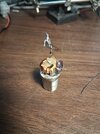
I also noticed the bottom section is aluminum covered in fiberglass. I put the matcher back into the base and put the antenna together and put it up 10 feet off the ground. Without replacing the toasted cap, im getting a 1.2 on ch 40 and a 1.7 on ch 1. Upon looking at the top section, it looks like someone cut or trimmed it to tune the upper channels..

Would you have better, more detailed photos of the matching transformer? The cap value?I got one locally from a lady selling off her dad's stuff. When I hooked it up I had a bad match, so I decided to open up the bottom where the matching device is located. I found a wire broke off the coil. Also the cap looks toasty. Ill replace that woth with a better one. View attachment 76795


I should add that the SWRs went wacko every few years. I'd spray a little electronics or tuner cleaner up one of the week holes on the bottom and everything would be fine for a few more years.
Also, I did not leave the antenna expose to the elements. I wrapped in automotive wire loom. That meant the loom would take the beating from UV rays - not the fiberglass on the antenna. I do the same for my A99 and my IMAX 2000.
Also, I did not leave the antenna expose to the elements. I wrapped in automotive wire loom. That meant the loom would take the beating from UV rays - not the fiberglass on the antenna. I do the same for my A99 and my IMAX 2000.
Ill look at it closer when Im home..Would you have better, more detailed photos of the matching transformer? The cap value?
Mine has a very low vswr on 40 and a 1.7 on 1.. upon looking at it, the top whip has been cut down.Yes if it is the Archer Bow Antenna?
Worked as well as an Antron-99.
I helped a friend install one when I was in college.
It worked really well for us. The only problem we had was getting it to read a low SWR.
People talk all the time about coax length and swr. When I would test it with my short, high grade Belden coax that was hand made fited by me it read low. When he would hook it up in shack to his much larger but much cheaper Radio Shack 100 foot length he could not get a safe swr reading.
The antenna was fine. The coax tested fine but when hooked up to his meters in shack returned absurd readings. I suggested he take the coax back and just let me build him some. Instead he listened to people on the radio and started to chop the coax down and kept soldering new conectors on it until it read good on his cheap SWR meter.
Now I tell you the above story because these where known by many IRL and online in usenet groups to have tunning issues and swr issues. I never saw it though myself because when I would hook up my gear and coax they always worked as they should. I suspect that it was always the radio shack 100feet pre-terminated coax that was at fault.
This was back in the 1990's and as the bird flys he was either 48 miles or 60 miles from me. He was initialy talking to be on a bone stock Cobra 40ch AM base with his Archer Bow Antenna 30' above the ground. I was in my old 4Runner sitting in my dormitory parking lot with am RCI2950 and single transistor amp and 102" SS whip antenna. There where a lot of nights where I only had audio no signal on the meter but he sounded just great. There was never a night that we where both on air and could not talk.
Like always when it comes to antennas "height makes might" !
I often wondered how the inside of the 18.5ft ones and the 16ft ones differed.I got one locally from a lady selling off her dad's stuff. When I hooked it up I had a bad match, so I decided to open up the bottom where the matching device is located. I found a wire broke off the coil. Also the cap looks toasty. Ill replace that woth with a better one. View attachment 76795
I had an 18.5ft one.
I burned it up with too much power, but it had a very small coil and a capacitor in the center.
The RG-58 coax inside the bottom half, had "Shakespeare" printed on it.
Radio Shack later came out with the 16ft blue one, that had a Hygain type mounting bracket on it.
I knew one family that had the 16ft one and it worked surprisingly well and it wasn't very high in the air, though the surrounding ground was flat in the area, with no hills.
Back in the 1970's, UPS started switching to smaller, shorter delivery trucks.
UPS started charging additional shipping charges for boxes and packages over 8ft long.
Shakespeare continued to sell the original 18.5ft Big Stick, but also added a slightly cheaper "Big Stick II", that was 16ft long/tall.
The Big Stick II was sold as an "economical" antenna.
This really hurt sales as asking on the radio what was thought of them, everybody would be informed that it must be an inferior design.
Around 79-80, or the early 1980's, Shakespeare quit the regular Big Stick and the Big Stick II, replacing them with the "superior" 16ft "Super Big Stick."
The Super Big Stick was said to work as well as the 18.5ft Big Stick, using superior design.
Prices went up and sales went down, because of the price and because it was the same size as the "economical" Big Stick II.
They seemed to work well though.
Copper Electronics contracted Shakespeare to make a 18.5ft Super Big Stick, exclusively for Copper.
I think that was mid-late 1980's.
They didn't sell grea and even though only one run was made, Copper had them in stock, for sale for a long time.
In the bottom of my 18.5" Radio Shack Big Stick from 79-80, was nothing at all, but an inline coil and capacitor in its center.
In the pic here the bottom coil looks like possibly a choke coil.
This makes a lot of sense compared to the Sirio half wave coaxial antenna.
I believe this bottom coil / choke is the "Super" improvement.
My father gave me a radio handbook that ws published in 1963 and it said that coaxial antennas had the lowest angle of radiation, but had a narrow frequency range and the bottom acted as a sleeve that sufficiently isolates the feed line.
Well owners of early Big Sticks would notice the narrow frequency range and often suffer TV interference from their CB radios.
Sirio adds a large choke coil on the bottom of their half wave coaxial antenna and it has a wide frequency range and doesn't sugffer from feed line radiation.
I think the early Big Stick did not isolate the feed line very well and from the pic here, the Super Big Stick has a coil at the very bottom.
I wonder if it is a matching coil for the antenna being 2.5ft shorter, or if it is an RF choke to help isolate the feed line.
I'm not sure RF chokes became much of a design feature before the late 1980's - 1990's though.
The Radio Shack and Hygain aluminum half wave antennas have short radials, that Hygain correctly describes are isolating the feed line, for improved frequency range.
Radials do help gain on 1/4 wave and 5/8 wav antennas, but not so much so on halfway antennas, though short radials can help extend frequency range of half wave antennas, but don't really help gain.
Maybe the Super Big Stick was a better design. than the original, which was a very old design by then.
Good post. Interesting read. I do have a 16 foot big stick and I've never really used it aside from putting it up to check the match. I also own a regular 18 foot one too. It had a swr issue that had to do with corrosion. I solved that by taking it apart and rebuilding the bottom..I often wondered how the inside of the 18.5ft ones and the 16ft ones differed.
I had an 18.5ft one.
I burned it up with too much power, but it had a very small coil and a capacitor in the center.
The RG-58 coax inside the bottom half, had "Shakespeare" printed on it.
Radio Shack later came out with the 16ft blue one, that had a Hygain type mounting bracket on it.
I knew one family that had the 16ft one and it worked surprisingly well and it wasn't very high in the air, though the surrounding ground was flat in the area, with no hills.
Back in the 1970's, UPS started switching to smaller, shorter delivery trucks.
UPS started charging additional shipping charges for boxes and packages over 8ft long.
Shakespeare continued to sell the original 18.5ft Big Stick, but also added a slightly cheaper "Big Stick II", that was 16ft long/tall.
The Big Stick II was sold as an "economical" antenna.
This really hurt sales as asking on the radio what was thought of them, everybody would be informed that it must be an inferior design.
Around 79-80, or the early 1980's, Shakespeare quit the regular Big Stick and the Big Stick II, replacing them with the "superior" 16ft "Super Big Stick."
The Super Big Stick was said to work as well as the 18.5ft Big Stick, using superior design.
Prices went up and sales went down, because of the price and because it was the same size as the "economical" Big Stick II.
They seemed to work well though.
Copper Electronics contracted Shakespeare to make a 18.5ft Super Big Stick, exclusively for Copper.
I think that was mid-late 1980's.
They didn't sell grea and even though only one run was made, Copper had them in stock, for sale for a long time.
In the bottom of my 18.5" Radio Shack Big Stick from 79-80, was nothing at all, but an inline coil and capacitor in its center.
In the pic here the bottom coil looks like possibly a choke coil.
This makes a lot of sense compared to the Sirio half wave coaxial antenna.
I believe this bottom coil / choke is the "Super" improvement.
My father gave me a radio handbook that ws published in 1963 and it said that coaxial antennas had the lowest angle of radiation, but had a narrow frequency range and the bottom acted as a sleeve that sufficiently isolates the feed line.
Well owners of early Big Sticks would notice the narrow frequency range and often suffer TV interference from their CB radios.
Sirio adds a large choke coil on the bottom of their half wave coaxial antenna and it has a wide frequency range and doesn't sugffer from feed line radiation.
I think the early Big Stick did not isolate the feed line very well and from the pic here, the Super Big Stick has a coil at the very bottom.
I wonder if it is a matching coil for the antenna being 2.5ft shorter, or if it is an RF choke to help isolate the feed line.
I'm not sure RF chokes became much of a design feature before the late 1980's - 1990's though.
The Radio Shack and Hygain aluminum half wave antennas have short radials, that Hygain correctly describes are isolating the feed line, for improved frequency range.
Radials do help gain on 1/4 wave and 5/8 wav antennas, but not so much so on halfway antennas, though short radials can help extend frequency range of half wave antennas, but don't really help gain.
Maybe the Super Big Stick was a better design. than the original, which was a very old design by then.
Good post. Interesting read. I do have a 16 foot big stick and I've never really used it aside from putting it up to check the match. I also own a regular 18 foot one too. It had a swr issue that had to do with corrosion. I solved that by taking it apart and rebuilding the bottom..
Until your picture, I didn't know the 16ft model had a coil at the bottom.
I don't think I ever saw that inside the 18.5ft version, but it had a small coil and a capacitor in the center, at the top of the bottom section.
It was a tiny component type coil, not as large as the one in the bottom of the 16ft version.
The Marine Big Stick stayed in production much longer than the base station version.
There was a company or Shakespeare itself, made a mast mount to use the Marine version at a base station, but that part was discontinued, while the Marine version actually stayed in production.
I don't know if they still make it, but sometimes the Marine version can still be found new in the box, especially at boat shops.
I wish I had tried the Copper Electronics 18.5ft Super version, but at the time, I running too much power to use it.
Also now I know the secret of the Sirio fiberglass coaxial half wave is the coaxial RF choke at the bottom, which gives it great frequency range and isolates the feed line very well.
Something like that could be added to the bottom of a Big Stick.
I don't know if the coil at the bottom of the 16ft version is to make up for the length, or to act as an RF choke, to isolate the feed line.
I wonder if there is a difference between the "economical" 16ft Big Stick II and the 16ft Super Big Stick.
I suspect they did make some improvements.
The 21 foot Military Big Stick was one of the best antennas, but was expensive and could only handle limited power.
The Shakespeare fiberglass seems much better than the Solarcon fiberglass.
I forget what the gain rating on the 16ft blue Radio Shack Big Stick was, but the 18.5ft white Radio Shack Big Stick had the same gain rating as their aluminum half wave antenna, made by Hygain, 3.75 db.
Radio Shack did have engineers on staff and I guess they figured a half wave antenna is a half wave antenna and didn't use the Shakespeare gain rating.
That may have hurt sales though.
dxChat
- No one is chatting at the moment.