I'm sorry maybe I misunderstood. I set AM power to 4W dead key no modulation (audio generator off) and mic gain at minimum. Then when using 30mVrms (1KHz) into the mic input and adjusting mic gain to maximum it increases to 6W although the AM envelope as mentioned is very distorted.Thats not right. It should be doing 4w with mic gain minimum and no audio to peaking 16w with 100% modulation.

You are using an out of date browser. It may not display this or other websites correctly.
You should upgrade or use an alternative browser.
You should upgrade or use an alternative browser.
-
You can now help support WorldwideDX when you shop on Amazon at no additional cost to you! Simply follow this Shop on Amazon link first and a portion of any purchase is sent to WorldwideDX to help with site costs.
-
The Winners of the three Retevis radios 16 Anniversary giveaway are announced!! Click Here to find out if you won!
Texas Ranger TR696F SSB RX ok, AM TX ok, SBB TX very weak
- Thread starter David Springmire
- Start date

Just a thought....... Are there other mods that need to be undone? Able to verify present wiring matches stock wiring via schematic?
One additional note, at 100% modulation AM RF output is just over 5W but the mic gain control is set to only "1" on the silkscreen of the faceplate. Turning the mic gain any higher produces distortion.I'm sorry maybe I misunderstood. I set AM power to 4W dead key no modulation (audio generator off) and mic gain at minimum. Then when using 30mVrms (1KHz) into the mic input and adjusting mic gain to maximum it increases to 6W although the AM envelope as mentioned is very distorted.
Thank you, that's a really good question. I'll need to go back and fix the SWR cal control, it's just disconnected right now. There are 3 other mods I see - 1). The bright/dim switch (using AM CH.20 as a reference) in one position shifts the frequency from 27.2050 to 27.8450. 2). In one position the CH.9 switch shifts the frequency to 26.8850. 3). The TX frequency pot has been removed, a hole drilled in the rear of the chassis and an external pot added in it's place.Just a thought....... Are there other mods that need to be undone? Able to verify present wiring matches stock wiring via schematic?

Oh, and to your point, I can't find a "real" schematic for this unit anywhere, it seems to most closely resemble the Galaxy DX-2547.Thank you, that's a really good question. I'll need to go back and fix the SWR cal control, it's just disconnected right now. There are 3 other mods I see - 1). The bright/dim switch (using AM CH.20 as a reference) in one position shifts the frequency from 27.2050 to 27.8450. 2). In one position the CH.9 switch shifts the frequency to 26.8850. 3). The TX frequency pot has been removed, a hole drilled in the rear of the chassis and an external pot added in it's place.

I think that inablity to reach 12.5v on the APC adjustment provides a vital clue (had to redraw it on paper to understand it). Give me a minute to scribble on a schematic. I want to detail how all that works so you can check voltage levels throughout the APC path. Be back shortly.
Okay, Great! Thank you!I think that inablity to reach 12.5v on the APC adjustment provides a vital clue (had to redraw it on paper to understand it). Give me a minute to scribble on a schematic. I want to detail how all that works so you can check voltage levels throughout the APC path. Be back shortly.
First things first. Verify you have 13.8v at the power supply G. If you are using a 12v supply, the numbers in the manual will not be possible.
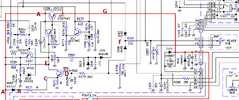
Lets talk about SSB. Since this radio has an automatic power control (instead of just a transistor switch saturating the passthrough regulator), transistor Q56 serves to hold the output at 12.5v.
Lets assume you did have 12.5v at TP7 (A). D103 is a triple-junction diode, so assume it drops .65v * 3 = 1.95v of that. 12.5v - 1.95v = 10.55v at point B. The voltage divider R271 and R270 cut that in half and present 5.275v to the emitter of Q56. Point D is .65v higher at 5.925v. VR17, in combination with the RF Power pot form a voltage divider that sets this base voltage at point D and holds it steady.
Think of Q56 as a voltage comparator. With the base held constant, as RF pulls down on the final supply A, Q56 wants to conduct harder, and this pulls down on the darlington pair (Q54 and Q55) to work to raise that final supply back up. It is a constant battle around that loop to hold A at 12.5v.
The two diodes at F serve to isolate this APC bias voltage from the AM carrier voltage, both of which must share the same RF Power control.
Lets stop there and see if you can figure out why you can't reach 12.5v. If this was too hard to follow, take some voltage measurements at all those points in SSB with no modulation.
Lets talk about SSB. Since this radio has an automatic power control (instead of just a transistor switch saturating the passthrough regulator), transistor Q56 serves to hold the output at 12.5v.
Lets assume you did have 12.5v at TP7 (A). D103 is a triple-junction diode, so assume it drops .65v * 3 = 1.95v of that. 12.5v - 1.95v = 10.55v at point B. The voltage divider R271 and R270 cut that in half and present 5.275v to the emitter of Q56. Point D is .65v higher at 5.925v. VR17, in combination with the RF Power pot form a voltage divider that sets this base voltage at point D and holds it steady.
Think of Q56 as a voltage comparator. With the base held constant, as RF pulls down on the final supply A, Q56 wants to conduct harder, and this pulls down on the darlington pair (Q54 and Q55) to work to raise that final supply back up. It is a constant battle around that loop to hold A at 12.5v.
The two diodes at F serve to isolate this APC bias voltage from the AM carrier voltage, both of which must share the same RF Power control.
Lets stop there and see if you can figure out why you can't reach 12.5v. If this was too hard to follow, take some voltage measurements at all those points in SSB with no modulation.
Last edited:
Thank you so much for the detailed explanation! I need to walk through this step by step so it may take a bit for me to wrap my head around it. I'll make measurements tonight and give you the results. Thanks again!First things first. Verify you have 13.8v at the power supply G. If you are using a 12v supply, the numbers in the manual will not be possible.
View attachment 74773
Lets talk about SSB. Since this radio has an automatic power control (instead of just a transistor switch saturating the passthrough regulator), transistor Q56 serves to hold the output at 12.5v.
Lets assume you did have 12.5v at TP7 (A). D103 is a triple-junction diode, so assume it drops .65v * 3 = 1.95v of that. 12.5v - 1.95v = 10.55v at point B. The voltage divider R271 and R270 cut that in half and present 5.275v to the emitter of Q56. Point D is .65v higher at 5.925v. VR17, in combination with the RF Power pot form a voltage divider that sets this base voltage at point D and holds it steady.
Think of Q56 as a voltage comparator. With the base held constant, as RF pulls down on the final supply A, Q56 wants to conduct harder, and this pulls down on the darlington pair (Q54 and Q55) to work to raise that final supply back up. It is a constant battle around that loop to hold A at 12.5v.
The two diodes at F serve to isolate this APC bias voltage from the AM carrier voltage, both of which must share the same RF Power control.
Lets stop there and see if you can figure out why you can't reach 12.5v. If this was too hard to follow, take some voltage measurements at all those points in SSB with no modulation.
We will circle back to the mic audio after we verify the final supply circuitry. But yes, something is probably wrong there too. Maybe someone clipped the negative feedback on the mic amp or there could be a bad cap in that area somewhere, but lets get the finals the fuel they need first.One additional note, at 100% modulation AM RF output is just over 5W but the mic gain control is set to only "1" on the silkscreen of the faceplate. Turning the mic gain any higher produces distortion.
And pull that mirror board. None of this requires the finals themselves be hot right now.
Good evening, I wanted to make the measurements first and see what you thought before looking at why I'm not seeing 12.5V there may be something you see that explains it.First things first. Verify you have 13.8v at the power supply G. If you are using a 12v supply, the numbers in the manual will not be possible.
View attachment 74773
Lets talk about SSB. Since this radio has an automatic power control (instead of just a transistor switch saturating the passthrough regulator), transistor Q56 serves to hold the output at 12.5v.
Lets assume you did have 12.5v at TP7 (A). D103 is a triple-junction diode, so assume it drops .65v * 3 = 1.95v of that. 12.5v - 1.95v = 10.55v at point B. The voltage divider R271 and R270 cut that in half and present 5.275v to the emitter of Q56. Point D is .65v higher at 5.925v. VR17, in combination with the RF Power pot form a voltage divider that sets this base voltage at point D and holds it steady.
Think of Q56 as a voltage comparator. With the base held constant, as RF pulls down on the final supply A, Q56 wants to conduct harder, and this pulls down on the darlington pair (Q54 and Q55) to work to raise that final supply back up. It is a constant battle around that loop to hold A at 12.5v.
The two diodes at F serve to isolate this APC bias voltage from the AM carrier voltage, both of which must share the same RF Power control.
Lets stop there and see if you can figure out why you can't reach 12.5v. If this was too hard to follow, take some voltage measurements at all those points in SSB with no modulation.
These voltage measurements are taken in SSB (USB) using a 30mVrms (1KHz) sinewave and mic gain set to maximum. (RF output about 1.8W) Using the measured pass transistor voltage and doing the rough math it looks like the circuit behaves just as you explained but about 0.3V lower across the various drops in your circuit description.
G= 12.7V
A= 12.0V
C= 5.34V
D= 5.92V
E= 11.42V
F= 5.39V
Thanks so much!
Those numbers look good. The supply is a little lower than usual, but it explains the rest of the voltages being a tad lower than expected. Good enough.
Now switch to AM and get the voltage on A with no modulation. I assume it is ok, just want to check.
Now switch to AM and get the voltage on A with no modulation. I assume it is ok, just want to check.
Great, thank you.Those numbers look good. The supply is a little lower than usual, but it explains the rest of the voltages being a tad lower than expected. Good enough.
Now switch to AM and get the voltage on A with no modulation. I assume it is ok, just want to check.
AM with no modulation RF power = 4W
A= 5.12V
That's about perfect given we are a volt low on the supply. I think we can poke around the mic amp/limiter area now.Great, thank you.
AM with no modulation RF power = 4W
A= 5.12V
Something is telling me we should check the caps around the 4558 chip. If you can remove and test C157, C153, C156, and C158, I can try to figure out what voltages to expect in that area to maybe discover an unnoticed mod or bad part.
Before we go voltage hunting, its best to be sure the caps are being caps so that any discrepancies can be blamed on silicon or carbon.
Ok, I'll get on those caps next and give you the results. Thank you!That's about perfect given we are a volt low on the supply. I think we can poke around the mic amp/limiter area now.
Something is telling me we should check the caps around the 4558 chip. If you can remove and test C157, C153, C156, and C158, I can try to figure out what voltages to expect in that area to maybe discover an unnoticed mod or bad part.
Before we go voltage hunting, its best to be sure the caps are being caps so that any discrepancies can be blamed on silicon or carbon.
dxChat