• You can now help support WorldwideDX when you shop on Amazon at no additional cost to you! Simply follow this Shop on Amazon link first and a portion of any purchase is sent to WorldwideDX to help with site costs.

wall adapter for astatic base mics?

space cowboy

Quack Quack
Oct 16, 2012
1,368
454
93
Michigan
I know they sold one for the echomax, there's one on ebay for 45$ right now, but I haven't been able to find it's output.

I have a 9v 350 mA class 2 adapter sitting right here, will it work?

I'd like to be able to use it for my tug 8 lollipop too...
 

Think you would be better off using a battery, as a battery doesn't make noise like a power supply will. The other consideration is that all wall-wart 9v power supplies are not made equal. No regulation and little/no filtering in some cases.
Just 10 good reasons why a battery is a better choice - IMO . . .
 
  • Like
Reactions: 3 people
Think you would be better off using a battery, as a battery doesn't make noise like a power supply will. The other consideration is that all wall-wart 9v power supplies are not made equal. No regulation and little/no filtering in some cases.
Just 10 good reasons why a battery is a better choice - IMO . . .


I agree with Robb. A battery is the way to go. Wall-warts are notorious for poor filtering which means HUMMMMMMMM on your audio and almost no regulation which means that 9 volt supply may in fact be 11 or 12 volts or even higher with a light load like a microphone draws.
 
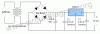
If you must have an external supply, you would be better off building one from scratch. A 120v to 16v transformer (~$3/more), bridge rectifier ($1/less), 470uf/35v electrolytic cap ($.35), two .01uf bypass caps ($.10/both), and a LM7809 regulator ($.50) Plus the wires, switch, 2A fuse (not shown in schematic; needs to be at the AC input), and a box (bet you could scrape all of that peripheral stuff together from junk). Or buy a fully regulated supply.
Sure wouldn't trust a wall-wart unless it had all of the above in it . . .
 

Attachments

  • 9v-power-supply-using-lm7809.GIF
    9v-power-supply-using-lm7809.GIF
    9.1 KB · Views: 46
Last edited:
  • Like
Reactions: 1 person
I doubt that even 470 uF is enough filtering for something like a microphone. My big question is what is wrong with using a battery? It will last a year or longer likely if you use an alkaline type. Cheap and convenient.
 
  • Like
Reactions: 1 person
I doubt that even 470 uF is enough filtering for something like a microphone. My big question is what is wrong with using a battery? It will last a year or longer likely if you use an alkaline type. Cheap and convenient.

Yup; I used 4700uf for the ripple filter cap on a +5v PS I recently built for the Rb clock. Also used a 2.2uf/35v tantalum at the output. This schematic didn't show the switch or even - more important - the fuse. But it did make for a reference that could be used for building a floating/ungrounded output PS.
 
Do you have a 12 volt power supply at your desk powering your radio? Might try a 9 volt regulator and see if it's noise free. The mic doesn't draw much current so you might get away without mounting the regulator on a heat sink. Maybe even tap into a 12 volt source in the radio if you have a base rig. Put the regulator in the radio and mount a 9v power jack on the back for a clean install. It was already mentioned but don't forget to use a fuse.
 
When I need to do this, I take a trip to the GoodWill and go through their box of wall warts. Specifically looking for a 9 VDC unit that has very little weight and will most likely be a switching type supply. These will be precisely regulated and free from hum. About 1 in 10 may produce some noise in your receiver but these supplies are so small they usually don't tear the receiver up with interference. The last issue is RF feedback through the DC wire. Bypass that with chokes and .01 caps to remove any squeal.

PS: The 3 terminal regulator is a near cure all fix for hum and RF feedback in amplified mics. The trick is the regulator should be placed inside the mic because it also has the ability to clean up RFI that may be picked up on the DC wire. If the rig has an extra unused pin in the mic jack, I'll often use this to feed the mic. Supply 12 volts to the unused pin through a 220 or 330 ohm 1 watt resistor so if the pin gets shorted the current will be limited to a safe level. Put the LM7809 regulator in the mic with a choke and .01 cap on the input terminal.
 
it's not that there anything wrong with using a battery, but I have 3 different mics and so I have batteries just sitting in the 2 mics that aren't being used, slowly dwindling away not being used. I was browsing the cb section of ebay and came across the astatic emk-1 and thought to myself that if I put a connector inside each mic I could just plug unplug each mic as needed.
since astatic put one out, I figured it should be easy enough.

unfortunately the one I have is heavier so I expect it's a transformer and will hum as many of you have experienced.

I do run a mobile radio off a computer 300W power supply for now, so I'll look into 543's suggestion, but will take shockwave's idea to stop by my local salvation army. the wall adapter would be easier than a whole ATX supply just for the microphone for when I (finally) get one of my base radios recapped.
robbs Idea of building my own is interesting, but I'm more likely to stick to batteries.
thanks for the inputs.

 
it's not that there anything wrong with using a battery, but I have 3 different mics and so I have batteries just sitting in the 2 mics that aren't being used, slowly dwindling away not being used. I was browsing the cb section of ebay and came across the astatic emk-1 and thought to myself that if I put a connector inside each mic I could just plug unplug each mic as needed.
since astatic put one out, I figured it should be easy enough.

unfortunately the one I have is heavier so I expect it's a transformer and will hum as many of you have experienced.

I do run a mobile radio off a computer 300W power supply for now, so I'll look into 543's suggestion, but will take shockwave's idea to stop by my local salvation army. the wall adapter would be easier than a whole ATX supply just for the microphone for when I (finally) get one of my base radios recapped.
robbs Idea of building my own is interesting, but I'm more likely to stick to batteries.
thanks for the inputs.

I was talking about using one of these with your current supply or the supply in your radio. NTE1966 - Integrated Circuit-Voltage Regulator 9V TO220 ISO : Voltage Regulators | RadioShack.com

One leg gets grounded, 12 volts into one leg and 9 volts comes out the other. You can feed it with 11-35 volts and you will always have a regulated 9 volts out. The link I posted says online only buy if you go to the store you should be able to find another 9 volt regulator. The leg that gets grounded is usually common with the tab on the back of the regulator. If you bolt or solder it to a grounded surface you're good to go.
 
My Icom IC-735 had 8 volts available right at the microphone jack. I rewired my desk microphone and had it powered directly from the radio thru the cable. No more batteries. Ever.
 
  • Like
Reactions: 1 person
I was talking about using one of these with your current supply or the supply in your radio. NTE1966 - Integrated Circuit-Voltage Regulator 9V TO220 ISO : Voltage Regulators | RadioShack.com

One leg gets grounded, 12 volts into one leg and 9 volts comes out the other. You can feed it with 11-35 volts and you will always have a regulated 9 volts out. The link I posted says online only buy if you go to the store you should be able to find another 9 volt regulator. The leg that gets grounded is usually common with the tab on the back of the regulator. If you bolt or solder it to a grounded surface you're good to go.

thanks, I was looking around and found quite a few different options so was going to ask you what you used.

my magnum had the voltage at the mic CK, but I messed that radio up so no point setting that up. none of my other radios have power at the plug.
 
thanks, I was looking around and found quite a few different options so was going to ask you what you used.

my magnum had the voltage at the mic CK, but I messed that radio up so no point setting that up. none of my other radios have power at the plug.

I haven't done this but it should give you a clean 9vdc supply. I was just throwing out ideas.
 

dxChat
Help Users
  • No one is chatting at the moment.
  • @ heartbreaker3473:
    Hello gentlemen and Ladies. I have the dreaded RCI-2990 receive issue where my radio gets distorted when people get close to my location. I found the C90 Capacitor, but I can not for the life of me find the C89 capacitor. Can or does anyone have a picture of the exact location of C89 ? Thank you in advance, Wes
  • @ AudioShockwav:
    Wes, it's better if you start a thread on the main forum, more people are going to see your question.
  • @ heartbreaker3473:
    Okay, sorry, will put in a forum
  • @ heartbreaker3473:
    I put it in the general disscution help area and started a new thread. Thank you for letting me know.