• You can now help support WorldwideDX when you shop on Amazon at no additional cost to you! Simply follow this Shop on Amazon link first and a portion of any purchase is sent to WorldwideDX to help with site costs.
  • A Winner has been selected for the 2025 Radioddity Cyber Monday giveaway! Click Here to see who won!

RCI 2950DX 6 - One issue at a time - this is a story with a question or two.....

Lkaskel

Well-Known Member
I Support WorldwideDX.com!
Aug 4, 2017
521
433
73
61
You know how discovery works? We have all had a radio with what we thought was one issue and then the discovery happens. So I had this radio come in for 2 things. The 1st was that it was over 100Hz off on transmit. The second was a complaint that the radio's TX audio tone was not amazing and wondered if there was something wrong or could be done. Now this radio was modded from a shop that adds a built-in amp to the factory setup so there are some minor differences including the fact that the finals had the part number removed for some reason. The drivers are RT1's. The frequency alignment was tricky because I could not get any adjustment out of VR8. I did find that the clarifier mod was at some point returned to stock but the diode (D63) was installed backwards. No big deal, I reversed the diode and VR8 was back in service. I was able to get the radio on frequency but I will admit that the audio did sound pinched or just off. My 1st thought was that the finals were some cheap E-**y parts so I started with replacing them with two ST IRF-520's I get from Digikey and then do a TX alignment (1st mistake). I should have just tried the TX alignment 1st. The issue (that is still current) is the voltage to TP8 is low on SSB at 9.5VDC with the front panel power knob at max and VR18 at max. Also, on AM it was at 2.7 VDC but I could adjust it to 6VDC per the alignment guide. This is where I should have just gone to bed as it was already late but I was locked in. Did I do something? Was the reversed diode a greater problem than I realized? I decided to remove the shield of the amp and saw that the FET's all had thier part numbers removed as well. AH HA!!! The finals had the part numbers removed from the amp guy as well. I don't know why he did that but no big deal. That was enough for me to call it a night.

I do some Saturday AM routines (chores) and just sat at the bench. At this point the IRF 520's are still in the radio and I can deal with that later. I went through the TX alignment again and sure enough the voltage at TP8 is low on SSB at 9.5VDC. The radio has 13.97VDC in. Q66 has a little above 13 volts on the outer pins and the center pin does change when you adjust the power knob.

2 quesions at this point.
- What would you guess the part number of the finals are? I was thinking maybe RT6's.
- What would cause low voltage through Q66? Could it or Q65 be bad even though they adjust the voltage as designed?

Thanks for reading my story!!! I'll be sure to finish it when I know more.
 
  • Like
Reactions: Shadetree Mechanic

Q67 can be bad which drives the modulator Q66.
a known problem in these. I did this repair on a 2995.

I have a 2970N4 here with a blown external amp
to play with. "015" main board is now working.

yes, "pinched audio" in transmit I was told,
bad in SSB and AM.
I tested the stock mic and others on my computer.
recorded in Audacity. sounded pinched.

Maybe I can get some voltage readings around Q67
for you, to save some effort.

but gotta make a "beer run" now, get some Lotto tickets.
 
OK, got Lotto tickets. a little bottle of Jack Daniels.
(gonna be cold down here again tonight!)

on this 2970N4 here,
in AM mode, mic all the way down, key up, and turn the
power control down for 3 volts at the shorting board T.P. 7/8/9.
and looking from the front of the radio at transistor Q67
you got B C E left to right.
at B 11.7 V at C 3 V at E 12.3 V

the V to look at is the V at E should be .6 to .7 V greater than V at B

if not, then a problem.

and while you are at it. I had trouble with the bias circuit to
RF driver Q62 on some radios. a missing resistor.
(I only have worked on a few so far)
so test it. put in LSB mode, MIC down off,
pull out shorting board, key up and note V at the banded end
of D93. note the voltage, then turn VR13 back and fourth
and note the voltage change. then turn back to the origional
voltage reading if you can.
 
OK, got Lotto tickets. a little bottle of Jack Daniels.
(gonna be cold down here again tonight!)

on this 2970N4 here,
in AM mode, mic all the way down, key up, and turn the
power control down for 3 volts at the shorting board T.P. 7/8/9.
and looking from the front of the radio at transistor Q67
you got B C E left to right.
at B 11.7 V at C 3 V at E 12.3 V

the V to look at is the V at E should be .6 to .7 V greater than V at B

if not, then a problem.

and while you are at it. I had trouble with the bias circuit to
RF driver Q62 on some radios. a missing resistor.
(I only have worked on a few so far)
so test it. put in LSB mode, MIC down off,
pull out shorting board, key up and note V at the banded end
of D93. note the voltage, then turn VR13 back and fourth
and note the voltage change. then turn back to the origional
voltage reading if you can.
Happy Holidays Bayou!!
Sorry for the delay as I was out of town for a bit. So I just sat at the bench and did the test as you suggested and I get 12.5 at the base and 12.6 at the Emitter with 3 volts at TP8 and at the collector. I am assuming that Q67 may be bad?

Also, I see Q67 as a 2SB798 (DL). After a quick search I do not see a great source for these. Would anyone have a source that they could let me in on?

Thanks!!
 
Last edited:
hello there Larry!

yes looks like Q67 is bad. I think Nomad was thinking of a kit to
sell for that area. both transistors. Q66 n Q67.

but I repaired a 2995 with this problem and just soldered in an
old PNP audio transistor, with some good long leads.
just takes some soldering skills, remove that bad transistor
and reach on down and make solder blobs on the circuit
board. flux the new transistor leads, hold it carefully and solder it
down in place. get one lead soldered in first, then the other two are
easy.

so not sure your skill level, and what parts you got laying around.
I got parts all over. Astron power supplies. transformers.

I will see what I used here, since I am currently organizing
my good "stash of junk"
 
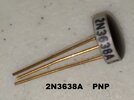
just took a pix. I used one of these old transistors from
my stash, a 2N3638A for Q67 in a 2995.

but any little audio PNP transistor should work.
a 2N3906A type is common.

2N3638A.jpg
.
It's good to have a stash of some 2N3906, 2N3904, 2N2222
2N3053 (NTE128), MPF102, 2N3055, 2N3772 around.
To repair or build most anything.
years ago at Radio Shack I would buy them bubble packs
of transistors -"2N2222 type" and "2N3906 type"
 
  • Like
Reactions: Cable Guy
but any little audio PNP transistor should work.
Yeah, pretty much. The challenge is to solder it in a stable way to the surface-mount foil traces.

This is the kit mentioned above. Comes with a fuse block and fuse to prevent similar tragedy when MOSFET finals take their periodic dumps. The larger type used to replace Q67 should be harder to hammer if the same thing happens down the line.

https://www.ebay.com/itm/1164314196...pid=5336136228&customid=&toolid=10001&mkevt=1

Thanks for mentioning it. The listing had somehow expired and was *NOT* posted for sale until just now. Had not noticed.

Oops.

Now it is. More than one way to skin a cat, but this kit saves us labor, and the fuse saves grief later on down the line.

73
 
  • Like
Reactions: Shadetree Mechanic
OK, there is the kit. it makes it easier to deal with this
Q67 transistor problem. A good idea!

and that kit will work on them other RCI/Galaxy/Connex/Anytone/Stryker
radios with that series modulator/regulator circuit.

Nomad, you should rename that kit of yours to mention this.
You will just have to add some different advise and instructions.

Increase your sales! $$$$$$$$$$$$$$$$$$$$$$$$$$
 
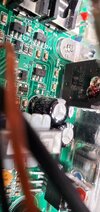
Thanks so much men!! Theboard in this radio is a 295016A. Q67 is in a diferent location but I assume the process is still the same.

Oh, and do either of you have a guess as to what the final FET part number is in this radio?

Thanks again!
 

Attachments

  • 20241228_112854.jpg
    20241228_112854.jpg
    1.2 MB · Views: 7

dxChat
Help Users
  • No one is chatting at the moment.