• You can now help support WorldwideDX when you shop on Amazon at no additional cost to you! Simply follow this Shop on Amazon link first and a portion of any purchase is sent to WorldwideDX to help with site costs.
  • A Winner has been selected for the 2025 Radioddity Cyber Monday giveaway! Click Here to see who won!

And now for something completely stupid. The Tweety Bird noise toy.

nomadradio

Analog Retentive
I Support WorldwideDX.com!
Apr 3, 2005
8,379
13,924
698
Louisville, KY
www.nomadradio.com
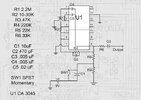
Now and again day-to-day life just drives me to do something stupid, if only for the sake of variety. This is a chore I have procrastinated for ten or fifteen years, maybe more. I'll guess that this wiring diagram for the traditional analog "Tweety Bird" noise toy has made the rounds over the last few decades. The CA3046 chip shown has been discontinued for a while. It's the most primitive integrated circuit you'll find. Only contains five NPN transistors. That's all. Two of them are connected together at the emitter, called a differential pair. I'm pretty sure this wiring diagram is correct. A guy who worked for me decades ago built a batch of them from this graphic and they worked. But it annoyed me that it isn't a proper schematic. Doesn't show me what's really going on.

images

Tweety Bird.JPG


That irresistible urge to do something stupid took over and I translated it into a proper schematic diagram.

Tweety.jpg

Maybe. And that's my reason for posting it today. Free proofreaders. If you find an error, I'd be grateful to see what it is. My patience has been consumed, and I refuse to look at it any more for a while.

Yeah, I have a batch of this chip. Might just do something stupid like make some of these. But only if I think they'll sell.

73
 

Attachments

Last edited:

I got bored and put it into CircuitLab. Everything to the left of the mouse cursor is the circuit posted above using discrete transistors (and a 100k output resistor to keep the simulation output clean).
Screenshot from 2025-07-28 03-41-22.png
Everything to the right of the cursor is an astable 555 with a low frequency and small duty cycle to produce a short pulse to the relay to simulate a button press. The bottom mosfet and associated RC keeps the relay off for a moment so the simulation can start before the button is pressed. The moment the switch (relay) is released, the capacitor across it begins to charge back up and that drops the voltage supplying the oscillator as it fizzles out.
1753692593759.png
Zooming in on the oscillation, it looks like
1753692695854.png
1753692736208.png
I have no idea if this is how the circuit actually behaves in real life, but I am tempted to put one together and find out. Just not tonight. If anyone wants a different point probed and the sim re-run, I can do that tomorrow at work.
 
Thanks for posting that, Nomad. Not sure I've ever actually heard that particular effect on the air but at least now if I do I'll know what's making it.
 
Thanks for posting that, Nomad. Not sure I've ever actually heard that particular effect on the air but at least now if I do I'll know what's making it.
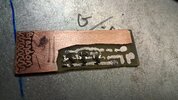
here is my tweety bird key up and noisemaker with echo turned on,,, i have had this closw to 30 years now,,, whoever made it did it dead bug style and shrink wrapped it,,
 
  • Like
Reactions: AudioShockwav
I could have done something wrong in the sim. Its not expensive software either, just an online sim with a cheap subscription. I should have just tossed one together to test it.
 
  • Like
Reactions: AudioShockwav
Finally got a wild hair to lay out this toy. Here's the first approximation. Green traces are on top, red on the bottom. I only use two-sided pc boards.

8lBuEJ.jpg


If someone finds an error here, please speak up. Probably won't try to order this one right away.

73
 
  • Like
Reactions: AudioShockwav

dxChat
Help Users
  • No one is chatting at the moment.