

You are using an out of date browser. It may not display this or other websites correctly.
You should upgrade or use an alternative browser.
You should upgrade or use an alternative browser.
-
You can now help support WorldwideDX when you shop on Amazon at no additional cost to you! Simply follow this Shop on Amazon link first and a portion of any purchase is sent to WorldwideDX to help with site costs.
-
The Winners of the three Retevis radios 16 Anniversary giveaway are announced!! Click Here to find out if you won!
Lightning L6 matching
- Thread starter Jim5570091
- Start date
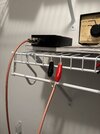
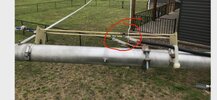

Should I unhook my feed lines from the antenna to test with an analyzer? I have a quarter wave @27.205 length of coax connected to the analyzer with clips for connecting to the boom and tuning stubs
Should I remove both the feed lines to test for 50ohm match on the tuning stubs?
Do I remove only the side I’m hooking the analyzer to?
Do I remove only the side I’m hooking the analyzer to?
I get the question now...didn't know it had separate feeds.Should I remove both the feed lines to test for 50ohm match on the tuning stubs?
Do I remove only the side I’m hooking the analyzer to?
The question is where is the polarization switch located? Relay??

Inside. Separate coaxes feed into the building.where is the polarization switch located
73
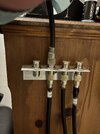

I emailed the owner designer of the L6. And the manual says the same thing. Leave both feed lines connected. But I think that’s is for tuning for lowest SWR in the shack. We know from many post here and other formats that you either connect the analyzer directly to feed point or a 1/4 wave jumper. I’m thinking of if I clip my analyzer directly to the feed point I’ll be measuring results of antenna + Coax. It just don’t sound right. I would think I should disconnect both feed lines and connect my analyzer to the tuning stubs. But this antenna is a very unique bread of antenna.


The side not being tuned needs to be how it would be in normal operation. This means if the side not being driven (tuned) has 20 feet of coax running to the "switch" panel, and that coax is unterminated when not in use, then that's exactly how it needs to be when you tune the other side.
When George said to keep them both connected, I think he assumed you would be connecting your analyzer at the shack end of each of those cables.
If you are tuning by SWR alone, this should work ok, but if you are measuring the feed point impedance, then you want to OSL calibrate to the end of those aligator clips. The ideal length for a VNA test cable is 1/2λ, not 1/4λ. I would recommend the OSL calibration anyhow.
If you ever change to a real coax switch, you may need to redo this tuning process because most coax switches short the unselected port (which is opposite to what you have now with the unused coax being open) and could significantly affect the tuning.
When George said to keep them both connected, I think he assumed you would be connecting your analyzer at the shack end of each of those cables.
If you are tuning by SWR alone, this should work ok, but if you are measuring the feed point impedance, then you want to OSL calibrate to the end of those aligator clips. The ideal length for a VNA test cable is 1/2λ, not 1/4λ. I would recommend the OSL calibration anyhow.
If you ever change to a real coax switch, you may need to redo this tuning process because most coax switches short the unselected port (which is opposite to what you have now with the unused coax being open) and could significantly affect the tuning.
I've seen that antenna over the years and I would be stumped to.
In fact how does the dual polarity work? Interesting.
Let us know how well it works on the air.
In fact how does the dual polarity work? Interesting.
Let us know how well it works on the air.
I've been wondering that too. I looked at the assembly instructions, and it looks like what would be a full wave loop driven at the corners is not. The wire eyelets go on the same post (corners connected, not a split feed point) with that corner driven against ground.In fact how does the dual polarity work?
So then what kind of driven is it if not a full wave loop? An end-fed half-wave (wire frame) like having a single fat dipole? And would the termination on the unused coax affect it much?
Interesting for sure.
Last edited:
Two of them in parallel, best I can tell. The driven element is an unbroken full-wave loop. We used a coax switch that grounded the unused coax of a 4-element antenna built on this model. Didn't seem to affect the match on the coax in use. Never could wrap my mind around that.An end-fed half-wave (wire
73
dxChat