

Got a request from a customer. Wants a how-to for the diode swing mod applied to a RCI2995DX. The surface-mount main circuit board has the same basic circuits as the older 2950/70/90 radios, just laid out differently.
The bill of materials is:
1) 1N4148 small signal diode. There are any number of equivalent parts, but this is the generic number most often used.
1) 10uf 50 Volt radial-lead electrolytic cap.
1) 5.6k 1/4 Watt resistor. Anything down to 4.7k probably works the same.
1) 1 Meg 1/4 Watt resistor.
First step is to remove R290. It's not marked with a callout. The two shiny solder blobs just to the right of VR15 show where it used to be.
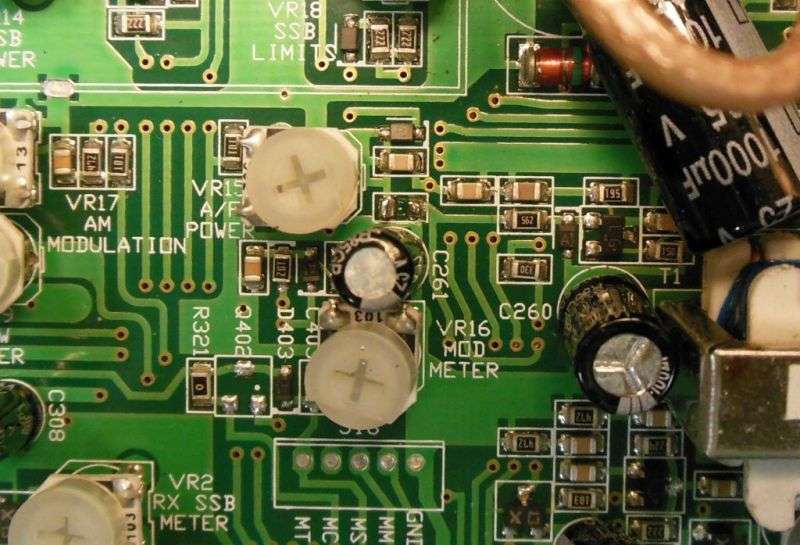
This would remove all AM carrier if we left it like this.
Next remove C260. It's a 100uf 25 Volt radial cap butted up alongside T1. Remove the solder from the positive solder pad. Don't bother with the negative side. It's a ground foil with too much surface area. Not worth the effort. No I didn't take a separate pic of that. C260 is visible at the right side of the pic above.
The rest of the action occurs on the solder side of the pcb. First, scratch all the green resist paint off of the foil trace that has two resistors lap-soldered to it. No, I didn't keep a separate pic of that step, either.
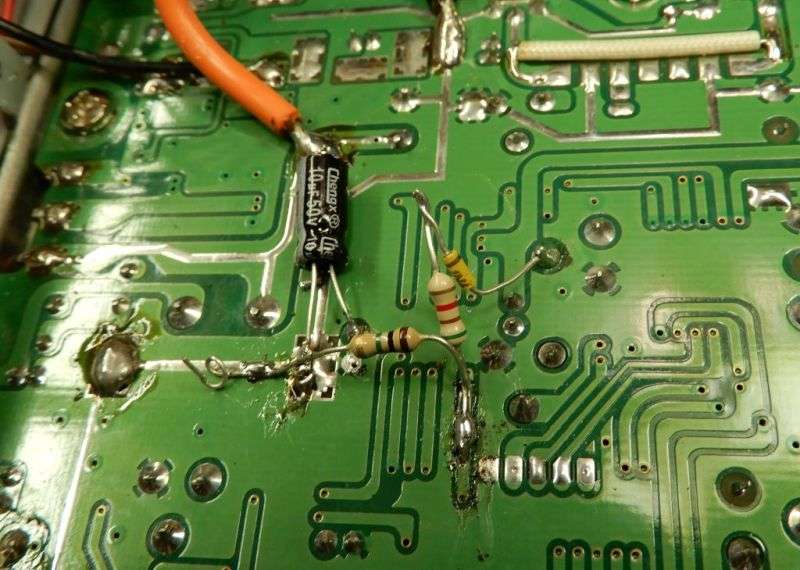
This pic is a little busy. The anode end of the diode solders to the center pin (wiper) of VR15. The cathode gets a flying lap-splice to the resistor. The one in this pic is 5.1k, not 5.6. Not critical. The other end of the resistor goes to the foil trace that got scraped.
This replaces R260 with the series pair of the diode and new resistor.
The 10uf cap gets its positive lead into the now-empty pad where the old R260's positive lead was removed. Lap the negative lead onto exposed solder on the adjacent ground foil. It's not pretty, but works.
The 1 Meg resistor gets one lead onto the foil trace where the new resistor was lap-soldered. The other end of the 1 Meg goes to ground.
And there you have it. Unless turning up the AMC trimpot VR17 fails to provide enough modulation.
It might turn up enough to suit you. If not, the AMC transistor Q68 can be removed. This will allow the sideband ALC and the built-in compression circuits to still function normally. It will disable the AM limiter only. I don't recommend pulling limiters, but customers want what they want. You don't succeed by telling them they can't have what they want.
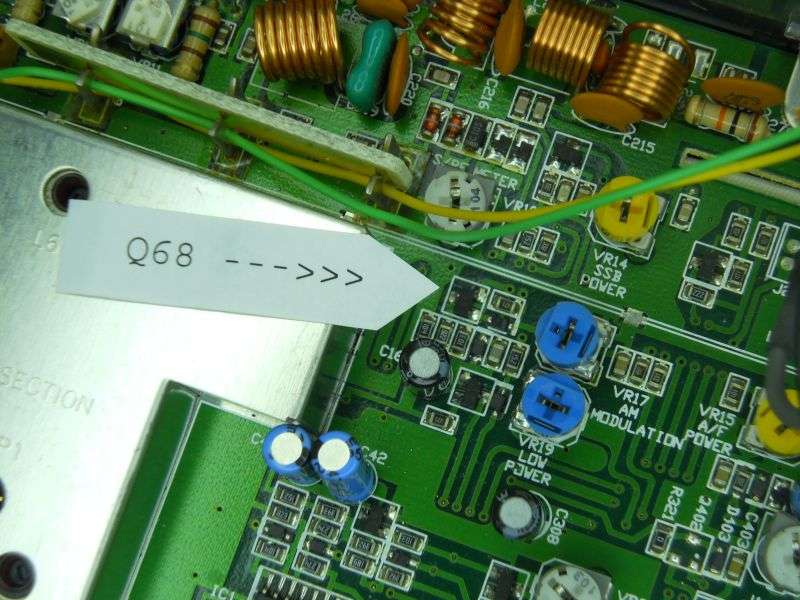
That's the procedure. It will permit the same peak modulated power at low carrier levels as seen with a high carrier setting. Your mileage may vary.
73
The bill of materials is:
1) 1N4148 small signal diode. There are any number of equivalent parts, but this is the generic number most often used.
1) 10uf 50 Volt radial-lead electrolytic cap.
1) 5.6k 1/4 Watt resistor. Anything down to 4.7k probably works the same.
1) 1 Meg 1/4 Watt resistor.
First step is to remove R290. It's not marked with a callout. The two shiny solder blobs just to the right of VR15 show where it used to be.
This would remove all AM carrier if we left it like this.
Next remove C260. It's a 100uf 25 Volt radial cap butted up alongside T1. Remove the solder from the positive solder pad. Don't bother with the negative side. It's a ground foil with too much surface area. Not worth the effort. No I didn't take a separate pic of that. C260 is visible at the right side of the pic above.
The rest of the action occurs on the solder side of the pcb. First, scratch all the green resist paint off of the foil trace that has two resistors lap-soldered to it. No, I didn't keep a separate pic of that step, either.
This pic is a little busy. The anode end of the diode solders to the center pin (wiper) of VR15. The cathode gets a flying lap-splice to the resistor. The one in this pic is 5.1k, not 5.6. Not critical. The other end of the resistor goes to the foil trace that got scraped.
This replaces R260 with the series pair of the diode and new resistor.
The 10uf cap gets its positive lead into the now-empty pad where the old R260's positive lead was removed. Lap the negative lead onto exposed solder on the adjacent ground foil. It's not pretty, but works.
The 1 Meg resistor gets one lead onto the foil trace where the new resistor was lap-soldered. The other end of the 1 Meg goes to ground.
And there you have it. Unless turning up the AMC trimpot VR17 fails to provide enough modulation.
It might turn up enough to suit you. If not, the AMC transistor Q68 can be removed. This will allow the sideband ALC and the built-in compression circuits to still function normally. It will disable the AM limiter only. I don't recommend pulling limiters, but customers want what they want. You don't succeed by telling them they can't have what they want.
That's the procedure. It will permit the same peak modulated power at low carrier levels as seen with a high carrier setting. Your mileage may vary.
73

