• You can now help support WorldwideDX when you shop on Amazon at no additional cost to you! Simply follow this Shop on Amazon link first and a portion of any purchase is sent to WorldwideDX to help with site costs.
  • A Winner has been selected for the 2025 Radioddity Cyber Monday giveaway! Click Here to see who won!

Carl Built 400hd ssb

So here's a detail that reveals Carl has a clue.
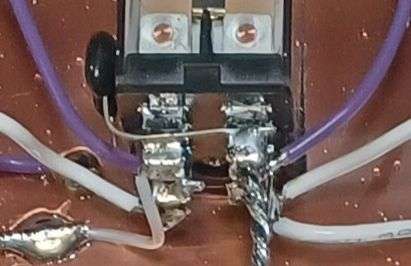
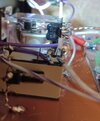
47E5bs.jpg


The small brown lump against the left side of the relay is a silver-mica cap. One side grounded, the other side connected to the relay's receive (standby) side.

When an amplifier is put in line with a radio, the radio's SWR reading should not go up. Should mimic a barrel connector, more or less. But on standby your signal is carried by several inches on NON-shielded wire, and another couple of inches traveling through the unshielded parts of the relay. This adds up to a "bump" in the system's SWR. Unshielded wire just won't have a 50-ohm impedance. The capacitor can't fully cancel out this quirk, but usually reduces it quite a bit. A look inside multi-kilobuck ham linears usually reveals this trick. Unless they use true coaxial relays and there is no unshielded wire in the signal's path.

Back in the 70s I had a customer who had bought a D&A Phantom and was annoyed by how it worked on standby. It drove the radio's SWR meter reading over 3 to 1. His antenna alone was around 1.1 to 1. Not only that, but the radio's barefoot carrier power dropped from 3.5 to about 2 Watts with the Phantom in line. He called the factory to gripe and they asked why was it in line if he wasn't using it? If you want to talk barefoot unhook it. And if you put it in line, turn it on.

Sounded simple, but he wasn't happy. I fixed it by bypassing the receiver preamp and adding that little cap. Was cheaper than a trip to Scottsbuff Nebraska.

73
 
So here's a detail that reveals Carl has a clue.
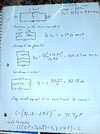
Lets give everyone that clue. Here's the math (because I can't find where I posted it last, maybe I didn't).

Anywhere from 1/4th to 3/4ths along the inductive path, the proper cap to ground will provide a significant improvement according to simsmith. If the resistive portions are equal looking both ways and the cap is dead center of that inductive path (which isn't always at the relay), it can provide a perfect match, but close is close enough here. Should be able to get 1.3 or better by placing the appropriate cap within the middle 50% of that inductive path. Heres the math:
relay cap.jpg
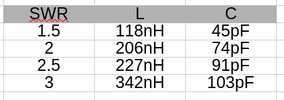
And just for fun, lets assume the resistive portion is a perfect 50ohm on both sides of the cap, this lets us calculate the inductance of the path using the SWR (chart @ 27MHz).
Screenshot from 2025-11-17 03-05-43.png
 
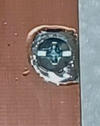
Another detail suggesting he has a clue is here
Screenshot from 2025-11-17 03-41-22.png
Zinc plated screw and copper are deep in the red of a galvanic incompatibility chart. Zinc and lead/tin are in the red too, but not as deep as with copper. Combined with the deformability of the solder, better contact can be made which might also keep oxygen out from between them longer.
 
thank you for drawing that up Brandon!

Where did you get "Ltotal" value from?
was it just a random guess to use for the example?

now we need to see what value cap Carl put in there!
LC
 
Yea, I just grabbed a random value that puts the SWR around 2. Its about 24nH per inch of wire I believe.
 
As for the swr, on 27.205 the radio is a flat 1.0 to1 and with the amp it's 1.3 to 1.

Edit: So I checked higher up, on 405 and my radio is at 1.2 to 1 but with the amp it's still 1.3 to 1
 
Last edited:
  • Like
Reactions: brandon7861
24pF? Thats all???? I wonder what the pass through SWR is with that cap unhooked. Makes me wonder if there is some parasitic capacitance involved. Maybe nomad can tell us what caps are commonly used here. I'd sure like to know. I need to dig out an amp and play around when I get the time.

edit: i might play with simsmith tonight to see what happens to the ideal cap value if the cap is not in the center of the inductive path.
 
what caps are commonly used here.
I use a 33pf on the Pride DX300 relay circuit board we sell. And that was a trial-and-error choice for best result. The factory used a "L" network on the antenna socket, with maybe 4-500 nH between the relay and the antenna socket, and 110pf to ground on the center pin of the antenna socket. Stretching/squeezing the coil could get you down to the same 1:1 as a direct connection to the dummy load. It's a mechanically iffy thing, and I remove it. The 33pf disc cap seems to compensate well enough in that application, soldered to the foil side of the pcb. I have seen a ceramic trimmer cap used for this. Can't remember the brand/model where I saw it. Could have been a 1980s Alpha ETO model, maybe.

73
 
I use a 33pf on the Pride DX300 relay circuit board we sell. And that was a trial-and-error choice for best result. The factory used a "L" network on the antenna socket, with maybe 4-500 nH between the relay and the antenna socket, and 110pf to ground on the center pin of the antenna socket. Stretching/squeezing the coil could get you down to the same 1:1 as a direct connection to the dummy load. It's a mechanically iffy thing, and I remove it. The 33pf disc cap seems to compensate well enough in that application, soldered to the foil side of the pcb. I have seen a ceramic trimmer cap used for this. Can't remember the brand/model where I saw it. Could have been a 1980s Alpha ETO model, maybe.

73
Interesting. So what am I missing then? Parasitics, not just the added inductance from the length of wire and relay contacts? The inductance values I put in my chart did seem high, but I couldn't justify the usual 2-3 SWR at 50ohm without using that much inductance. So my math, although theoretically good, neglects other important variables, and the real answer is to use trial and error (because it is easy enough) or put a dummy load on the amps ant jack and use a VNA to read the passthrough impedance.

This is one of my shortcomings, I get the math and theory, but a lack of real-world experience leads me to overlook some important aspects. Now I wanna see an actual R+jX of a passthrough relay as it would seem its me that doesn't have a clue lol! Thanks Nomad, I'm learning stuff today :) Now to dig through the shed and find a test subject.
 
ok, I concede, this isn't as easy as I thought.

I took the cover off my relay and removed the contact divider and wedged a piece of paper between the contacts so I could measure the capacitance to ground on both sides with the relay open/open. 28pF on one side, 33pF on the other.

The next thing I did was remove the paper, desolder the ant jack, and short its lead to ground to get a total inductance looking into the radio port. I measured 1.44+j81.5.

Here's where things fell apart.

I have a total inductance and a total capacitance, but the way these are distributed makes a big difference. Looking at the trace routing in this thing, I feel this is a job for Altium lol. If I go simple, split the inductance in half and put all of the capacitance in the middle, the simsmith marker lands in the general area of where my VNA did when I looked into "xmtr" with a dummy load on "ant". Simsmith reading 83+j34 vs the VNA saying 72+j20. Should I average that s#!t? lol Anyhow, when I put more capacitance to ground in the middle, things look much better. For this circuit, adding 53pF to the middle provided a great match as drawn in simsmith, 33pF did OK as well.

At the end of the day, the only place the cap can go is at the relay because anywhere else will interfere with the TX match, so yea, trial and error is by far the easiest. Get it good enough and quit. There you go, made an ass of myself again coming off like this was an easy problem, its not.

I am going to continue to think about this, and if I find a measure-and-install method, I will report back. I feel like I need to connect the VNA to the relay with dummy loads on both ports, convert to parallel equivalent, match reactance, or something like that. Another day perhaps...
 
Last edited:
connect the VNA to the relay with dummy
First job I ever had repairing radios I worked for a guy who knew everything I didn't. Mostly. After a particularly baffling fault got fixed I asked out loud "why did it do that?". The boss said "Sherlock Holmes stuff doesn't pay the bills. Don't worry about it and move on to the next one".

In the decades since I have taken the attitude that if you see a particular fault once, you'll see it again if you live long enough. Making sense of it will keep you from re-inventing the wheel next time it pops up. The boss was right decades ago, but only partly right.

I'll be curious to see what you can learn, but don't hold your breath waiting for me to do it. My VNA will be busy testing salvaged discontinued IF transformers.

73
 

dxChat
Help Users
  • No one is chatting at the moment.