• You can now help support WorldwideDX when you shop on Amazon at no additional cost to you! Simply follow this Shop on Amazon link first and a portion of any purchase is sent to WorldwideDX to help with site costs.

Built a free tool that diagnoses SWR problems from two numbers

cbradiohq

New Member
Aug 7, 2026
5
4
3
41
Got tired of seeing the same "my SWR is high, what's wrong" threads with 15 replies of guesswork, so I built something that actually gives a straight answer.

You plug in your Channel 1 and Channel 40 SWR readings, and it tells you exactly what's going on — antenna too long, too short, or a grounding fault — plus what to actually do about it. No account, no app, just numbers in, diagnosis out.

[SWR Doctor →] (https://cbradiohq.com/#swrlink)

Built it because I was tired of chasing that answer down manually every time, figured other people probably were too. Free, no catch. Let me know if it nails the diagnosis or if you run into an edge case it doesn't handle — still refining it.
 

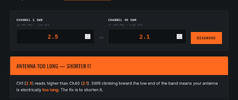
1786125665743.png
The SWR readings I entered suggest resonance is closer to ch40 than ch1 which would mean the antenna is too short, not too long. Antennas get shorter with higher frequency so this is 100% backwards. Shortening an antenna will raise its resonant frequency, not lower it.
 
I was trying to keep it simple, but yea, I used the term resonance incorrectly. "Resonance", as we all know, is a lack of reactance (resistance only) and has nothing to do with what resistance (or SWR) that point occurs at. The best SWR often occurs where jX is not zero. I used the term resonance incorrectly and I thank you for pointing that out.

I also wanted to add that not all antenna SWR plots are nice parabolas. Sometimes variables like ground planes, matching networks, mismatches and common-mode currents can all cause reflections and waves to superimpose. The SWR plot can be wavy which would entirely invalidate a tool like this that is based on just two readings.
 
  • Like
Reactions: Crawdad
Just remembering that the higher the frequency, the shorter the wavelength, the shorter the radiating element, tells one all the info that's needed. Especially if all one is tuning for is SWR.
 
View attachment 77541
The SWR readings I entered suggest resonance is closer to ch40 than ch1 which would mean the antenna is too short, not too long. Antennas get shorter with higher frequency so this is 100% backwards. Shortening an antenna will raise its resonant frequency, not lower it.
Hey, thanks for catching this and taking the time to write it up.

You're right — the tool had the too-short/too-long logic inverted. Ch1-higher should mean too short (lengthen), Ch40-higher should mean too long (shorten), since a shorter antenna resonates higher and ends up closer to resonance at the Ch40 end. That's fixed and pushed now.

Really appreciate the sharp eye — this is exactly the kind of feedback that makes the tool actually trustworthy. Let me know if you run into anything else.
 
  • Like
Reactions: brandon7861
I was trying to keep it simple, but yea, I used the term resonance incorrectly. "Resonance", as we all know, is a lack of reactance (resistance only) and has nothing to do with what resistance (or SWR) that point occurs at. The best SWR often occurs where jX is not zero. I used the term resonance incorrectly and I thank you for pointing that out.

I also wanted to add that not all antenna SWR plots are nice parabolas. Sometimes variables like ground planes, matching networks, mismatches and common-mode currents can all cause reflections and waves to superimpose. The SWR plot can be wavy which would entirely invalidate a tool like this that is based on just two readings.
Fair on both counts, and appreciated.

You're right on resonance — that's the zero-reactance point, not the SWR minimum, and conflating them was sloppy phrasing on my part. What the tool is really tracking is "which end of the band has lower reflected power," not resonance itself. I'll clean up the language.

And the second point is the more important one, honestly. The tool assumes a roughly monotonic slope across the band from a two-point sample, which holds for a typical vehicle whip with a decent ground plane, but you're right that ground plane irregularities, matching networks, or common-mode current on the shield can produce a non-monotonic or asymmetric curve where two points either miss the real picture or actively mislead. I don't want to ship something that gives confident wrong answers in those cases, so I'm going to add a caveat to the tool making that limitation explicit — and possibly a sanity-check prompt (e.g., check a mid-band point too) for anyone whose results seem to fight their setup.

Thanks for pushing on this — exactly the kind of scrutiny that makes it worth trusting.
 
Just remembering that the higher the frequency, the shorter the wavelength, the shorter the radiating element, tells one all the info that's needed. Especially if all one is tuning for is SWR.
That's a good way to boil it down, and it's really the whole trick — if you're just tuning for SWR and not chasing a textbook-perfect match, you don't need reactance or resonance in the vocabulary at all. Higher freq = shorter wavelength = shorter element needed, so if your reflected power skews toward the high end of the band, the antenna's electrically longer than it needs to be for that end, and vice versa. That's the whole diagnosis.

Good reminder not to over-engineer the explanation for something that's fundamentally that simple. Thanks again for the back-and-forth on this — it's sharpened the tool.
 
Quick update on the SWR Doctor tool for anyone following along: fixed a logic bug where the too-short/too-long diagnosis was backwards, thanks to a sharp catch from a forum member.

The short version of the fix, if you're tuning by SWR alone: higher frequency = shorter wavelength = shorter element needed. If your reflected power skews toward the high end of the band, the antenna's electrically longer than it needs to be for that end (shorten it), and vice versa. No need to overthink resonance or reactance for this — that's the whole diagnosis.

While I've got you all here — I'd genuinely like to know: what do you like about the site, and what falls flat or feels off? Building this out and want it to actually be useful for people who live and breathe this stuff, not just look nice.
 

dxChat
Help Users
  • No one is chatting at the moment.