

Here's the followup to the Mark 4A receiver crystal substitute mod.
The Browning Mark 3 receiver is an older dog than the Mark 4/4A. Does use a crystal for each tuneable band. The first version from 1970 had only one tuneable band and two fixed-crystal channels. The one and only band crystal was originally soldered directly to pin 2 of V3 and ground. This radio had already been converted to add a second and third tuneable band, channels above 23 at "XTL1" and lowers at "XTL2".
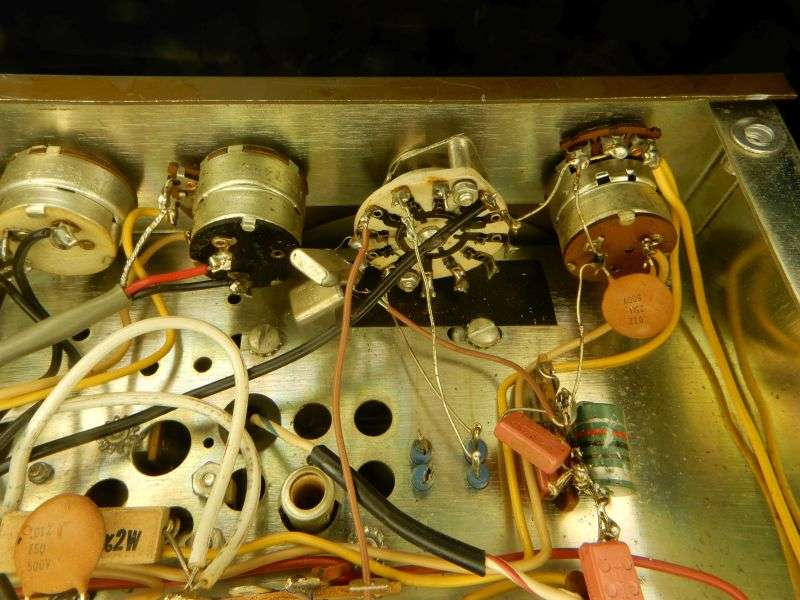
The original 31.4 MHz and 31.72 "HF" crystal are visible here. The 31.1 lower-channel crystal was plugged into one of the tiny blue socket contacts. The long brown wire reaches back to V3 pin 2.
And here's where it gets fiddly. The factory places two mica capacitors onto the band selector. This is to adjust the oscillator circuit's feeback level to suit a crystal or to suit the tuning coil/main tuning capacitor.
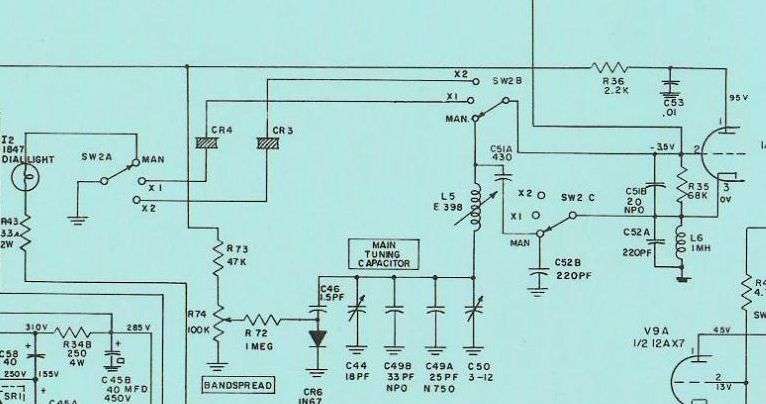
C51A and C2B get removed from the selector and soldered directly.
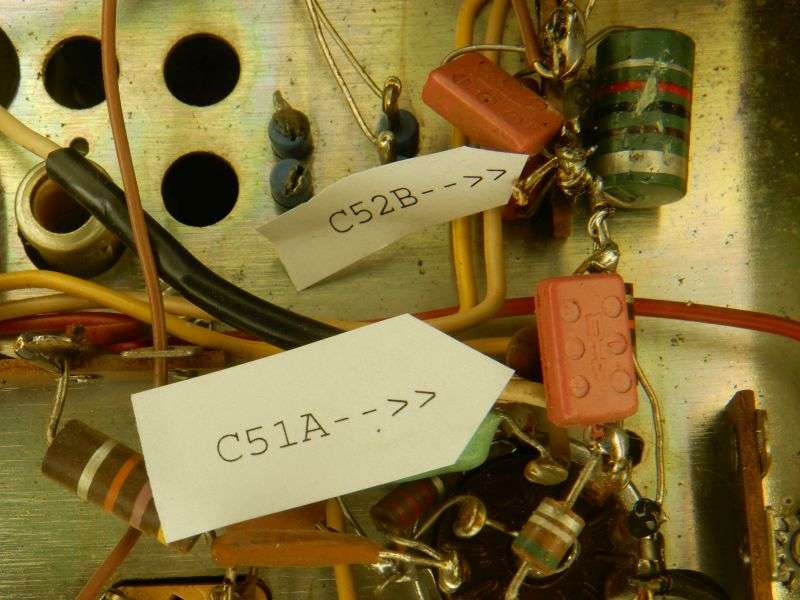
C52B is easy. Only one lead gets unsoldered from the selector. Its other lead is already grounded to the tie strip where it will move. C51A is another story. Might have to package a new 430pf mica cap with the kit if I try to market this trick.
Power for the module comes from pin 3 of V5, a 1N4001 diode feeding into a 1000uf 25 Volt cap. The module mounts in one of the vent holes with a flat washer top and bottom to take up the space around the mount screw.
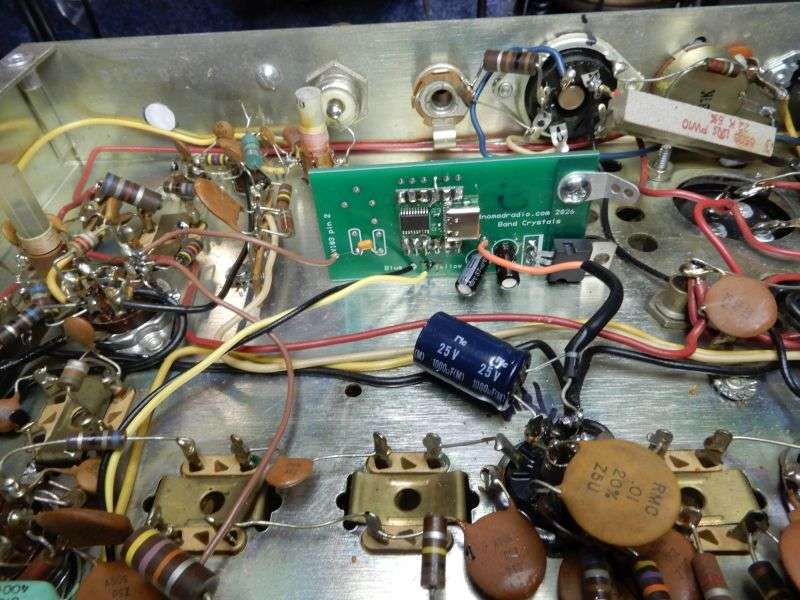

The long wire from V3 pin 2 to the selector gets removed from pin 2 and soldered to the adjacent ground lug. The output wire from the module now goes to pin 2.
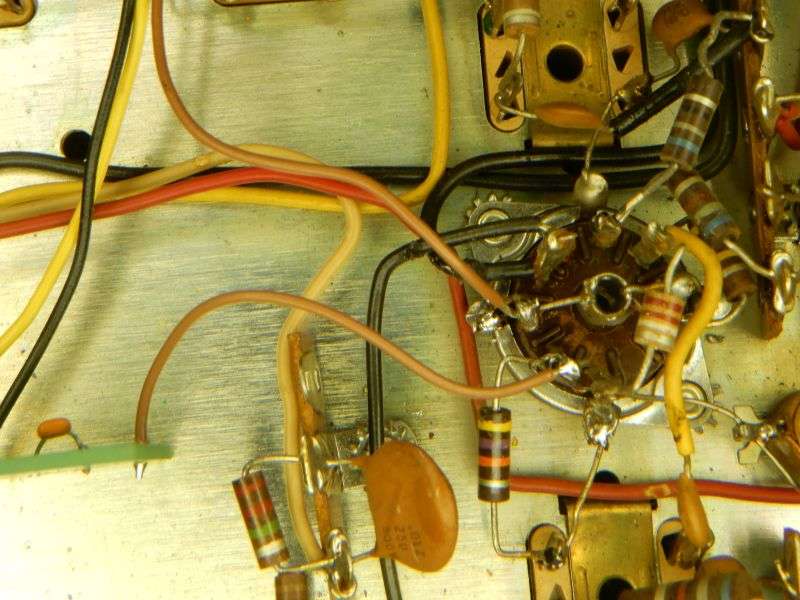
The selector wiring is now much simplified The long brown wire stays where it was. The lug for the "CB" position has no connection. The "XTL1" lug has the black wire connected to the pad marked "blue" on the module. Couldn't find the spool of blue. This selects the "HF" band above channel 27. The yellow wire is at the "XTL2" lug for lower channels.
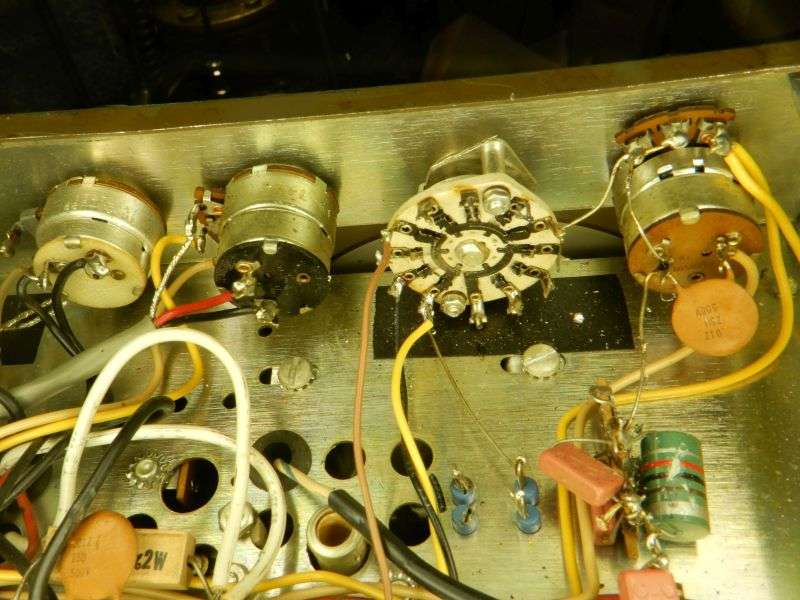
The one step I left out had already been done to this radio. Visible at the bottom of the "before" pic at the top showing the crystals is a white wire with a red stripe soldered to pin 2 of V4. It had been connected to the selector. And a white wire with a blue stripe comes down from upstairs, connected to L5, the manual tuning coil. It was also soldered to the selector. Those two wires get shortened, the ends stripped and lap-soldered together. This enables the tuning coil L5 full time.
Don't know how many readers are snoring away by now, but this is the process to eliminate the band crystals from a Mark 3 receiver. The later version had two tuneable bands, and only one crystal socket. Still mostly the same conversion.
No telling how long it will take to market this trick, but step one is to see it work. So far so good.
Now I'm having daydreams of finally making the Mark 3 and Mark 4 a serious sideband receiver. A second ProgRock module could be used to provide a STABLE receive carrier frequency for the sideband product detector. The factory circuit drifts like a rudderless boat. Stabilizing the "BFO" source might actually (finally?) make it a SSB receiver. Hmmm.
73
The Browning Mark 3 receiver is an older dog than the Mark 4/4A. Does use a crystal for each tuneable band. The first version from 1970 had only one tuneable band and two fixed-crystal channels. The one and only band crystal was originally soldered directly to pin 2 of V3 and ground. This radio had already been converted to add a second and third tuneable band, channels above 23 at "XTL1" and lowers at "XTL2".
The original 31.4 MHz and 31.72 "HF" crystal are visible here. The 31.1 lower-channel crystal was plugged into one of the tiny blue socket contacts. The long brown wire reaches back to V3 pin 2.
And here's where it gets fiddly. The factory places two mica capacitors onto the band selector. This is to adjust the oscillator circuit's feeback level to suit a crystal or to suit the tuning coil/main tuning capacitor.
C51A and C2B get removed from the selector and soldered directly.
C52B is easy. Only one lead gets unsoldered from the selector. Its other lead is already grounded to the tie strip where it will move. C51A is another story. Might have to package a new 430pf mica cap with the kit if I try to market this trick.
Power for the module comes from pin 3 of V5, a 1N4001 diode feeding into a 1000uf 25 Volt cap. The module mounts in one of the vent holes with a flat washer top and bottom to take up the space around the mount screw.
The long wire from V3 pin 2 to the selector gets removed from pin 2 and soldered to the adjacent ground lug. The output wire from the module now goes to pin 2.
The selector wiring is now much simplified The long brown wire stays where it was. The lug for the "CB" position has no connection. The "XTL1" lug has the black wire connected to the pad marked "blue" on the module. Couldn't find the spool of blue. This selects the "HF" band above channel 27. The yellow wire is at the "XTL2" lug for lower channels.
The one step I left out had already been done to this radio. Visible at the bottom of the "before" pic at the top showing the crystals is a white wire with a red stripe soldered to pin 2 of V4. It had been connected to the selector. And a white wire with a blue stripe comes down from upstairs, connected to L5, the manual tuning coil. It was also soldered to the selector. Those two wires get shortened, the ends stripped and lap-soldered together. This enables the tuning coil L5 full time.
Don't know how many readers are snoring away by now, but this is the process to eliminate the band crystals from a Mark 3 receiver. The later version had two tuneable bands, and only one crystal socket. Still mostly the same conversion.
No telling how long it will take to market this trick, but step one is to see it work. So far so good.
Now I'm having daydreams of finally making the Mark 3 and Mark 4 a serious sideband receiver. A second ProgRock module could be used to provide a STABLE receive carrier frequency for the sideband product detector. The factory circuit drifts like a rudderless boat. Stabilizing the "BFO" source might actually (finally?) make it a SSB receiver. Hmmm.
73
