• You can now help support WorldwideDX when you shop on Amazon at no additional cost to you! Simply follow this Shop on Amazon link first and a portion of any purchase is sent to WorldwideDX to help with site costs.
  • A Winner has been selected for the 2025 Radioddity Cyber Monday giveaway! Click Here to see who won!

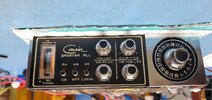
Courier Spartan PLL40 service info

Lkaskel

Well-Known Member
I Support WorldwideDX.com!
Aug 4, 2017
521
433
73
61
Hey Everyone,
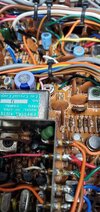
I have a Spartan PLL 40 on the bench for repair and alignment. I have searched hi and low for any info on it. The closest I have found is the Centurion PLL40. I am finding that it is not the same. For instance, in the PLL section the Spartan has 4 CT's and the Centurion has 3 CT's. The radio has issues so I am hoping for a more accurate schematic.
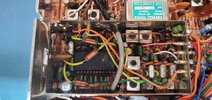
1747877554292.jpeg1747877590035.jpeg

Thanks as always!!!
 

It's a Uniden radio on the inside. The lack of LED channel digits suggests 1977. A circuit-board number might point to a competing brand that used the same innards and has the info online. Usually a three-digit number preceded by "PC".

73
 
The biggest clue here is there are two common ways and two uncommon ways to arrive at 27MHz using a 7.8MHz crystal filter.
Usually the SSB versions are subtractive ie , look at the 148/142/2000 GTL
Usually the AM versions are additive ie, trc52 et all.
 
Hey Everyone,
I have a Spartan PLL 40 on the bench for repair and alignment. I have searched hi and low for any info on it. The closest I have found is the Centurion PLL40. I am finding that it is not the same. For instance, in the PLL section the Spartan has 4 CT's and the Centurion has 3 CT's. The radio has issues so I am hoping for a more accurate schematic.

View attachment 72976View attachment 72977

Thanks as always!!!
Try Midland 79-893 SAMS CB-211
 
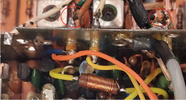
Here is the story. The op bought this radio new in the late 70's. It was used as a base for a few years and put back in the box. The op asked for me to go over it and align it but, it had some issues. It no longer transmitted or received. The first thing I did was test it out. The op was correct. No xmt or rcv. You can hear the relay clicking when you key the mic. I decided to check the alignment first. It was way out and I believe the PLL was not locked. Thanks to Dan M. I was able to get the correct alignment steps and once I got the PLL aligned it now transmits very well. It still does not have any receive so that will be next. This radio is a little different in how it was built. The PLL section is in its own shielded case and is connected to the rest of the radio with wires. Only the case itself is directly attached to the circuit board.
 
It's a Uniden radio on the inside. The lack of LED channel digits suggests 1977. A circuit-board number might point to a competing brand that used the same innards and has the info online. Usually a three-digit number preceded by "PC".

73
Hi Nomad,
The board is a PC-159AA

Thanks!!
 

Attachments

  • 20250522_222154.jpg
    20250522_222154.jpg
    1.1 MB · Views: 4
A couple of the wires on the PLL can passthroughs look pretty bad, especially the orange one. Could just be the picture, but it looks like some acidic flux had its way with those wires.

wires.png
 
Last edited:
If it transmits, this is probably a red herring. PLL trouble of most any kind tends to kill transmit.

First place to look is the ceramic filter in the 455 kHz IF. Take your manual digital analog signal injector and touch it to each of the two 'hot' solder pads under the filter. One is input, the other output. You should get raucous noises from the output pad, somewhat less by touching the input pad.

Oh, yeah. Your finger (digit) laying alongside the shaft of a tiny screwdriver. The tip becomes a signal injector, just from stray RF your body picks up from the surroundings.

If you get a good noise level this way, look for a 3-legged ceramic filter in the first IF stage. Don't have the schemo handy, but it might be a small brown ceramic piece, or might look like a metal crystal case with three legs.

If you get a good noise level from the input and output pads of that filter, the holdup is upstream from there.

And if the radio is dead under this test, looking downstream from the filter that doesn't respond is the next step.

73
 
If it transmits, this is probably a red herring. PLL trouble of most any kind tends to kill transmit.

First place to look is the ceramic filter in the 455 kHz IF. Take your manual digital analog signal injector and touch it to each of the two 'hot' solder pads under the filter. One is input, the other output. You should get raucous noises from the output pad, somewhat less by touching the input pad.

Oh, yeah. Your finger (digit) laying alongside the shaft of a tiny screwdriver. The tip becomes a signal injector, just from stray RF your body picks up from the surroundings.

If you get a good noise level this way, look for a 3-legged ceramic filter in the first IF stage. Don't have the schemo handy, but it might be a small brown ceramic piece, or might look like a metal crystal case with three legs.

If you get a good noise level from the input and output pads of that filter, the holdup is upstream from there.

And if the radio is dead under this test, looking downstream from the filter that doesn't respond is the next step.

73
So here is where I am right now. I have not had a lot of time the last few days because of work so I just left it on the bench turned on (let it bake for a while). This morning I went through the alignment again as a fresh start. The PLL alignment was close as I had done one a few days back. I then went to the transmit alignment and it went well as well. I did need to adjust CT2 and CT4 a very little bit to get it to be on frequency with my bench radio (Kenwood TS-430). I do believe that one main issue was that the PLL was unlocked when I received it. I then went to the receive alignment and I could not get much signal trough in AM so I aligned it in SSB. The receive alignment in SSB went VERY well but the truth is, it was WAY out and I gained a ton of signal as I aligned it. I went back to AM and the signal was still very low. You could almost not hear the tone. The signals on USB and LSB were great!! After some troubleshooting I checked the PLL alignment again and USB and LSB were still great. AM however was out of alignment. You are supposed to read 11.285 at the emitter of TR8 and now it is reading 11.2965 but is slightly adjustable with CT3. It was reading 11.285 earlier and I cannot figure out what happened or changed to get the now incorrect reading. I do believe that the lack of AM receive is because of this.

Any thoughts?


The alignment guide I used was for the Midland 79-893 radio and in most cases it was the same. There were a few differences so I created an alignment location guide for the Spartan. All of this can be found in the attached.
 

Attachments

When load capacitance goes down, frequency goes up. The trimmer may have failed open. Check by putting a 20pF cap across it and see it if goes below the target frequency. If it does, the trimmer is bad.
 
It is also possible that the crystal is bad.

I think the more common crystal failure mode is electrode bond breakage rather than crystal fracture, so if one of these electrodes broke off, it could cause a sudden or erratic frequency shift. They don't all just stop when they go bad.

If this is the case, adding that 20pF cap will not lower the frequency.
 
Last edited:
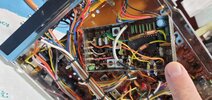
You men are awesome!! I was able to get the Sams schematic for the Midland version of this radio and that gave me a lot of info to check on based on your responses. I did a voltage check in AM and USB and was able to compare those readings against the schematic and the voltages were good. That led me to follow your various thoughts and here is what I found. The frequency would change when measured at TP11 if I applied pressure to the crystal. Because of that I needed to remove the PPL assembly which is like surgery compared to most radios. I did find 2 bad solder joints in the AM path. One was on a leg of the crystal. I re-flowed much of the board and replaced the 2 caps. I reinstalled the PLL assembly and the radio is now solid on frequency. I did the alignment again and I will do a final check in the AM. This PLL assembly was removed at some point in the past and I am curious if that was why. Lets hope for a positive result tomorrow.

Thanks as always!!!

1748394821130.jpeg

1748394895349.jpeg
 

dxChat
Help Users
  • No one is chatting at the moment.