

Here's the breezy version of extra transmit channels for the Browning Mark 4A transmitter.
Not the Mark 4. Different transmitter altogether.
This setup requires two toggle switches and wire. One DPDT on-on switch and a SPST switch. Or any substitute.
The focus of this trick is nine black-insulated parallel jumper wires on the PLL circuit board. Each jumper is labeled with a multiple of two. We're interested in three of them. The one labeled "256", "128" and "64". The actual binary weight of each wire is half the number you see. Removing the "64" jumper will move the frequency down 32 channels. Not across the whole 40 channels, but enough to get you below channel 1.
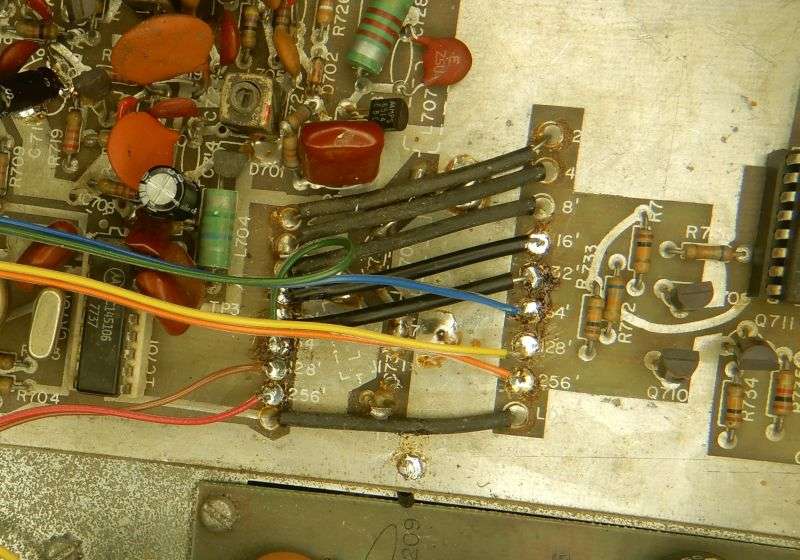
The "64" jumper gets replaced by two wires leading to a simple SPST switch. In this exapmle, the blue and green wires. You don't need a picture of two wires attached to a switch.
The other two black jumpers that get pulled out are "128" and "256". The DPDT switch is used to reverse these. Like the reversing switch on an old-school 12-Volt trolling motor. This is to move the frequency up 64 channels. This is just past the end of the receiver's tuning dial. Not useful. The other switch moves us down 32 channels. So if you open the SPST switch, you move down 32. So up 64 minus 32 gets us channel 42 when the display shows 12. From 1 to eleven, it just repeats channels 28 to 40. It skips 41, since it's in between 11 and 12 on the display. The "RC" skip. Top channel is 27.735. Well beyond the receiver dial's coverage range.
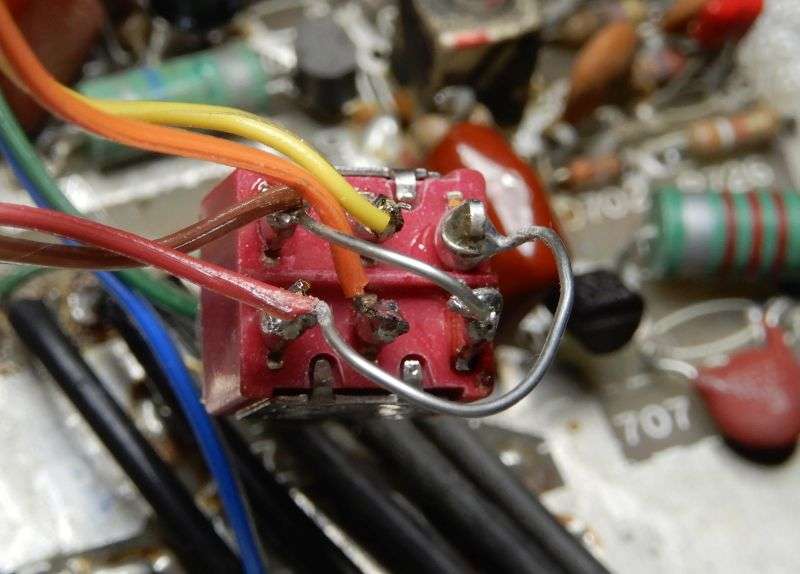
There are some frequencies that get skipped in this scheme. Kinda like the five channels get skipped between channel 1 and channel 20.
I forgot to bring home a chart of the added channel frequencies to go with this setup. I'll check back and post that later.
Naturally this doesn't do a thing for the receiver's frequency coverage in any way whatever. The two boxes are independent except for the shared power supply. The receiver has no idea what channel the transmitter has been set to.
When I come back with the chart, I'll add some explanation about the why of this mod.
73
Not the Mark 4. Different transmitter altogether.
This setup requires two toggle switches and wire. One DPDT on-on switch and a SPST switch. Or any substitute.
The focus of this trick is nine black-insulated parallel jumper wires on the PLL circuit board. Each jumper is labeled with a multiple of two. We're interested in three of them. The one labeled "256", "128" and "64". The actual binary weight of each wire is half the number you see. Removing the "64" jumper will move the frequency down 32 channels. Not across the whole 40 channels, but enough to get you below channel 1.
The "64" jumper gets replaced by two wires leading to a simple SPST switch. In this exapmle, the blue and green wires. You don't need a picture of two wires attached to a switch.
The other two black jumpers that get pulled out are "128" and "256". The DPDT switch is used to reverse these. Like the reversing switch on an old-school 12-Volt trolling motor. This is to move the frequency up 64 channels. This is just past the end of the receiver's tuning dial. Not useful. The other switch moves us down 32 channels. So if you open the SPST switch, you move down 32. So up 64 minus 32 gets us channel 42 when the display shows 12. From 1 to eleven, it just repeats channels 28 to 40. It skips 41, since it's in between 11 and 12 on the display. The "RC" skip. Top channel is 27.735. Well beyond the receiver dial's coverage range.
There are some frequencies that get skipped in this scheme. Kinda like the five channels get skipped between channel 1 and channel 20.
I forgot to bring home a chart of the added channel frequencies to go with this setup. I'll check back and post that later.
Naturally this doesn't do a thing for the receiver's frequency coverage in any way whatever. The two boxes are independent except for the shared power supply. The receiver has no idea what channel the transmitter has been set to.
When I come back with the chart, I'll add some explanation about the why of this mod.
73
Last edited:
