

Oops. Should say "fifth decade".
Took a few shots of a D&A Maverick we refreshed for a customer. This is the gray one with the tube-type keying circuit and the 3-position band switch in the middle of the lower three knobs. The mileage looked really low, so it keeps the original relay and keying tube. A specimen that needs to replace the 50 year-old relay gets one that runs from 12 Volts DC and has a transistor to key it. I don't trust a 6AQ5 tube for this job, but this customer knows not to leave the room with the power on and the switch set to "operate". It's safe enough to trust set to standby, but someone should always be there to notice if it spontaneously keys itself and shut it off short of the mushroom cloud that eventually follows.
Here's the wide view and a breezy snapshot of the 48-year tuneup.
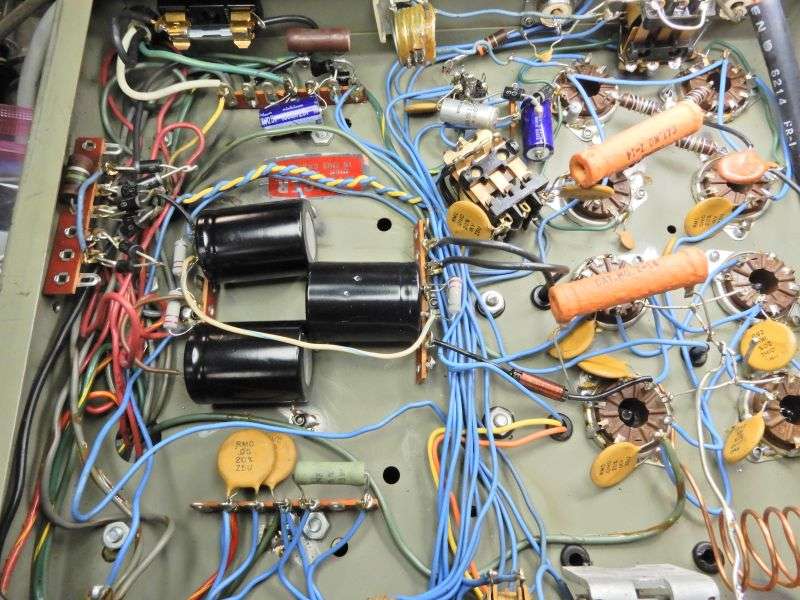
The previous eight HV filter caps are replaced with three caps, all rated for 220 uf at 500 Volts. The one on the right is the low-side filter, the two on the left are wired in series for the high side B+.
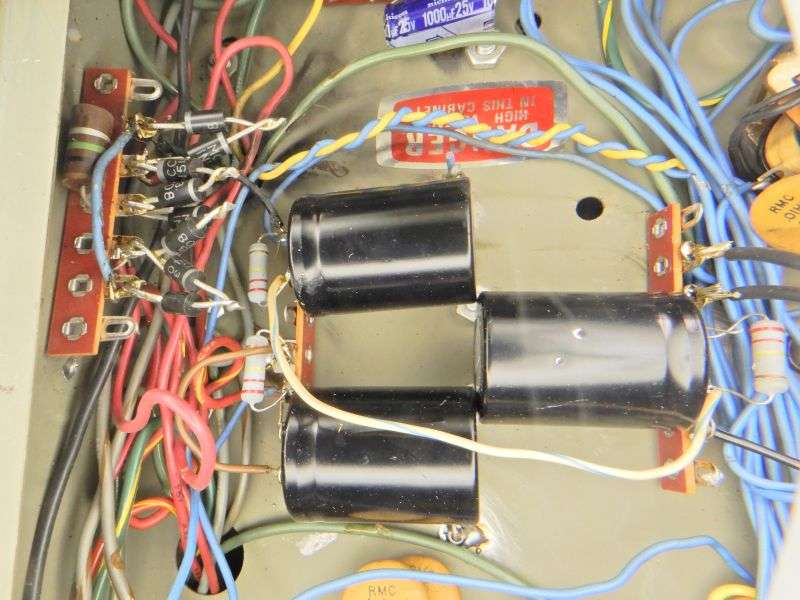
The total capacitance in the low-side B+ circuit will now be four times the original filtering capacitance. The high side capacitance is nearly twice the factory 66 uf.
This will boost the size of the current surge at turn-on. I don't trust the factory rectifier diodes as a rule. Eight 1N5408 diodes rated at 3 Amps will shrug off the added surge current.
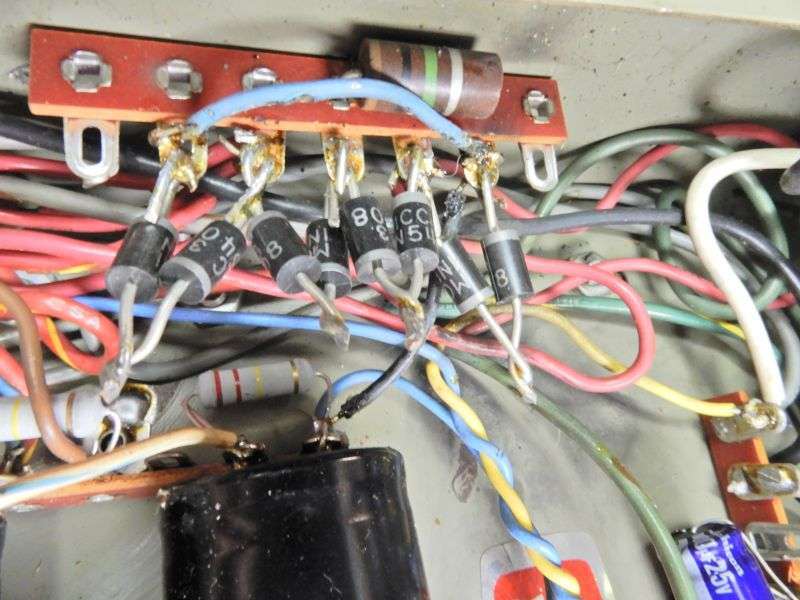
And if the amplifier's mileage is high and some of the old diodes have been replaced, it's even more important.
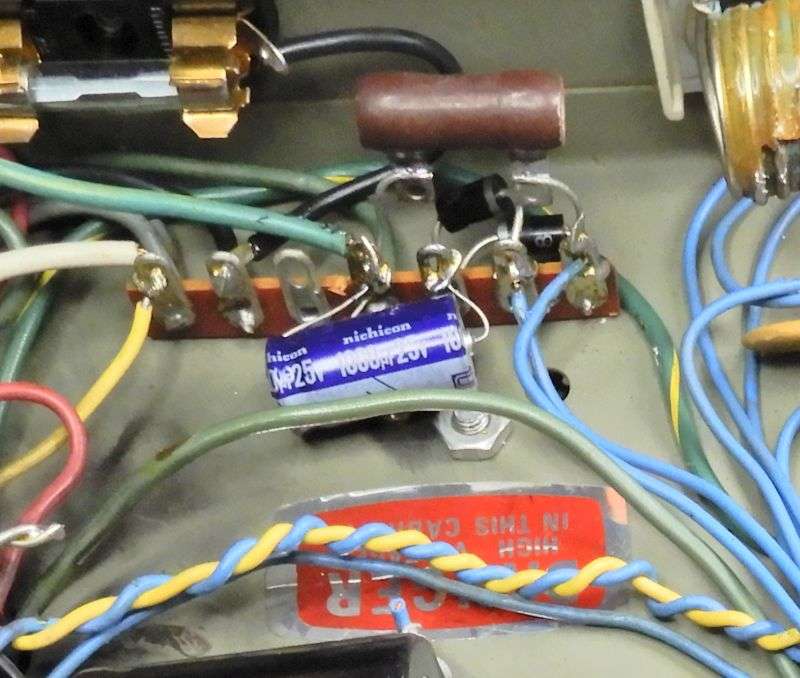
The bias voltage source for the final tubes gets modified. The Blue wire at the rightmost end of the tie strip leads to the grid pin of each final socket. The brown wirewound resistor is a 1K 5 Watt part that takes the place of two carbon-comp resistors rated at 2 Watts each. I don't trust them, so this wirewound takes their place. The blue wire one lug to the left of the right end feeds 6.3 Volt AC heater power into the banded end of one rectifier diode. The unbanded end of this diode feeds the negative lead of the 1000uf filter cap. You can't see it, but the center lug of this strip is ground, where the positive lead of the filter caps is soldered. Here's where it gets different from the factory. A second rectifier diode now connects the filtered negative 8 Volts DC into the grid resistor, and into the wire feeding the grids of the final tubes. This second diode isolates the filter capacitor from higher negative DC voltages produced by the final tubes. Yeah, those grids are also rectifiers and there will be 40, 50 Volts negative DC or more backfeeding into that resistor. And if the filter were connected directly to that resistor, it would charge up to that higher voltage. We'll skip why that's not desireable. That second diode blocks the higher negative DC so the filter cap never has more than 8 Volts on it. Before everyone starts snoring, I'll leave it at that.
This takes us to the driver stage that's built with zero bias. The control grid on the baldy tubes connects to pin 2 only, and not to any other pin. That pin gets CAREFULLY lifted from ground on all four driver tubes. A .01uf disc cap goes from each pin 2 lug to ground. A wire now links pin 2 of the two outside tubes. The wire goes on the outer side of the sockets, away from the area between the sockets. Another wire goes from pin 2 of the outer-rear tube to the inner-rear tube socket on the other side of the relay. One more wire now goes from pin 2 of the inner-rear socket to pin 2 of the inner-front socket. This ties the control grid of all four tubes. A 1k 2 Watt or larger resistor goes from pin 2 of the inner-rear socket to ground. Doesn't really matter which of the four driver sockets has this resistor. Just has to be one of them.
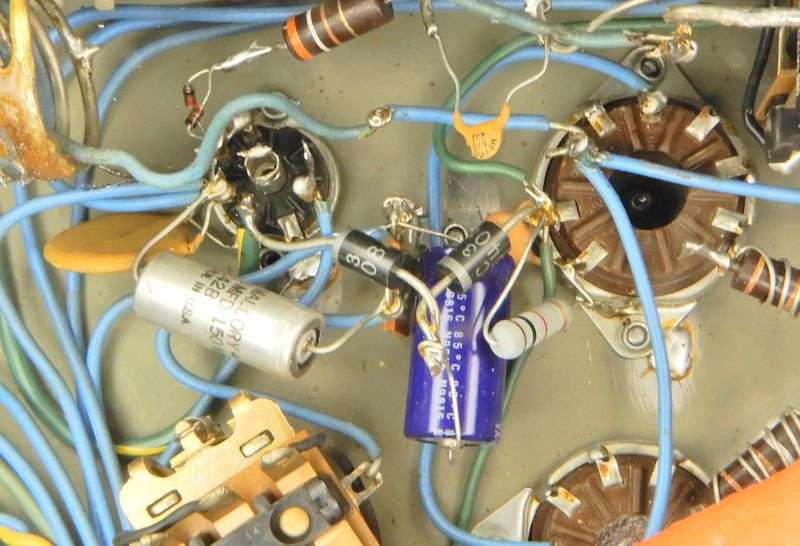
This setup borrows 6.3 Volt AC heater power from the keying tube. And if your amplifier has a transistor keying circuit, pin 5 of this driver tube works, too. The same two rectifier, one filter cap setup as the final bias is used here, too.
The band selector switch is a breakdown liability. The enormous driver plate coil gets removed and shrunk down to five and a half turns on a 3/4 inch diameter.
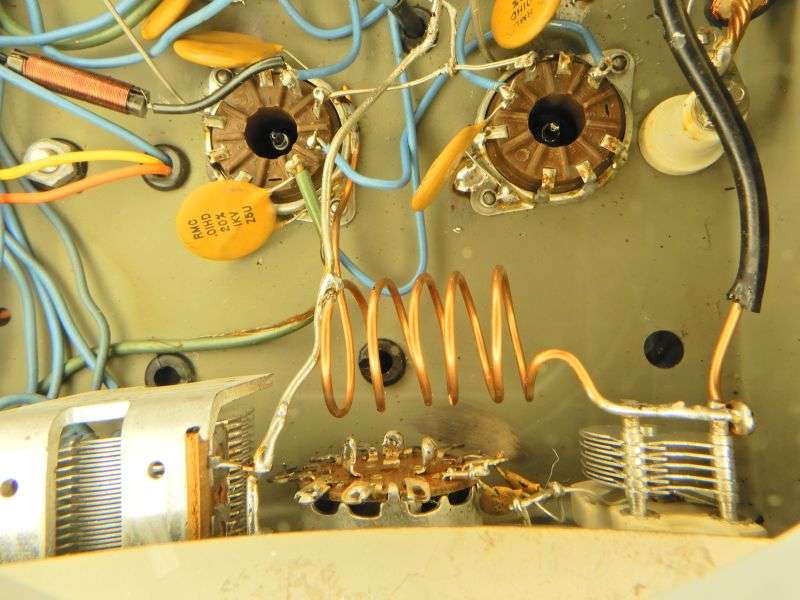
This one used a setup I'm fond of. The driver coil is tapped about 3/4 of a turn up from the grounded end. The driver Load control connects here and feeds directly to pin 3 of all four final tubes. If there was a Z14 RF choke here, it's no longer needed to connect the final cathodes to ground. This coil does it now.
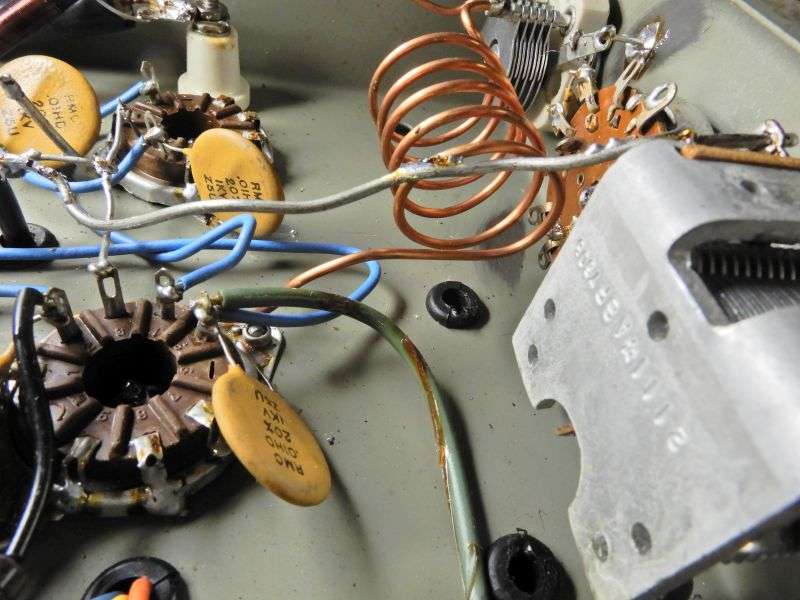
YMMV, exact placement of this tap point should get you peak swing with the driver Load set near center of its range. If it goes all the way open, move the tap point closer to ground a little bit. And if it peaks with the plates meshed fully together, the tap point is already too close the ground end of the coil. Move it upwards a bit.
I was in a bit of a hurry to button this one back up and move on to the next task, so I spaced getting a pic of the final coil. Pretty sure it gets cut down to about four turns.
I think. If you stuck with me this far you probably know how to zero in on the correct length for that one.
Low mileage always works in everyone's favor, the customer and tech both.
73
Took a few shots of a D&A Maverick we refreshed for a customer. This is the gray one with the tube-type keying circuit and the 3-position band switch in the middle of the lower three knobs. The mileage looked really low, so it keeps the original relay and keying tube. A specimen that needs to replace the 50 year-old relay gets one that runs from 12 Volts DC and has a transistor to key it. I don't trust a 6AQ5 tube for this job, but this customer knows not to leave the room with the power on and the switch set to "operate". It's safe enough to trust set to standby, but someone should always be there to notice if it spontaneously keys itself and shut it off short of the mushroom cloud that eventually follows.
Here's the wide view and a breezy snapshot of the 48-year tuneup.
The previous eight HV filter caps are replaced with three caps, all rated for 220 uf at 500 Volts. The one on the right is the low-side filter, the two on the left are wired in series for the high side B+.
The total capacitance in the low-side B+ circuit will now be four times the original filtering capacitance. The high side capacitance is nearly twice the factory 66 uf.
This will boost the size of the current surge at turn-on. I don't trust the factory rectifier diodes as a rule. Eight 1N5408 diodes rated at 3 Amps will shrug off the added surge current.
And if the amplifier's mileage is high and some of the old diodes have been replaced, it's even more important.
The bias voltage source for the final tubes gets modified. The Blue wire at the rightmost end of the tie strip leads to the grid pin of each final socket. The brown wirewound resistor is a 1K 5 Watt part that takes the place of two carbon-comp resistors rated at 2 Watts each. I don't trust them, so this wirewound takes their place. The blue wire one lug to the left of the right end feeds 6.3 Volt AC heater power into the banded end of one rectifier diode. The unbanded end of this diode feeds the negative lead of the 1000uf filter cap. You can't see it, but the center lug of this strip is ground, where the positive lead of the filter caps is soldered. Here's where it gets different from the factory. A second rectifier diode now connects the filtered negative 8 Volts DC into the grid resistor, and into the wire feeding the grids of the final tubes. This second diode isolates the filter capacitor from higher negative DC voltages produced by the final tubes. Yeah, those grids are also rectifiers and there will be 40, 50 Volts negative DC or more backfeeding into that resistor. And if the filter were connected directly to that resistor, it would charge up to that higher voltage. We'll skip why that's not desireable. That second diode blocks the higher negative DC so the filter cap never has more than 8 Volts on it. Before everyone starts snoring, I'll leave it at that.
This takes us to the driver stage that's built with zero bias. The control grid on the baldy tubes connects to pin 2 only, and not to any other pin. That pin gets CAREFULLY lifted from ground on all four driver tubes. A .01uf disc cap goes from each pin 2 lug to ground. A wire now links pin 2 of the two outside tubes. The wire goes on the outer side of the sockets, away from the area between the sockets. Another wire goes from pin 2 of the outer-rear tube to the inner-rear tube socket on the other side of the relay. One more wire now goes from pin 2 of the inner-rear socket to pin 2 of the inner-front socket. This ties the control grid of all four tubes. A 1k 2 Watt or larger resistor goes from pin 2 of the inner-rear socket to ground. Doesn't really matter which of the four driver sockets has this resistor. Just has to be one of them.
This setup borrows 6.3 Volt AC heater power from the keying tube. And if your amplifier has a transistor keying circuit, pin 5 of this driver tube works, too. The same two rectifier, one filter cap setup as the final bias is used here, too.
The band selector switch is a breakdown liability. The enormous driver plate coil gets removed and shrunk down to five and a half turns on a 3/4 inch diameter.
This one used a setup I'm fond of. The driver coil is tapped about 3/4 of a turn up from the grounded end. The driver Load control connects here and feeds directly to pin 3 of all four final tubes. If there was a Z14 RF choke here, it's no longer needed to connect the final cathodes to ground. This coil does it now.
YMMV, exact placement of this tap point should get you peak swing with the driver Load set near center of its range. If it goes all the way open, move the tap point closer to ground a little bit. And if it peaks with the plates meshed fully together, the tap point is already too close the ground end of the coil. Move it upwards a bit.
I was in a bit of a hurry to button this one back up and move on to the next task, so I spaced getting a pic of the final coil. Pretty sure it gets cut down to about four turns.
I think. If you stuck with me this far you probably know how to zero in on the correct length for that one.
Low mileage always works in everyone's favor, the customer and tech both.
73
Last edited:
