• You can now help support WorldwideDX when you shop on Amazon at no additional cost to you! Simply follow this Shop on Amazon link first and a portion of any purchase is sent to WorldwideDX to help with site costs.
  • A Winner has been selected for the 2025 Radioddity Cyber Monday giveaway! Click Here to see who won!

Fullwave loop over a half wave dipole

  • Thread starter Thread starter Mr Fix it
  • Start date Start date
M

Mr Fix it

Guest
My center fed dipole came down 2 hurricanes ago when I lost the tree which held the center feed point up. Im trying to decide if I should replace it with another dipole of some sort or maybe a full wave loop/skywire antenna.I mostly talk on 80 meters.

The antenna would be a mono bander for 80 meters.

Any thoughts
 

Fullwave loop or 1/2 Wave Dipole

Scott,

comes down to real estate, I have used a full wave loop for 80 meters fed

with open wire line for forever, recently added to it and now use a two wave

length loop for 160 meters, again fed with open wire line.


Works great all bands, rarely use my amplifier any more (it's a 25 year old

S.S. Icom 2KL)

Again, if you have the real estate use a full wave loop for 75/80, you will not

look back.....Mac
 
Hi Mac, Thanks for the response, Im going to give it a shot. I have a 1000ft roll of #14 copper weld wire. I think I can support 4 corners so it will be in the shape of a square or at least close to it.

I really dont want to have to use a tuner with my amplifier. Would a q section consisting of 75 ohm coax fed with 50 ohm coax be the best route. The antenna would be cut to resonance for 80 meters.

I will snap a few pics once I get it up.

73

Scott
 
I don't mind using a tuner (amplifier or not) so would also rather have a full wave loop (or larger) if I have a choice. I also would rather use parallel feed lines instead of coax (if I've got a choice), cuz' that tuner takes care of the impedance mismatches. If it's done correctly there will be some losses, but nothing outstanding. I've also done the matching section with 75 ohm coax. It does work, but you have to pay close attention to power limits and tuning.
In general, a loop with the most area inside of the loop tends to be more 'efficient' than one with less area inside it. That's not exactly simple, you may not have the room to do it that way. As long as it's 'close', it won't be noticeable, probably.
There are lots of 'catches' with tuners, parallel feed lines, etc, but nothing the average person can't deal with.
Will that result in the absolute most bestest antenna in the world? Not really, but it can certainly have some advantages. And disadvantages, you do your own figuring on that part. :)
- 'Doc
 
I got a wire up. The length is about 275 ft. I can trim it if I need to I have not hooked any coax up to it yet.
 

Attachments

  • phpt4gsF6AM (2).jpg
    phpt4gsF6AM (2).jpg
    37.7 KB · Views: 341
  • phphe0GkvAM (2).jpg
    phphe0GkvAM (2).jpg
    97.6 KB · Views: 310
  • phpokKJ67AM (4).jpg
    phpokKJ67AM (4).jpg
    67 KB · Views: 304
  • phpI6YfPzPM (2).jpg
    phpI6YfPzPM (2).jpg
    57 KB · Views: 313
  • P9130039.JPG
    P9130039.JPG
    169.4 KB · Views: 325
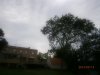
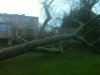
Here is the tree that fell down during tropical storm sandy. It was a locus which is a really hard wood. Boy what a pain to cut up took a couple days and 5 or so chains.

If you look closely you can see the white piece of teflon that I used for the center feed point and one of the wires for one side of the dipole.

Thank god I disconnected the tension weight on the house side. I forgot to disconnect the tension weight on the other side which went to a sail boat mast which was mounted in a tree at the back of the property. The wire consisted of #12 copper weld wire. Well to make a long story short when the tree fell the sail boat mast snapped in half and the mast guy rope kept the mast close to the tree. The copper weld wire and the parachute type rope were unharmed.Boy that wire is strong.
 

Attachments

  • image.jpeg
    image.jpeg
    144 KB · Views: 277
Full wave loop is an OK antenna.

works good 160 through 40 meters, After that it starts throwing lobes off in various directions.

If you get lucky and the direction you want happens to have a nice lobe from the antenna then it will be a "great" antenna.

At low heights, of course it will be a BIG cloud warmer NVIS.

A dipole will have a more predictable pattern on the higher bands.

Put it up and have fun. It will be a good learning experience.
 
You know, that 'cloud warmer/NVIS' designations are so, so, misunderstood. It assumes that signals will only be transmitted/received at certain 'angles', which is just not true. They are generalizations, which are only true in certain situations/circumstances. It's only 'right' maybe 50% of the time. The other 50% of the time a received/transmitted signal arrives at a higher angle.
Give a loop a try and see what happens.
- 'Doc
 
You know, that 'cloud warmer/NVIS' designations are so, so, misunderstood. It assumes that signals will only be transmitted/received at certain 'angles', which is just not true. They are generalizations, which are only true in certain situations/circumstances. It's only 'right' maybe 50% of the time. The other 50% of the time a received/transmitted signal arrives at a higher angle.
Give a loop a try and see what happens.
- 'Doc

Is there any difference between a half wave dipole and a full wave loop in radiation pattern?

If the loop is horizontally suspended?

Does it matter where you feed the loop as to what type of direction the major lobes will be?


If one side of the loop is higher than the other side will it affect the radiation pattern of the loop antenna?


A horizontally suspended full wave loop installed less than 1/2 wl above above ground is a roll of the dice for performance. Regardless of what the angle of radiation is.

It is the major lobes and the nulls one needs to be concerned with. Especially the nulls.

The only way to "really" find out how that full wave loop will perform is to put one up and try it out.

It will be fun, you will make some contacts.

You will hear ops describe how they have worked over 100 different countries with their full wave loop.

Then again so has the op running mobile with a screwdriver antenna.

If you can install an antenna, and control which way the major lobes and the nulls are then you can make this antenna perform as you want it to.

With a full wave loop, the antenna controls where you will be heard and what you will hear.

Almost every antenna is a compromise antenna with the exception of a half wave dipole, and a 1/4 wl ground plane.

 
"Is there any difference between a half wave dipole and a full wave loop in radiation pattern?"
Sure. Along with the antenna's height above ground it depends on the 'shape' of the loop. Round, square, rectangular, something in between all that. A horizontal loop tends not to be directional if the sides are close to equal in length. A dipole after a certain height above ground becomes bi-directional. If that 'directionality' is desirable then it would probably have an edge on a loop, maybe.


"If the loop is horizontally suspended?"
Back to that height above ground thing. At less than a desirable height a horizontal loop tends to be sort of omnidirectional. And also back to that loop's 'shape', it can also become sort of bi-directional, or quad-directional. Lot's of 'buts' in that.


"Does it matter where you feed the loop as to what type of direction the major lobes will be?"
It can, but it's the 'shape' thingy again.


"If one side of the loop is higher than the other side will it affect the radiation pattern of the loop antenna?"
Yes it will. It can affect the radiation pattern in a number of ways. I won't even try to guess how that radiation pattern would be like for any particular situation.

All this depends on what's around that loop (or dipole) as to what direction(s) any lobes/nulls will be (assuming it's only used on it's resonant band). Unless you can model the environment accurately (good luck!), there is no definite radiation pattern other than a 'general' one.
Very in general, at less than about a 1/2 to 1 full wave length above ground loops tend to be omnidirectional. That does not mean that they wouldn't be adequate for most situation. At the lower HF bands you won't see many antennas of any sort at more than maybe a 1/4 - 1/2 wave above ground. At 80 and 160 meters you could probably count the antennas at a 'right' height above ground on one hand.
One aspect of loops is that they tend to be 'quieter' than a dipole. That's primarily due to 'end effect' on those dipoles. That 'quietness' is NOT super noticeable at all, it is not a biggy. You still hear static, just not quite as much of it?
Is full wave loop the 'answer' to everyone's antenna problems? Not by a long shot! But I like them.
- 'Doc
 
"
Is full wave loop the 'answer' to everyone's antenna problems? Not by a long shot! But I like them.
- 'Doc

I know you like them doc. A very good friend of mine (SK) liked his also.

He put his up over his catfish pond. Lumped a hell of a signal when he fired up that old collins station he used to run.

I can not say what it did for the catfish.
 
The catfish probably enjoyed listening to all the hoo-haa. That RF stimulates them catfish growth hormones so they just got bigger.
- 'Doc

Didn't know that did you? ... s'a fact.
 

dxChat
Help Users
  • No one is chatting at the moment.