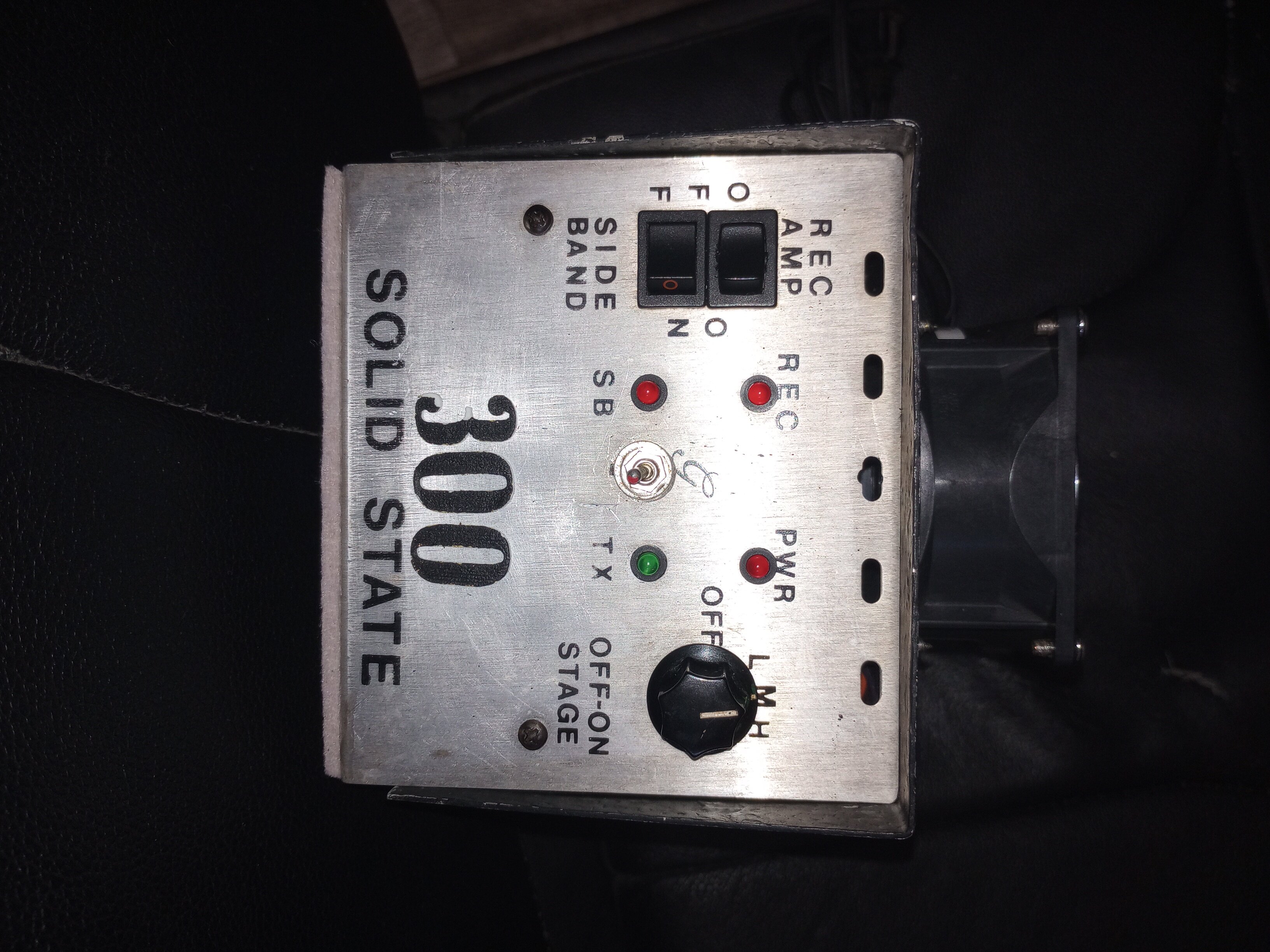
That particular amplifier has a big issue when it comes to sideband.
I'm not talking about the lack if "idle current" bias. Yeah, that's why it makes sideband sound like dirt.
But once you install a bias circuit, the other problems emerge.
The power supply is not regulated. It puts over 20 Volts on the RF transistors in standby. The power supply is just too small, and the voltage will drop to a safer 12 to 14 Volts under load while it's keyed.
But an unregulated amplifier still tends to sound bad on sideband, with or without bias.
You will also discover that the amplifier wants to become unstable and oscillate. Might not run away and hold itself keyed up after you unkey the mike.
Might.
But an oscillation that only happens on the upper half of your voice waveform will still ruin the audio quality at the other end.
Adding negative feedback and removing Billy's gimmick capacitor on the relay wiring will probably take care of that issue.
But once you do that, the input impedance will usually change in a big way, and at the very least you'll have to change the value of the silver mica cap that's wired across the primary of the input transformer. And possibly also the 330pf silver-mica cap across the input secondary.
They say the transistors used to build these were hand-selected for low leakage currents at 20 Volts. Parts that would likely break down from excess leakage current got sidelined to put into mobile linears.
Don't know how many parts out of a hundred flunked this test and how many passed.
We learned to install an automotive "ice cube" Bosch-type relay between the main power and the DC input to the RF transistors. It would key with the antenna relay, and turn on the collector supply only when there was drive power. So long as you drove it with an AM carrier, this would pull down the supply voltage while loaded down from making RF power. And the high unregulated voltage would be switched off from the RF transistors in receive mode. This allows the use of replacement transistors that haven't been selected to resist breakdown from a 20-Volt supply. Random replacement transistors tend to blow out in this model. Frequently at the moment you unkey.
But hey, it's a Gray. The only way to spell "project" with four letters.
73