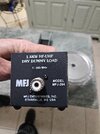
I was told I could put my mfj-264 1500 watt dummy load in mineral oil and it would work. I had no luck just very high swr from the load. It works all cleaned up from the oil but did not work in the oil. What did I do wrong?


That's exactly what i did with a mfj-260. I had posted pictures either here or cbt several years ago. It's probably 6 or 8 years in a can and still going strong.I was told I could put my mfj-264 1500 watt dummy load in mineral oil and it would work. I had no luck just very high swr from the load. It works all cleaned up from the oil but did not work in the oil. What did I do wrong?
I started messing with it again last night after reading this old post. I was able to get swr down to 1.5 before I called it quits for the night. I am left to believe it is something to do with the grounded end. I will tinker more soon and see what I can get.That's exactly what i did with a mfj-260. I had posted pictures either here or cbt several years ago. It's probably 6 or 8 years in a can and still going strong.
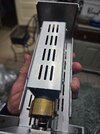
I took the outer cover off, modified the mounting plate and bolted the so239 into the can lid. Make sure the clamps around the ends of the resistor are clean and tight. Mine had no standing wave and never has. I've probably dumped at least 1k into with various other amounts. It's my work bench dummy load. It'll take what you throw at it.I started messing with it again last night after reading this old post. I was able to get swr down to 1.5 before I called it quits for the night. I am left to believe it is something to do with the grounded end. I will tinker more soon and see what I can get.

I am clearly not as smart in the topic as you are, but I definitely have to agree with you.Thinking out loud again.
For MFJ to claim that it is good up to UHF with a resistor the length of a UHF antenna, I would think that the shield has to be working along with the resistor to form something of a transmission line.
If the dielectric in a coax cable is changed from air to oil (1 to 2.4), the characteristic impedance is cut roughly in half.
If you have a center conductor in a square shield, the characteristic impedance is approximately Zo = 59.96 * ln(1.079*D/d).
I am wondering if making the inner shield bigger would help with it being in oil. The MFJ-264 manual specifically states not to run it in any liquid, and the only reason I can figure is the dielectric change. IDK.

Bake it with rf was the final solution after returning it to its mfj case. I cleaned it with dawn and water and let it sit a couple days. I would have to say that it did absorb some of the mineral oil and a slight bit of water. After returning it to its mfj case, the heat from running a 2x10 into it for tuning purposes, had it smoking. At first I was concerned I was burning the resistor itself, but after investigation I found an oil residue around the inside of the case. The case was never near the oil. Now some of the smoke could have been steam from any water absorbed, but was mostly the oil. So I concluded it was burning off oil residue. I never thought at that time that it could of absorbed it...just figured I did a shit job cleaning it.I was just reading on another forum about carbon resistors being made with organic binders. So not only can moisture soak into them and change the value, but I now wonder if certain oils could affect the binder in some way.
Eldorado just reported good long-term results, so I am not too concerned about the mineral oil, but the moisture part makes me wonder if cleaning it last time had an effect. Did you use water?
I saw in a cooling oil paper that dielectric oils are subjected to high heat under strong vacuum to remove moisture and dissolved gasses. Although not very practical on a home scale, I wonder if heating it at atmospheric pressure would remove some of that.
I guess I would put 100w into it at a duty cycle that flirts with its rating to see if driving moisture out of it helps. Bake it with RF