• You can now help support WorldwideDX when you shop on Amazon at no additional cost to you! Simply follow this Shop on Amazon link first and a portion of any purchase is sent to WorldwideDX to help with site costs.
  • A Winner has been selected for the 2025 Radioddity Cyber Monday giveaway! Click Here to see who won!

Interesting Antenna Height Question...

Thought that's what I said...........

Kind of, but not completely. You mentioned take off angle changing with height but you also mentioned where gain comes from. I simply clarified about the reflected signal combining with the incident signal to gain an extra 5-8 dB. Just more info, that's all.
 
Ground distance influence on quad is totally different than for a Yagi.
@ Mike,

Hello Mike !

Perhaps im missing something ?
Normally that would mean it also has a different take-off angle compared to a Yagi.

But..that is sadly not true.
Though maybe you are trying to indicate something else ?
As you know your antenna stuff...so im not sure if that is what you were after ?

Regarding that story about TOA Quad versus Yagi....
Not so long ago I got an email from someone claiming the same story.
Infact he had "proof" as chat GPT backed it up.

So I took the bait..and asked the question..to AI
Chat gpt responded:
Yes, a cubical quad antenna typically produces a slightly lower takeoff angle than a Yagi antenna when both are mounted at the same height above ground — particularly when measured in wavelengths.
I asked if there was any proof to back that up ...
And it replied :
Antenna TypeEffective HeightRadiation TypeTakeoff Angle
YagiCenter of ½-wave dipoleDirectional (horizontal polarization)~15–20°
Cubical QuadCenter of full-wave loop (slightly higher)Directional (horizontal pol.)~12–18°

Again, I asked can you provide proof of that 2..3 degree difference ?

Then it replied :
I couldn’t find a verified case in the literature or modeling reports that clearly shows a cubical quad producing exactly 2‑3° lower take‑off angle than a Yagi under all else equal conditions. Most of the modeling I examined finds very small differences (fractions of a degree), or effectively no angle advantage.

So, i stated his initial point of view wasnt accurate..

There is no solid proof — either from rigorous modern measurements or modeling — that a cubical quad consistently produces a 2–3° lower take-off angle than a Yagi at the same height.

The idea that a quad “has a lower takeoff angle” is a long-standing belief in amateur radio circles — often repeated in books, forums, and by experienced operators.

  • But that belief is not backed by modern simulation or controlled comparative measurements.
  • The only example that might be seen as “proof” is anecdotal: that 1966 QST article, which doesn't provide angular measurements — just observations about long-haul performance.

And that was the end of my chat GPT experience..... terrible !
I often see people using chat GPT or other forms of AI and this clearly shows chat GPT isnt accurate. And the most bizar thing... if you would ask chat GPT again...does a quad produce a lower take off angle then a yagi... it will repeat it self and doesnt learn.

@ All,
Perhaps to add to the question height and gain ...
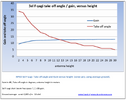
A while a ago I constructed the below diagram representing TOA and Gain for various heights
1758948856340.png

As we can see.... although there is a slight gain advantage by extending the height of a yagi ...it would be fair to say:
"it remains more or less equal from a halve wave lenght from the ground and further up"
.... obviously the take off angle will become lower.

indeed an interesting antenna question !

Kind regards, Henry

 
Hello, I'm a new member and this is my first post. My question/need of opinion is as follows:

I have a 4 element Sirio mounted at 50'. Would I benefit any lowering it down to 36ish feet to get it to the height or 1 wavelength, or just leave it at 50' and let it ride there? It would be easy to lower it, but just checking.
Yes there is an advantage. There is such a thing as being too high and it's all to do with the angle of arrival of incoming signals. Below is a chart of gain at various angles of arrival for signals for dipoles at various heights but the same applies to a horizontal yagi.
Gain.png

As you can see at two wavelengths high you actually start to have significant loss for signals arriving between 12-17 degrees and at 15 degrees a dipole just half a wavelength high would have an almost 20dB advantage, several S points, over the one at two wavelengths.

So here's the problem... The closer the stations the higher the arrival angle of their signal is for DX. I've been in a situation during contests where with a beam for 10m at 2 wavelengths high I've not been able to even hear anyone closer than 1500-2000 miles, so for me in the UK I couldn't hear a single thing from Europe which is not a good thing in a contest. As soon as I lowered the antenna to a wavelength high they all came booming in.

One wavelength high, so 36ft for CB, has just over a S point lower signal strength than one at two wavelengths high for the really low angle >3000 mile stuff, but it doesn't come with the massive disadvantage of not being able to hear stations closer to home.

And as we know transmit and receive characteristics are fairly similar to each other so as well as not being able to hear nearby stations very well when you whack it up too high they won't be able to hear you that well if at all too.

So my personal point of view is that it's not worth going over a wavelength, 36ft on 11m, for a horizontal antenna like a dipole or yagi.
 
I realize that anecdotal proofs carry very little weight in more science backed discussions, but I nevertheless value them as evidences when they corroborate science (not withstanding anomalies sometimes show up).
About 4 years ago a fellow CB operator 4 blocks from me who had mounted his A99 about 55' up was conversing with a mobile traveler as he drove nearer into town. He had the advantage of me with my 1/2ʎ antenna mounted only 17.5' until... he drove closer to a point the mobile operator vanished from the neighbor's recieve. I was by then receiving the mobile with ease and continued talking with him. The fellow with the highest mounted antenna in town was very upset that my lowly homebrew low mounted antenna system was at an advantage he'd never anticipated. I do not recall the distances out from town the mobile was at the moment of these events, but very clearly recall the experience. BTW, as the mobile got even closer to town the higher antenna once again regained contact while I never lost it. I always just figured it was the TOA match up between stations. This proves nothing of itself, but was my experience, and seems to fit within the current discussion.
 

dxChat
Help Users
  • No one is chatting at the moment.