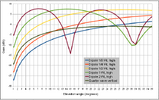
Ground distance influence on quad is totally different than for a Yagi.
@ Mike,
Hello Mike !
Perhaps im missing something ?
Normally that would mean it also has a different take-off angle compared to a Yagi.
But..that is sadly not true.
Though maybe you are trying to indicate something else ?
As you know your antenna stuff...so im not sure if that is what you were after ?
Regarding that story about TOA Quad versus Yagi....
Not so long ago I got an email from someone claiming the same story.
Infact he had "proof" as chat GPT backed it up.
So I took the bait..and asked the question..to AI
Chat gpt responded:
Yes, a cubical quad antenna typically produces a slightly lower takeoff angle than a Yagi antenna when both are mounted at the same height above ground — particularly when measured in wavelengths.
I asked if there was any proof to back that up ...
And it replied :
| Antenna Type | Effective Height | Radiation Type | Takeoff Angle |
|---|
| Yagi | Center of ½-wave dipole | Directional (horizontal polarization) | ~15–20° |
| Cubical Quad | Center of full-wave loop (slightly higher) | Directional (horizontal pol.) | ~12–18° |
Again, I asked can you provide proof of that 2..3 degree difference ?
Then it replied :
I couldn’t find a verified case in the literature or modeling reports that clearly shows a cubical quad producing exactly 2‑3° lower take‑off angle than a Yagi under all else equal conditions. Most of the modeling I examined finds very small differences (fractions of a degree), or effectively no angle advantage.
So, i stated his initial point of view wasnt accurate..
There is no solid proof — either from rigorous modern measurements or modeling — that a cubical quad consistently produces a 2–3° lower take-off angle than a Yagi at the same height.
The idea that a quad “has a lower takeoff angle” is a long-standing belief in amateur radio circles — often repeated in books, forums, and by experienced operators.
- But that belief is not backed by modern simulation or controlled comparative measurements.
- The only example that might be seen as “proof” is anecdotal: that 1966 QST article, which doesn't provide angular measurements — just observations about long-haul performance.
And that was the end of my chat GPT experience..... terrible !
I often see people using chat GPT or other forms of AI and this clearly shows chat GPT isnt accurate. And the most bizar thing... if you would ask chat GPT again...does a quad produce a lower take off angle then a yagi... it will repeat it self and doesnt learn.
@ All,
Perhaps to add to the question height and gain ...
A while a ago I constructed the below diagram representing TOA and Gain for various heights
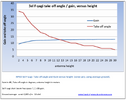
As we can see.... although there is a slight gain advantage by extending the height of a yagi ...it would be fair to say:
"it remains more or less equal from a halve wave lenght from the ground and further up"
.... obviously the take off angle will become lower.
indeed an interesting antenna question !
Kind regards, Henry