• You can now help support WorldwideDX when you shop on Amazon at no additional cost to you! Simply follow this Shop on Amazon link first and a portion of any purchase is sent to WorldwideDX to help with site costs.
  • A Winner has been selected for the 2025 Radioddity Cyber Monday giveaway! Click Here to see who won!

Mechanical echo

brandon7861

Loose Wire
I Support WorldwideDX.com!
Nov 28, 2018
2,045
2,256
293
Has anyone tried a magnetic tape/disk/drum for echo? Or any other mechanical methods? Maybe a disk coated with a phosphorescent material with a laser charging it and an optical sensor picking it back up? Someone out there has to have a cool echo story.

nm the fiber idea, did my math wrong
 
Last edited:

well there's always the Alabama Echo Box.

It's a long standing CB tradition in some areas of the country.

It is very simple to build!

All you need is a metal bucket or trash can that will fit over your head.

place the bucket over your head, put your mic inside the bucket with you and VOILA!
LC
 
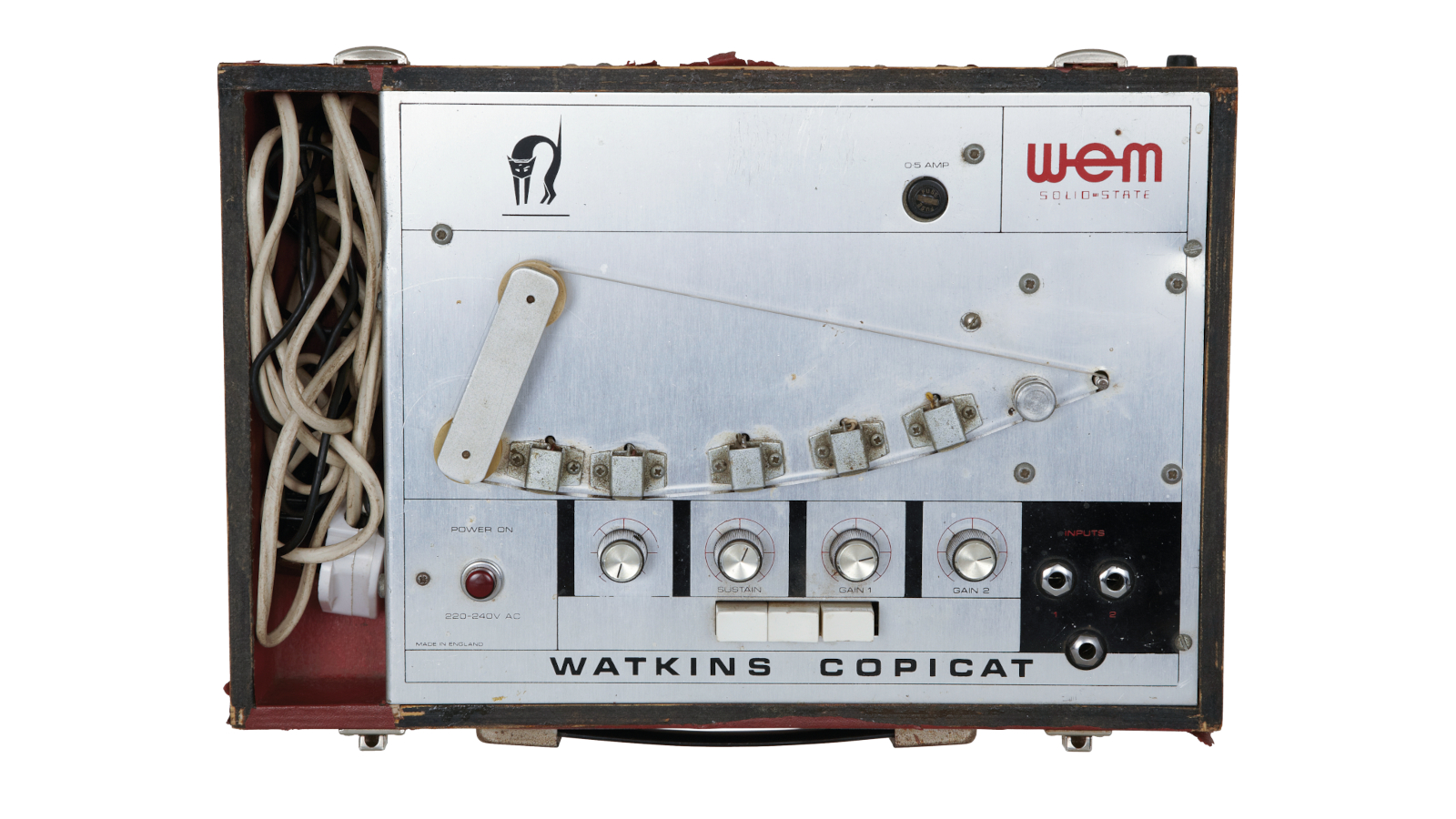
Back in the day, there were echo machines made from tape recorders. I have one called an ECHOLETTE. A continuous tape with a record and two playback heads. the second head was moveable and allowed the user to increase/decrease the echo. Supposedly the first tape echo was was the Watkins COPYCAT. Picture and story here:

ECHO.png


_ J.J. 399
 
years ago locally here there was a guy with a echo tape machine he had got it from a recording studio back in the late 1970s i had a realistic mic mixer with echo, wired a 4 pin plug and with batteries used it till slide controls gave out
 
  • Like
Reactions: brandon7861
One night, in 1970, while stationed in Vietnam, I was introduced to a guitar connected (by microphone) to a 7" reel-to-reel tape player. The sound come out of the speaker as an echo being that it was picked up by the same microphone. The object (at that time) was to be able to play (Smoke on the water) while listening to the echo sound (through headphones) and be able to play the guitar ...... Everyone that tried it failed.

While stationed in Germany in 1971, I showed the effect to a one group of guys in the barracks that had all the stereo equipment, and what fun they had. Of course, others in the barracks had to have it, four story buildings have a lot of rooms and can hold a lot of stereo equipment.

After I got my 1st base station, in 1974, and had access to a 10" reel-to-reel, I was able to duplicate the echo affect. Many CBers wanted to do it, but had no idea how it was done.

Talking into the (reel-to-reel) microphone the sound comes out the speaker, that same sound would get picked up by the same microphone over and over to cause the echo effect. The sound from the speaker would get picked up by the CB radio's microphone as the echo. It was just as hard to keep your voice away from the CB radio's microphone, and was all more work than pleasure.
Knowing that it worked was enough for me. ........ Due to all the work involved the thrill ended shortly after.

73

 
  • Like
Reactions: brandon7861
Thats a cool trick, but I would hate to hear myself talk at the same time I am trying to talk. At work I have to be careful where I use my radio because everyone has a radio and they all have the volume cranked. Getting better at ignoring the feedback but it hits my brain like a computer virus.

We have some old bill validators from the slot machines and each one has 3 magnetic heads. I am wondering if I can somehow repurpose one. They have stepper motors and gears already but I am not sure what I would use for the medium. Tape or disk.

I figure the closest practical spacing for the magnetic heads would be 5/8", which translates into a minumum of 30 inches per second of tape (or an old 3.5" floppy disk spinning 163RPM.)
 
Reel tape decks came in two basic types. Two head and three head. Naturally, the two head setup was cheaper, using one for erase, and one for both record and playback.

A three-head deck had one for record only and one downstream from it for playback only. The delay from record head to play head provided an echo feature if you fed the play head audio back into the record input. The elaborate versions with 6, 7 or more heads just heaped onto this trick.

Robert Fripp toured record shops promoting his new band "UK" 45 or so years ago. He brought two Revox A77 pro-grade reel tape decks and put them a few feet apart. The left-hand deck was in record mode, but the tape continued over into the second deck, through the head nest and onto the takeup reel. This produced an analog version of long sampling, and would then accompany himself after setting up a long repeating loop. Called it "Frippertronics".

Ah, the analog world was primitive. But it encouraged creativity.

73
 
Last edited:
Old late 60's, early 70's gutar amps had what was called tape reverbs, where the sound is recorded to a large thick tape and played back at the same time through the speaker. I had one of these type amps. I was stunned when I opened it up to see that continouse piece of tape that wrapped around a large wheel.
 
Last edited:
  • Like
Reactions: brandon7861
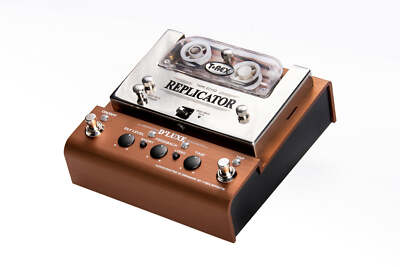
I found something cool, but it is out of my price range.
 
I feel like this continuous tape technique would wear the tape out quickly. It seems like a 12" loop of tape would wear fast, with the continuous reading and writing, er, uh, erasing and recording. Were replacements readily available, or could the loop be made with other readily available tape? Just curious. I never saw any such tape loops, besides an 8 track with hundreds of feet of tape.
 
When I originally looked these up, i was met with countless tape replacements. The tapes are still available. And I thought the same, it would wear fast. i remember reusing cassette tapes and they didn't take long to go bad. same with VHS tapes.
 
Cassette tapes only go bad if you don't rewind or fast foward them to the begin or the end. Thats why in a recording studio environment, for example the ampex 2" reel to reel tapes have a long lead in before music is even recorded on them. Sure over time like 40 years or more they could degrade just a little, but mostly due to moisture or heat. I have cassette tapes from the 70's and 80's that still work like new in my Alpine car deck or my Luxman 3 head tape deck.
The tape that was in the guitar amps was more durable.
 
How does not starting at the beginning damage the tape? I though the long lead-in was to allow for breakage when connecting the tape to the empty reel.

Is it possible that radon degrades tapes? I tried converting some of my grandmas favorite tapes and reels to mp3 and most were too degraded to listen to. She did play them a lot over the years, but I wonder if radiation played a role. We later found out that her house had a radon problem.
 

dxChat
Help Users
  • No one is chatting at the moment.