• You can now help support WorldwideDX when you shop on Amazon at no additional cost to you! Simply follow this Shop on Amazon link first and a portion of any purchase is sent to WorldwideDX to help with site costs.
  • A Winner has been selected for the 2025 Radioddity Cyber Monday giveaway! Click Here to see who won!

Problem with AL-80B

W8Radio

New Member
Dec 10, 2025
3
0
1
74
I have an AL-80B in which the 3-500Z tube will not light up. HV is showing just under 4000.
It worked fine the last time I used it and there was no noise or smoke when I turned it on today.
I reseated the tube in its socket with no improvement. Is the problem likely the tube itself ?
I hesitate installing a new one only to have it burn out due to another issue with the amp.
Thanks!
 

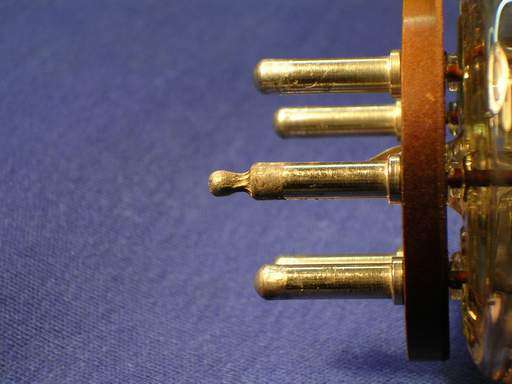
Check for filament voltage at the socket. You should see about 5.0 volts. If it is present, look carefully at the tube filament pins. If the tube has been run hot, solder has been known to melt and run out of the pins making an open circuit
I know it can happen but silver solder melts at around 1200-1500 degrees. You have to really try to melt a z pin.

Do what he says. Step one see if you have 5v on filament. While in there make sure the contacts on the pins are bent in a way that they make contact etc sometimes they just break off or don't line up
 
I know it can happen but silver solder melts at around 1200-1500 degrees. You have to really try to melt a z pin.

Do what he says. Step one see if you have 5v on filament. While in there make sure the contacts on the pins are bent in a way that they make contact etc sometimes they just break off or don't line up
I do have 5.4V filament voltage. From what i have read it should be no more than 5.25. Pins look fine and are making good contact. In your opinion do you think 5.4 V is high enough to destroy the tube ?
 
Have a close look at the filament pins. As in very-bright light and a magnifier. This is the pair of pins closest together. They carry the 15 Amps of filament current and get hot first. The real danger here is damage to the tube socket. The thick wire that passes through the glass base of the tube is soldered to the inside of a hollow brass pin with bright plating on the outside surface. That solid thick wire can't be soldered. It's a tungsten alloy. A thin layer of nickel is electroplated onto the solid wire. Solder will stick to the nickel-plate layer. When the solder melts inside the tube's hollow brass pin it also washes away that thin layer of electroplated nickel. There's mostly no point in attempting to resolder the tube's filament pins. The nickel layer the solder was adhered to is at least partly gone.

Have a severe look at the spring contacts for the two filament pins. They should be as tight as the other three socket contacts. If the triangular-shaped tension spring is loose, that socket is bad and has to go. If the metal surface is darker than it is in the other three pins, that socket may be worn enough to overheat the pins on a new tube and melt the solder again.

And if the surfaces of the sockets' spring contacts have been overheated they'll have a high resistance. Current through a resitance makes heat. If the socket is bad, that heat will damage pins on the next tube, just like the current tube.

73
 
  • Like
Reactions: Gman
I know it can happen but silver solder melts at around 1200-1500 degrees. You have to really try to melt a z pin.

Do what he says. Step one see if you have 5v on filament. While in there make sure the contacts on the pins are bent in a way that they make contact etc sometimes they just break off or don't line up

Better check those melting points again. 60/40 solder is fully a liquid at 375 degrees F. Aluminum will melt at 1200F.
 
Better check those melting points again. 60/40 solder is fully a liquid at 375 degrees F. Aluminum will melt at 1200F.
no. the 500z has silver solder in its pins. not regular lead 60/40. Its a dead giveway that tells you a tubes pins have been melted and resoldered. If you look at the pins and one or two are dull at the tip, thats the regular solder a moron tried to resolder them with, the factories use silver solder that is much harder and stays shiny.
I might be off a few degrees but in general you will have a hard time replicating the factory's silver solder method. its almost like brazing.
 
No, the solder adheres to a thin electroplated layer of nickel. The solid pin that comes through the glass is a tungsten alloy chosen to have a tempco of expansion that matches that of the glass. If either the pin or the glass were to expand faster than the other with heat, the glass-to-metal seal will break. Solder will not stick to a tungsten surface, silver or not. Lost track of how many Black Cat, Heathkit and Drake amplifiers we have seen with melted solder in the cathode pins. The 3-500Z will happily generate enough heat to damage itself this way. Biggest hazard when you find this sympton is to the contact surfaces of the sockets. If that surface gets burned, the poor contact it makes with the tube's pin generates heat, too. A damaged socket is a good way to melt cathode-pin solder. And a damaged tube pin is a good way to damage the contact surfaces of a socket. If both don't get replaced together when this happens, you'll play ping-pong, putting a good tube in a bad socket, replacing the socket and putting the damaged tube back into it. Another new tube goes into the damaged socket. Lather, rinse, repeat.
 

dxChat
Help Users
  • No one is chatting at the moment.