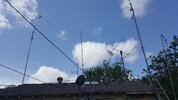
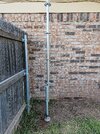
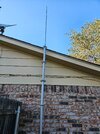
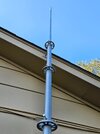
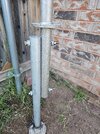
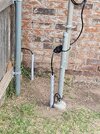
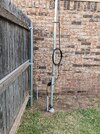
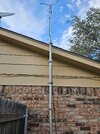
I got my Ham Radio licenses at age 17 back in December ‘99. January 1, 2000 dad and I installed a Rohn 50’ galvanized push up antenna mast for my G5RV Inverted V dipole antenna. In May ‘08 I bought an AL-811H amp. I decided to upgrade the coax to RG-213 as well as replace the G5RV Inverted V with a new G5RV Inverted V dipole. I also added a 10’ section of 1.25 OD galvanized TV antenna mast to the top of the push up pole so I could get the G5RV Inverted V up closer to 60’. This has been my home HF antenna set up for the past going on 26 years other then for the 10’ TV antenna mast extension added in May ‘08. When dad and I installed the push up pole January 1, 2000, we dug a 30” deep by 18” wide hole. We placed the base of the pole in the hole and then filled it up with tightly packed pea gravel. This has made for a very sturdy base for the 50’ push up pole. The pole is grounded at the base with an 8’ copper ground rod in the ground and a 10” long 00 gauge copper braided 48V electric forklift battery cable connected from the ground rod to the pole. The pole is mounted at the back of the house right next to the brick chimney. The chimney is about 16’ - 18’ tall. At the top of the chimney, there are two 2” wide stainless steel “chimney mount” straps that provide a strong support for the pole. About 38’ - 40’ up, I have three 5 1/6th” gauge steel braided cable guy wires. Each guy wire has a Porcelain guy wire insulator 12” from the guy wire pole end as well as 12” from the support end. Because the G5RV Inverted V dipole antennas total weight is less then 4lbs, the guys are not supporting any weight other then keeping the pole from swaying back and forth in strong winds. I live 27 miles north of downtown Houston, Tx and 70 miles north of Galveston Island. Over the past 25 years, Houston has had 4 tropical storm direct hits and 4 cat 3 or higher hurricanes along with countless numbers of strong thunder storms with 70mph + winds. The galvanized push up pole (at 60’ since May ‘08) has stood tall like a champ and twice on Sundays with zero issues. When I know a tropical storm / hurricane is coming, all I need to do is take both legs of the G5RV Inverted V dipole antenna (that are tied off to the back yards right / left side picket fence line, from the end of the antenna leg porcelain insulator to the picket fence, using 8lb test “Spider Wire” nylon braided fishing line) and coil both legs back to the base of the push up pole (each of the two inverted v antenna legs are made using 51’ of 14 gauge stranded bare copper wire), zip tie both coiled legs so the wire doesn’t come un coiled. And then zip tie both coiled antenna legs to the pole a 3 or 4 feet from the ground so that nether of the two legs blow around in the high winds as well as preventing the copper wire going up the pole to the top of the G5RV Inverted V from blowing around. Since the total weight of the G5RV Inverted V dipole antenna is no more then 4lbs, there’s practically no weight, other then the weight of the galvanized push up pole its self, to have to worry about. The three 5 1/6th” guy wires up around 38’ - 40’, are more then enough to keep the pole from swaying around in high winds. During hurricane Ike in September 2008, before it made a direct land fall on Galveston Island, it was the largest Cat 5 hurricane in history. When it hit land fall on Galveston, it was a very strong Cat 4 with wind gusts up to 151mph. By the time Ike got up to my home, 70 miles north of Galveston, it was a strong Cat 3 with max wind speeds of 126mph at my home. The push up pole performed like a champ. In the spring of 2010, 2012, 2019 and 2024, we had several back to back thunder storms with wind gusts as high as 84mph at my home during one of these thunder storms in May 2024. June 2024 Houston got a direct hit from hurricane Barrel which was a strong Cat 3 when the eye made land fall. The eye of the storm passed just 6 miles west of my home. My max wind speeds were 112mph. The push up pole right around 60’ up, had zero issues with the wind thanks to the 3 guy wires up around 40’. If I had a much heaver 3 or 4 element multi band beam antenna at the top and not the light weight G5RV Inverted V dipole antenna, I would have used heaver 1/4” - 3/8” gauge guy wires depending on the antenna weight. I would have also lowered the push up pole as low as the beam antenna would let me. A 3 or 4 element 3 or 4 HF band beam antenna or a long 13 element 2m band yagi antenna will have a much greater wind load compared to a 14 gauge copper wire dipole antenna thats hanging straight down from the top of the pole to the base of the pole. I would not give it a second thought if I needed to buy another 50’ galvanized push up antenna pole tomorrow if needed. I’v been very pleased with my almost 26 year old push up pole.
- KD5ITM -