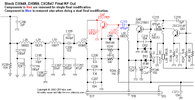
The MOSFET is missing the Bias Source to Drain - resistor network.
They are not Bipolars, that type needs an MV-1Y or a typical 1N4148 PN diode (Read as: Non-Schottky)
These guys, your MOSFET need a source resistor, and a dropping resistor - two resistors from the 8V bias line - the middle where the two resistors meet, is the Bias point - a resistor divider with the middle connection being towards the GATE or with that 100K trim, you shunt the output wiper arm - load across it, with a 47K resistor (or 4.7K if they did the Final Bias too - just duplicate that if you can) to that same GATE.
View attachment 61822
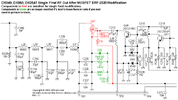
After
View attachment 61823
See the Green highlighted work? You rework the DRIVER side and source thru that
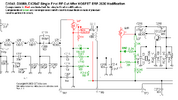
View attachment 61825
So D92 gets pulled, L37 can be kept - R245 changed to a 47K and at junction of R245 and D93 (D93 is removed - kept for later to be installed elsewhere)
The Trace where D93, R246 and VR12 meet you install a 39K resistor from that junction trace, solder 1 leg to that trace and across to foil ground the other resistor leg gets soldered to that foil ground.
Thats the Divider for the voltage trimmer.
VR12 then sources 1/3 the supply rail voltage to turn on the MOSFET
But you're not done, then at the junction of where D92 went solder a 2.2K resistor and D93 or D92 either or can be used, as the Bias diode and resistor (done in series) to drop 1/5 the output of VR12 - so this should give you an adjustment of 2.3 to as much as 3.4 volts - which is all you need for the Driver.
You see two dividers, yes that is correct, and the reasoning is the DC side, is the HIGH-IMPEDANCE side which gives you your source voltage to start.
The other side, towards the Driver itself, is the secondary one that handles RF issues when RF is present in higher amounts that can get "reinjected" so the purpose of the D92 is to rectify that RF into a DC-current you can work with in the RF - Driver side.
The Diodes BANDED end goes towards Foil Ground.
Some people revert to the older style of Zener across where D92 was, D93 if it exists - is removed.
What you have to keep in mind, if you decide to do this, is if you go the Zener route, that diode can get your biasing into trouble - you can shoot more voltage to the MOSFET - latching it on - as you're experiencing now.
So you'll have to "divide" down the voltage to less than 4V and adjustable from 2.5 to 4.1 volts - to make this work.
10 Amps is not correct - 100mA or even 55mA is the recommended draw.
Attached is a PDF I captured from the old CB Tricks site to show how to convert the older "dual final 2312 - style" EPT3600 boards.