• You can now help support WorldwideDX when you shop on Amazon at no additional cost to you! Simply follow this Shop on Amazon link first and a portion of any purchase is sent to WorldwideDX to help with site costs.
  • A Winner has been selected for the 2025 Radioddity Cyber Monday giveaway! Click Here to see who won!

SIRIO sy27-4 yagi keep the gama match or convert to hairpin , Thoughts ? experience ?

Geoexplorer69

Member
Sep 18, 2024
49
41
18
56
Hello Everyone .
Getting my setup situated at the new qth. I have a good deal on a slightly used ( doesn't look like it to me ) Sirio 4 element yagi with a rotor and controller .

my question to all you gurus or folks with experience is ,

the Sirio has a gama match Ive been reading and researching all I can on the plusses and minuses of gamma vs hairpin matching . ether way I will be using a 1 to 1 balun at the antenna and LMR 400 coax for the run . I'm a little bit confused about getting a Very good if not perfect match from about 26.900 -
27.700 MHz if possible . might be wishful thinking I know but hey I can hope right .

I want a low a swr as possible not only for the radios and the loss of power or signal I might entertain an amp at some time in the future . right now I run an Anytone quad 5 v2 and a Yaesu Ft991 that I modded for 11m . I have been using a serio monsoon 5/8 vertical with good dx but I want to work Dx better .
ok that's about it any suggestions would be greatly appreciated
cheers
 
  • Like
Reactions: Dusty1USA

Direct connect coax with ugly balun.
Just tune antenna for freq you use the most.
Mike
ok that one I assume for a hairpin match . thank you Mike .
since I'm mostly on the upper portion of the LSB band and rarely go below 27.285 I'm not really concerned with a little higher SWR ( 1.2-.3 max ) below .
My biggest concern is having to take the Yagi down as that would be a PITA to do. Im not at a per QTH so no towers here just a pole .
 
  • Like
Reactions: Dusty1USA
Direct feed, the drivin element is insulated from the mast and fed directly with with a 1:1 Balun
Good info here on direct feed, element length, spacing.....

thank you , indeed good info . I'm leaning more and more on direct feed the more I research it . Any way since im not at a perm QTh and using a pole I think I'll mount the rotor on the ground to start that way if I do have to pull the yagi down it will be easier . 73
 
You can always do the direct feed and tuner option, but you might find the harder path is more rewarding in the end. I have spent quite a bit of time figuring out the design process for both if you need any help with it (assuming you can measure the feed point impedance). The hairpin is wider, but I don't think it matters for the narrow bandwidth you are interested in.

I would leave the gamma match on it since the gamma requires no balun. If you could measure the feed point impedance at the center of your desired band, I could probably tell you what needs to change in which direction to get a better match. The only caveat is that the VNA must be calibrated to the end of the coax.
 
Last edited:
  • Like
Reactions: Geoexplorer69
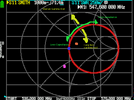
Here is a quick cheat sheet for tuning gammas. I used a random nanoVNA pic from the internet to make this so ignore all the background stuff.

gamma.png
You must have the VNA calibrated to the end of the coax for this to work. Lets say you set the CW frequency to the center of your desired range and got the orange dot. You would have to shorten the gamma rod until the dot was on the red line, then reduce the gamma cap to bring the dot down to the middle. If you had the pink dot, you would have to lengthen the gamma to get it on the red line, then probably add capacitance to bring it along the red line to the center.
 
You can always do the direct feed and tuner option, but you might find the harder path is more rewarding in the end. I have spent quite a bit of time figuring out the design process for both if you need any help with it (assuming you can measure the feed point impedance). The hairpin is wider, but I don't think it matters for the narrow bandwidth you are interested in.

I would leave the gamma match on it since the gamma requires no balun. If you could measure the feed point impedance at the center of your desired band, I could probably tell you what needs to change in which direction to get a better match. The only caveat is that the VNA must be calibrated to the end of the coax.
Brandon 7861,
Thanks for the info , I do have a nano vna and also was gifted an MFJ259B and an mfj226. not quite sure how accurate the MFJ's are however I did purchase some calibration connectors for the 226 . I use both along with the nano vna. I'm still trying to completely understand all the nuances of the nano and the fact that I'm 63 and I bought the small screen nano doesn't help. Maybe I'll spring for a 4 inch screen version after I'm done with this little spending spree.

I do like the idea of keeping the gamma match because that's what the antenna was designed around the only reason I said, I would possibly use a one to one Balun is everything I've read or seen videos, shows people using a one to one Balun on a hairpin .

I think I can certainly measure the field point impedance at the center of the band, and I believe you are alluding to me changing the length of the Director in the gamma match if I'm not mistaken. I really don't want to purchase a tuner if I can get away without one although I do have two but one is a manual QRP tuner I was gifted along with a Yaesu Ft817nd I don't think it would handle 100 W ( MFJ16010 )and the other one is a Chicom 100 W auto tuner that I don't know if I trust it enough.

Anyways, thank you for all the information. I'm waiting on the antenna to arrive this week along with the coax, and I had to purchase cable for the rotor.
73's and thank you for you time
 
Here is a quick cheat sheet for tuning gammas. I used a random nanoVNA pic from the internet to make this so ignore all the background stuff.

View attachment 73505
You must have the VNA calibrated to the end of the coax for this to work. Lets say you set the CW frequency to the center of your desired range and got the orange dot. You would have to shorten the gamma rod until the dot was on the red line, then reduce the gamma cap to bring the dot down to the middle. If you had the pink dot, you would have to lengthen the gamma to get it on the red line, then probably add capacitance to bring it along the red line to the center.
wow you answered my questions while I was formulating a reply to your earlier post. Thanks again, Brandon. Cheers.
 
Why not leave the gamma-match attached ?
You can expect a bandwidth as can be seen here :

That is no problem for most amplifiers, besides the Sirio isnt constructed to handle hugh number of Kw's.

I am a big fan of direct fed, but you will need to take element diameter etc in consideration for a good design, it isnt like lets take some rough dimensions and play with that. Well yes that will end-up with something that works but might actually be worse that what u started with.

A possible solution might be something similair like this:
That is 50 Ohms direct fed and if needed can be changed to your diameters and frequency span.

PS if you remove the gamma-match the antenna will have an impedance of roughly 30 Ohms J-14.

You could also search for an F-yagi on my site without using a folded dipole but just a normal isolated dipole and feed the antenna with a so called DK7ZB match 2x50 Ohms https://www.qsl.net/dk7zb/dk7zb-match.htm
That will provided a nice symetrical match.

I would just put it up first and enjoy the beam !
And when really needed..there certainly are various options..
 
I am a big fan of direct fed, but you will need to take element diameter etc in consideration for a good design, it isnt like lets take some rough dimensions and play with that. Well yes that will end-up with something that works but might actually be worse that what u started with.
If that was for me, I do take element diameters into consideration.

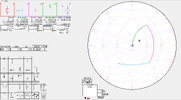
The ratio of the driven diameter to the gamma rod diameter, along with their spacing, form an impedance step-up constituting the first step in the transformation (the blue line). Then, there is a shunt inductance, the gamma path back to ground. This inductance also depends on the diameter ratios and spacing. The inductor portion of the gamma is essentially a shorted transmission line of a specific characteristic impedance and wavelength (easy math). This is shown using the pink line. Then, the green line is the gamma capacitor following the series path down to 50ohm. So yes, I do take the diameters into account..
Screenshot from 2025-07-06 22-37-19.png

Hairpins aren't any different, diameter and spacing matters there too. Again, the hairpin is a shorted transmission line, so its characteristic impedance and wavelength matter. I don't guess (not with matching networks anyhow lol).
 
I don't do enough antenna modeling. I know making a diameter bigger, the length must get shorter, and the bandwidth should increase. That must make it easier to tune or something? The OP needs less than 1MHz BW.

Until I can explore modeling in depth, I have to think in terms of discrete components and ignore the EM field stuff. A lifetime isn't enough to absorb it all.
 
Why not leave the gamma-match attached ?
You can expect a bandwidth as can be seen here :

That is no problem for most amplifiers, besides the Sirio isnt constructed to handle hugh number of Kw's.

I am a big fan of direct fed, but you will need to take element diameter etc in consideration for a good design, it isnt like lets take some rough dimensions and play with that. Well yes that will end-up with something that works but might actually be worse that what u started with.

A possible solution might be something similair like this:
That is 50 Ohms direct fed and if needed can be changed to your diameters and frequency span.

PS if you remove the gamma-match the antenna will have an impedance of roughly 30 Ohms J-14.

You could also search for an F-yagi on my site without using a folded dipole but just a normal isolated dipole and feed the antenna with a so called DK7ZB match 2x50 Ohms https://www.qsl.net/dk7zb/dk7zb-match.htm
That will provided a nice symetrical match.

I would just put it up first and enjoy the beam !
And when really needed..there certainly are various options..
Thank you Henry ,
I after all the helpful advice I've received on this thread form everyone ( yourself included of course ) I think I will just put the antenna together as per the specs , set the SWR for the best frequency spread I want hoist it up and give it a try .

The 11m band has been pretty fickle for me the past day or so not many contacts on LSB 38 or 37 or 36. getting too much QRM on my 5/8 vertical even with the choke and all the settings on the FT991. Australia came booming in the afternoon as usual, but I only made two Australian contacts two Colorado contacts A Washington state and 145 Jamaica , as compared to last Friday where I made over 40 contacts all across the USA , Canada , Australia, Hawaii, Jamaica .ect before I shut er down

I do appreciate the link to the other Yagi antenna's. I'm going to seriously be considering one of those direct feed Yagi's but probably one with more elements at least 5 , but I might go for a six when I have the room .

In the foreseeable future, the most I'll be putting through this antenna is 100 W which means with the coax ( LMR400 ) I'll probably see somewhere around 87 to 95 watts actual. I normally only push the Yaesu to about 60-80w depending on the skip. most time I'm just running 20w which I figure is around 12w actual .

I don't think an amplifier is in the cards for a while an since the Sirio is rated for I believe 1000 or maybe 2000 watts ( ether way I'll expect to half that figure ), I still won't get an amp that puts out more than 500W unless I can find a good Yaesu amp made for this FT991 that puts out more wattage .
Cheers and 73's
 
  • Like
Reactions: Henry HPSD

dxChat
Help Users
  • No one is chatting at the moment.