
• You can now help support WorldwideDX when you shop on Amazon at no additional cost to you! Simply follow this Shop on Amazon link first and a portion of any purchase is sent to WorldwideDX to help with site costs.
  • The Winners of the three Retevis radios 16 Anniversary giveaway are announced!! Click Here to find out if you won!

Stryker 955HP v2 doesnt like the cold

MKwrench

Wooohoooo!!!
Aug 6, 2023
125
116
53
55
My Stryker is back on my workbench, It seems that when the temperature goes below about 60f, it loses RX and TX.
I suspect a VCO voltage change causing an old fashoned "Out Of Lock" condition. I opened it back up and went to town with the freeze spray (When did that crap get so pricey?).
It's narrowed to the fornt left corner viewing the component side. I believe the issue is under the brass colored shield that I'm having a hard time removing. I had the other longer shield off to directly test the area too.
What's in there? I kind of doubt I'll be able to repair it unless it's real obvious. I don't have any hot air equipment for SMT stuff.
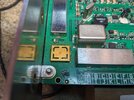
 

Attachments

  • Brass shield.jpg
    Brass shield.jpg
    1.6 MB · Views: 7

I see a crystal under the lower right slot. It's most likely an oscillator.

If I was in a situation like that without hot air, I would flood the left and right sides with solder (since that is where it appears there are through hole pins on the shield), and then with two very hot irons, simultaneously heat both of those sides. After about 5-10 seconds of heating, chop sticks it out with the two irons.

Or, if you have a crappy pliars, get it very hot with a torch and use it to grab the two solder-flooded sides and gently lift after the heat spreads around the shield. just don't be huffin' those zinc and chromium plating fumes when heating the tool, not good for the lungs.
 
The number one problem I see repairing radios these days is bad solder joints, especially in Ranger built radios. It is most prevalent in the spring and fall when you get big temperature swings outside in the vehicle. If you can catch it doing the failure, with the case off, take the eraser end of a #2 leaded pencil and gently go all around the foil side of the main PCB and apply a little pressure with the pencil. If it is a cold solder connection, it will usually show itself when you get to the area of the problem. If that don't reveal the problem, try the top side of the board and apply pressure where the board does not have a component mounted. Surface mount ICs can also be a source of a bad solder connection with their numerous and tiny legs. All solder used now has no lead in it and a low melting temperature, so it is not as hard of joint as the old days of leaded solder. There are many problems that can cause your symptom, but this is an easy test you can do with virtually no tools required.
 
  • Like
Reactions: BC Coyote

dxChat
Help Users
  • No one is chatting at the moment.