I'm trying to find a photo of the solder side, and the inside if possible of a Cobra 29 PC board. Mostly because of this( see photo). Also in a last ditch effort to figure out what the heck's wrong with this thing.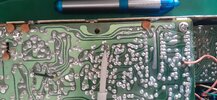

10V ZenerI'm trying to find a photo of the solder side, and the inside if possible of a Cobra 29 PC board. Mostly because of this( see photo). Also in a last ditch effort to figure out what the heck's wrong with this thing.View attachment 71814

Tell us what's wrong with it. What's the issue you're having?I'm trying to find a photo of the solder side, and the inside if possible of a Cobra 29 PC board. Mostly because of this( see photo). Also in a last ditch effort to figure out what the heck's wrong with this thing.View attachment 71814

I crossed the marking. 10V Zener. BZX384-C10Hmm. Just to the rear of the PLL chip. Are we sure it's not a varactor diode? RCI has been doing this for years since varactors with wire leads became harder to come by in large quantities.
73
No audio. I mean, at all. Meter doesn’t move beyond original key up. No swing at all. Replaced original final due to short to the heat sink. Never was audio out of the 4 watt carrier. If I yell or blow into the mic I can hear that thru another radio. No words at all! I have audio out of the PA. BC Coyote and NomadRadio have helped me with this for a while on another thread “Cobra 29LTD parts list”. V4 does nothing so I removed D11 it tests good. Removed the nearest cap, tests good. Double checked 2 mics. I intend to remove and check tr17 and tr18 just because they are in this circuit. I’ve examined every inch of this thing, nothing obvious visually.Tell us what's wrong with it. What's the issue you're having?

A 1SV215 varactor diode also has T2 as a marking.I crossed the marking. 10V Zener. BZX384-C10
A 1SV215 varactor diode also has T2 as a marking.


It gets worse in this case as there are multiple zener diodes marked T2, not just a 10v zener and the varactor I mentioned. There are also switching diodes marked T2;I'm obviously WAY too old.
How are you supposed to know "what part is what" when multiple SMD parts have the same marking??? I like old radios!
It is still... in my humble opinion... goofy to have multiple part types with the same number. Do bear in mind..... I said I was getting WAY too old...It gets worse in this case as there are multiple zener diodes marked T2, not just a 10v zener and the varactor I mentioned. There are also switching diodes marked T2;
My first step is an image search, because there, you will see the most common ones. With the most likely suspects in mind, I then go to the SMD code databases and double check, comparing package sizes etc.
This next suggestion is more applicable to transistors than diodes, but may still apply. It is common for a radio to use the same parts more than once in the circuit, so look around for another one with the same marking. It is unlikely that they will use two different parts sharing the same marking, so finding another gives you one to test in the event the one in question is smoked. In the case of zeners or varactors, finding another is unlikely, but worth a look anyhow as switching diodes would likely exist in multiple places. Follow the hints the radio provides.
After that, it really does come down to looking at the schematic, or if you dont have one, looking at the nearby circuitry and maybe measuring voltages or signals to get an idea which of the remaining suspects it could be.
I crossed the
I've been working with the schematic. I started at V4 because that controls the modulation. I went forward in the circuit through all of the likely suspects. Now I'm going to go backward from V4 there's two transistors in there I'm going to remove and check. It's just so close, everything else works. And I wish I could get a picture of the inside and the solder side of the circuit board. I asked on Dan's thread for Sam's photo facts haven't heard back yet.It gets worse in this case as there are multiple zener diodes marked T2, not just a 10v zener and the varactor I mentioned. There are also switching diodes marked T2;
My first step is an image search, because there, you will see the most common ones. With the most likely suspects in mind, I then go to the SMD code databases and double check, comparing package sizes etc.
This next suggestion is more applicable to transistors than diodes, but may still apply. It is common for a radio to use the same parts more than once in the circuit, so look around for another one with the same marking. It is unlikely that they will use two different parts sharing the same marking, so finding another gives you one to test in the event the one in question is smoked. In the case of zeners or varactors, finding another is unlikely, but worth a look anyhow as switching diodes would likely exist in multiple places. Follow the hints the radio provides.
After that, it really does come down to looking at the schematic, or if you dont have one, looking at the nearby circuitry and maybe measuring voltages or signals to get an idea which of the remaining suspects it could be.

