• You can now help support WorldwideDX when you shop on Amazon at no additional cost to you! Simply follow this Shop on Amazon link first and a portion of any purchase is sent to WorldwideDX to help with site costs.
  • A Winner has been selected for the 2025 Radioddity Cyber Monday giveaway! Click Here to see who won!

Why are Bird meters all the rage?

Dirty Duck

New Member
Mar 29, 2025
47
9
8
29
I have a Dosy meter that hasn’t been reliable since day one.

Usually I’m running barefoot on either a uniden Grant that swings 15 watts or a Galaxy 959 that swings 20 watts. “tested on a friends meter”

Once in awhile I’ll run an amp if someone is straining to hear me but, usually there’s no need to.

Why are Bird meters so expensive? What’s so special about them? Are they worth getting over what I have?
 

I have never had a Bird, but I have three of the discontinued Autek WM-1 meters. I think the Bird is out of my price range for hobby use. I guess the Bird slugs can be calibrated, and it is a robust unit that is capable of measuring a crazy amount of power. But I haven't been able to convince myself that I need one.

The WM-1 can be found used on eBay, and the most I have paid for one is $160.

image-241217-161205.jpg
 
The Bird meters were built for the professional technician, rugged, to be carried around on the job.
They are expensive, and for casual hobby use is overkill as far as I am concerned.
To be accurate the slugs need calibration if they are old and have been used in the field.
This also opens the door for people to tamper with them, and the same goes for the peak kit add ons, they can also be manipulated to show excessive power.
We used Telewave meters when I worked for the county because it did not need slugs and it was also a rugged meter that could be used mobile without feeling fragile.
It boils down to user preference in the end.
If you buy the meter and slugs new from a reputable person, good chance they will be calibrated properly, anything used....
Crapshoot.
That's any used meter, too many people don't like what they see based on unrealistic expectations and just have to pull the cover and twiddle things to make them feel better.

2 cents

73
Jeff
 
The Bird meters were built for the professional technician, rugged, to be carried around on the job.
They are expensive, and for casual hobby use is overkill as far as I am concerned.
To be accurate the slugs need calibration if they are old and have been used in the field.
This also opens the door for people to tamper with them, and the same goes for the peak kit add ons, they can also be manipulated to show excessive power.
We used Telewave meters when I worked for the county because it did not need slugs and it was also a rugged meter that could be used mobile without feeling fragile.
It boils down to user preference in the end.
If you buy the meter and slugs new from a reputable person, good chance they will be calibrated properly, anything used....
Crapshoot.
That's any used meter, too many people don't like what they see based on unrealistic expectations and just have to pull the cover and twiddle things to make them feel better.

2 cents

73
Jeff
As part of my employment agreement with a manufacturer I now refer to "Turd", I used my own Bird equipment, that was repaired and calibrated at 6 month intervals, at their expense. When it was time for repair or cal, the cal lab would condemn at least a third of my elements, as unable to cal/repair and would replace them. I have 3 250H's. All read differently. 3 100E's, same thing. I had one meter movement replaced 3 times in 3 years.

The YouTube techs/builders showing big numbers are full of shit. The cal is fudged or non existent and/or, spurious is unknown, when no SA is shown. The meters are slow and I don't trust them, especially when reading PEP. I also have Telewave 44A, that I am not much of a fan of either.

Bird equipment is not what it once was. Cost cutting in manufacturing is obvious. The people that swear by Bird wattmeters, are living in the past, because they have no future.

73,

SL
 
I also have Telewave 44A, that I am not much of a fan of either.
It was decent for vehicle install work back when a lot of the county vehicles ran VHF lowband and I was ok just throwing the thing in a bag with other tools.
The only thing that the Bird or Telewave has going for them is the solid enclosures the way I look at it.
And your correct for a base station/bench there's now better choices that offer much more value.
It's a name that has gained a cult following in the CB world.
Got to have them bird watts or ur not a big strap.
It's
Kinda like RMS
One company printed that on the face.....

73
Jeff
 
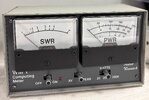
This is the meter that sets on my radio bench 95% of the time hooked up because I like the features it has,

Dosy TC-4002 SW-4 Watt Meter​

When I first got it I took it to a small radio shop and had it calibrated to a Bird meter and it hasn't messed up a radio yet on me. The only thing was it was stingy on the modulation reading so I took a radio to a reputable repair shop and had them set the modulation at 100% and then hooked up the radio to my meter and adjusted the modulation on my meter to read 100%. Been happy with it ever since. I also have a

Dosy TFC-3001-S Inline Watt Meter​

When I want to check the 6 digit freq reading on a SSB radio.

I also have a Dosy TFC-3001 that only reads AM freq reading but the SWR reading is broken down to finer detail reading and I use that for checking mobile radios on installation and all 3 Dosy meters read the same. I don't bang my stuff around but I wouldn't go into business with them either. Just my Humble Opinion !
 
  • Like
Reactions: Shadetree Mechanic
Bird is the word..
People get butt hurt when they see their 1000w amp doing 500w swinging to 200w.
Bird or coaxial dynamics. No other watts matter.
 
The Bird's claim to fame dates back to the dark ages when the only way to tune the antenna on a police car or fire engine was with a wattmeter. It was the universal standard in business-radio installation/maintenance when I was wet behind the ears. The Bird's popularity was with its ruggedness, and the ability to hold its calibration even after being dropped a few times. The meter movement wasn't bulletproof. Had to replace a couple of them after a model 43 fell out the door of a semi. New meter movement, and it's as good as new. Oldest one I have is 50 years old. Pretty sure it's on its third meter movement. The serial-number plate fell off decades ago. The difference boils down to lab grade versus consumer grade. If you're a consumer, the other alternatives are perfectly suitable. Just how much accuracy do you need in a universe where cutting your power in half barely makes a difference to the S-meter at the other end?

73
 
Besides the tough as old boots rugged enclosure & line sections the reason Bird is popular with cbers ( Birds the word ) is the H slugs response rolls off as you go up in frequency so they don't massage your ego like wide band couplers do when testing your harmonic spewing cb amplifiers & clip n tuck cb radios,

strip line cb type meters have a habit of indicating more power as you go up in frequency & the line section becomes a larger fraction of a wavelength,
DOSY watts, Perfect for showing off to your gullible cb buddies

I have bird43 & Tellewave 44 but I much prefer the coaxial dynamics larger oblong meter using bird H slugs, Much easier on the eyes.
 
  • Like
Reactions: Shadetree Mechanic

dxChat
Help Users
  • No one is chatting at the moment.