• You can now help support WorldwideDX when you shop on Amazon at no additional cost to you! Simply follow this Shop on Amazon link first and a portion of any purchase is sent to WorldwideDX to help with site costs.

And now for something completely stupid. The Tweety Bird noise toy.

nomadradio

Analog Retentive
I Support WorldwideDX.com!
Apr 3, 2005
8,522
14,157
698
Louisville, KY
www.nomadradio.com
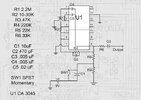
Now and again day-to-day life just drives me to do something stupid, if only for the sake of variety. This is a chore I have procrastinated for ten or fifteen years, maybe more. I'll guess that this wiring diagram for the traditional analog "Tweety Bird" noise toy has made the rounds over the last few decades. The CA3046 chip shown has been discontinued for a while. It's the most primitive integrated circuit you'll find. Only contains five NPN transistors. That's all. Two of them are connected together at the emitter, called a differential pair. I'm pretty sure this wiring diagram is correct. A guy who worked for me decades ago built a batch of them from this graphic and they worked. But it annoyed me that it isn't a proper schematic. Doesn't show me what's really going on.

images

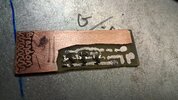
Tweety Bird.JPG


That irresistible urge to do something stupid took over and I translated it into a proper schematic diagram.

Tweety.jpg

Maybe. And that's my reason for posting it today. Free proofreaders. If you find an error, I'd be grateful to see what it is. My patience has been consumed, and I refuse to look at it any more for a while.

Yeah, I have a batch of this chip. Might just do something stupid like make some of these. But only if I think they'll sell.

73
 

Attachments

Last edited:

I got bored and put it into CircuitLab. Everything to the left of the mouse cursor is the circuit posted above using discrete transistors (and a 100k output resistor to keep the simulation output clean).
Screenshot from 2025-07-28 03-41-22.png
Everything to the right of the cursor is an astable 555 with a low frequency and small duty cycle to produce a short pulse to the relay to simulate a button press. The bottom mosfet and associated RC keeps the relay off for a moment so the simulation can start before the button is pressed. The moment the switch (relay) is released, the capacitor across it begins to charge back up and that drops the voltage supplying the oscillator as it fizzles out.
1753692593759.png
Zooming in on the oscillation, it looks like
1753692695854.png
1753692736208.png
I have no idea if this is how the circuit actually behaves in real life, but I am tempted to put one together and find out. Just not tonight. If anyone wants a different point probed and the sim re-run, I can do that tomorrow at work.
 
Thanks for posting that, Nomad. Not sure I've ever actually heard that particular effect on the air but at least now if I do I'll know what's making it.
 
I could have done something wrong in the sim. Its not expensive software either, just an online sim with a cheap subscription. I should have just tossed one together to test it.
 
  • Like
Reactions: AudioShockwav
Using a few cheap, discreet transistors rather than the ic would be much cheaper, I found a couple options for sale of the ic but I would definitely not spend that much on something I could build cheaper. If you have a batch just laying around and nothing better to do, sure. At those prices, however, I would just sell them and use transistors anyways. I may just build one using my abundance of thru hole parts and perf board. Idk why. Bored I guess.
 
  • Like
Reactions: brandon7861
Slightly off-topic but still noise toy related:

Anyone remember the TI SN76477 sound effects chip? Used in a LOT of video games of the 70s and early 80s. I still have one in my junk box.

One of the electronics mags of the period had a noise toy construction article. I played around with the concept, incorporated shift registers, latches and a sequencer - and the resulting sound was the first 10 seconds of the old Missile Command game.

It was used very sparingly on the air.
 

dxChat
Help Users
  • No one is chatting at the moment.
  • @ Hambones amps:
    Does anyone know if you can replace the 2290 in a galaxy dx 93t twin turbine with a 2sc2879 red dot? If so, what would have to be tuned?
  • @ ShadowDelaware:
    Hambones the entire amp section would have to be retuned, and the rf transformers re wrapped.