

Haven't played with Lazarus this week, hardly. Ordered the Tune and Load control capacitors from RF Parts. I'll feel more enthusiastic with those two parts in place.
In the meantime here's an angle from my day job. This particular Browning Mark 3 SSB transmitter is getting its AM/USB/LSB mode selector bypassed, making it a straight AM-only transmitter. Much cheaper than replacing the Mode switch.
But here is a step out of our "hot-wire" procedure to totally bypass the defective Mode Selector in the Browning Mark 3 SSB transmitter. The switch develops leakage across the insulation separating individual switch circuits.
One of the most annoying of these "across two circuits" leakage paths will affect the transmitter's meter. The symptom is that switching the meter select knob to "Mod" causes the meter to peg violently while receiving. Don't even have to key the mike. If you see this, PULL THE PLUG. NOW! Then you can turn the meter selector back to "SWR" or something safe.
The really annoying part is when the coil inside the meter burns out. Forever.
To avoid this we routinely bypass just the "Mod" meter circuit. Only involves two wires, and it's cheap insurance even if your mode selector appears to still be perfect. There is a major wear-and-tear angle to this breakdown, so a low-mileage transmitter may have no such problem.
Maybe not today, maybe not tomorrow, but soon. And for the rest of your life.
Sorta.
This trick simply unhooks the transmitter's meter from the mode selector. This will protect it from later failure of the selector down the road.
First, identify the two wires we'll be molesting.

The orange wire leads from the meter switch to the mode selector. The white/green wire leads from the modulation-voltage detector to the mode selector.
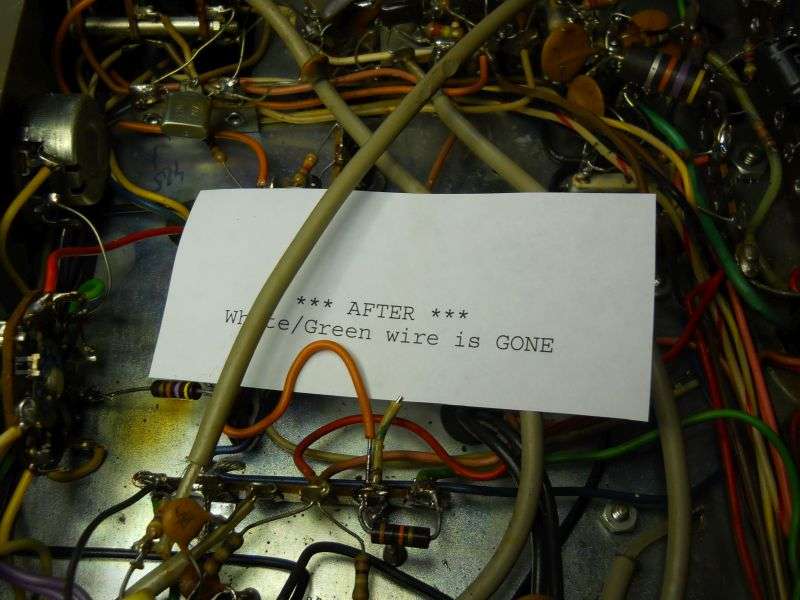
The white/green wire gets removed altogether. The orange wire gets cut near the mode selector so it will reach to the tie point where the white/green was just removed.
I wouldn't normally leave a stub of the white/green wire, but it serves to identify the correct lug.
And that's all there is to it. Remove one wire, the white/green and move the orange wire to where it used to be.
73
In the meantime here's an angle from my day job. This particular Browning Mark 3 SSB transmitter is getting its AM/USB/LSB mode selector bypassed, making it a straight AM-only transmitter. Much cheaper than replacing the Mode switch.
But here is a step out of our "hot-wire" procedure to totally bypass the defective Mode Selector in the Browning Mark 3 SSB transmitter. The switch develops leakage across the insulation separating individual switch circuits.
One of the most annoying of these "across two circuits" leakage paths will affect the transmitter's meter. The symptom is that switching the meter select knob to "Mod" causes the meter to peg violently while receiving. Don't even have to key the mike. If you see this, PULL THE PLUG. NOW! Then you can turn the meter selector back to "SWR" or something safe.
The really annoying part is when the coil inside the meter burns out. Forever.
To avoid this we routinely bypass just the "Mod" meter circuit. Only involves two wires, and it's cheap insurance even if your mode selector appears to still be perfect. There is a major wear-and-tear angle to this breakdown, so a low-mileage transmitter may have no such problem.
Maybe not today, maybe not tomorrow, but soon. And for the rest of your life.
Sorta.
This trick simply unhooks the transmitter's meter from the mode selector. This will protect it from later failure of the selector down the road.
First, identify the two wires we'll be molesting.
The orange wire leads from the meter switch to the mode selector. The white/green wire leads from the modulation-voltage detector to the mode selector.
The white/green wire gets removed altogether. The orange wire gets cut near the mode selector so it will reach to the tie point where the white/green was just removed.
I wouldn't normally leave a stub of the white/green wire, but it serves to identify the correct lug.
And that's all there is to it. Remove one wire, the white/green and move the orange wire to where it used to be.
73

