• You can now help support WorldwideDX when you shop on Amazon at no additional cost to you! Simply follow this Shop on Amazon link first and a portion of any purchase is sent to WorldwideDX to help with site costs.
  • A Winner has been selected for the 2025 Radioddity Cyber Monday giveaway! Click Here to see who won!

How do you probe amplifier outputs...

brandon7861

Loose Wire
I Support WorldwideDX.com!
Nov 28, 2018
2,157
2,357
293
....without buying a ready-made attenuator? Here's the problem:

All 10x probes are de-rated with frequency. The PP215 probes that came with my siglent scope have a 600v DC rating, but the chart says that at 27MHz and up, they are only rated at 25v. 12w into 50ohm is already 24.5v, so any higher, such as the antenna jack of a dual final radio, exceeds that probe rating.

A transmission line probe is tempting, but the typical 21:1 transmission line probe with the 1k series resistor would require a 5w 1k resistor if I were to tee into a 100w 50ohm system (since 100w across 50ohm is 71v, and 20/21 of that across a 1k resistor would be 4.54w). I could do that, but I don't like my probe tips getting hot. If I wanted to use a 1/4w resistor to make my TL Probe, it would take a 20k series resistor and a 401:1 multiplier with a terminated 50ohm cable. Thats not practical.

So then I thought, what about using the 10x probe and another voltage divider at its tip. If I know I need a total of 20kohm to be able to use quarter watt resistors, using (6.7k+6.7k)/6.7k for a 1:3 divider will let me safely probe that 71v of RF, but I still need to tell the scope its a 30:1 probe and this all seems kinda janky.

I know some bird meters have a sample port, but I assume that attenuation is far greater meant for a spectrum analyzer input rather than a scope, never owned one to know.

What method do you use to probe high power signals? I feel like I am missing something really simple here.

Anyone know where I can find a decent 150w 20dB attenuator without spending $600? It doesn't have to go to 8GHz lol.
 
Last edited:

Hi,

I've never measured high output like that myself yet, but with that out of the way...
Before I got my wonderful Spinner 40dB attenuator that can handle 400 Watt, I did build myself a RF Power Tap and that works pretty well. (I tested it with low power only)

See this pdf: https://pa3csg.nl/wp-content/uploads/2017/04/build-an-rf-power-meter.pdf (it mentions the power tap a bit later in the doc)
and here's a youtube video that shows the device
 
That's neat, I like that. I didn't think of splitting up the resistor to split up the wattage. I already have a tee on the dummy load, so I think I will fit the tap portion into a burnt out SDR housing and attach it to the tee with an adapter. Thanks!
 
I ended up making a power tap to go on a tee at the dummy load. For the power tap, I did a 51:1 ratio using 5 sets of 4 paralleled 1k resistors in series (to spread out the power), and that into 50ohm across the output. All installed in the SDR housing.
1000004774.jpg

This is now connected to my old USB scope with a terminator on the scope end so both ends of the cable see 50ohm. I should be able to look at a 120w signal for short periods now without the tap getting too hot.

I liked sp5it's idea, but I wanted something I could set a custom probe for and get accurate readings. Now, with one click on my desktop, I can see the watts, modulation and spectrum.

Ugly dummy load, I know. The resistor inside that heat sync is 250w, just wrote 50w on it for a safe margin. edit: Its a G250N50W4 from mouser, 15 bucks and a CPU heat sync cut in half.
 
Last edited:
I connect the 10x oscilloscope probe at RF output,
or inside the radio at the RF output at the coax connector.
an easy place, if the covers are off of the radio.

I usually was using Tektronix, or B and K, 100 MHz scopes,
with their good probes.

on a 100W radio, into a 50 ohm dummy load,
adjust the ALC to kick in at 200 volts peak to peak.

then you can see on the scope, you have
100W p-p in SSB, and max key down CW 100W.
 
  • Like
Reactions: 19wrc333
I connect the 10x oscilloscope probe at RF output,
or inside the radio at the RF output at the coax connector.
an easy place, if the covers are off of the radio.

I usually was using Tektronix, or B and K, 100 MHz scopes,
with their good probes.

on a 100W radio, into a 50 ohm dummy load,
adjust the ALC to kick in at 200 volts peak to peak.

then you can see on the scope, you have
100W p-p in SSB, and max key down CW 100W.
I would be surprised if your BK probes are made to take 200v at HF. This came with my siglent probes:
1767026267253.png

although its a moot issue now with the power tap, I wouldn't mind buying a probe that can safely take 200v of RF if they exist.
 
I have a Pomona Electronics 6265 probe here that I use. it says right on it,
60 MHZ 300V

click here: Pomona O-scope Probes

my BK probes are PR-45. not made anymore.
Mine says 600v right on it. I don't think it is safe to assume that number applies to HF and up simply because they did not list the voltage/frequency curve in the info sheet. Maybe some of their newer probes list that info. If they do handle that voltage all the way up to the BW limit, I will definitely want to get one.
 
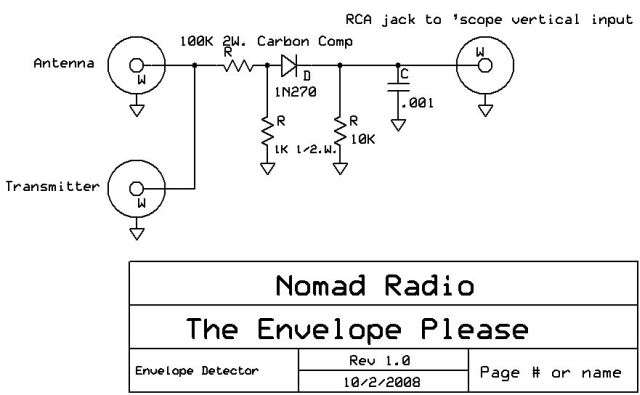
I use an envelope detector on the dummy load. Can't watch the RF output on the antenna this way, but that's not an issue.

The Heathkit cantenna has this circuit built in, meant to insert a meter probe. Changing a capacitor in it allows a fine view of the demodulated audio, and makes triggering on the modulation easier than when the 'scope tries to trigger on the carrier waveform.

Tells me what I need to know.

This was gonna be an inline version. Never even climbed up onto the back burner.

tepsm.jpg


73
 
I use an envelope detector on the dummy load. Can't watch the RF output on the antenna this way, but that's not an issue.

The Heathkit cantenna has this circuit built in, meant to insert a meter probe. Changing a capacitor in it allows a fine view of the demodulated audio, and makes triggering on the modulation easier than when the 'scope tries to trigger on the carrier waveform.

Tells me what I need to know.

This was gonna be an inline version. Never even climbed up onto the back burner.

tepsm.jpg


73
That's a good trick there too, just get rid of the high frequency stuff. Had you mentioned this yesterday, I probably would have done that and been satisfied.

I sure don't regret making the power tap though. With that, I can just click over to FFT and tune the 54MHz trap too, so I am really happy I went that route. It made quite a few things easier. For instance, last night talking to a local, my audio dropped out. I already had it connected, just opened the program and I could tell I wasn't modulating. Within seconds, I knew I had a bad mic gain pot. The more I can streamline diagnosing radios, the better.
 
  • Like
Reactions: Cable Guy
I have things wired up pretty slick. I have a coax switch that selects either my radio or the bench test coax (for repair radios) and sends it to the tuner's transmitter port. The tuner (MFJ-941E) has a dummy load position where the dummy load and oscilloscope tap are. The antenna is on "coax 1" and the sig gen, connected via attenuators, is on "coax 2". With one switch, I can select either my radio or a radio being repaired, and with the tuner switch, I can select between antenna, dummy load/scope/fft, or the sig gen for signal injection/tracing/meter adjustment. One coax, no messing around swapping cables.
 
Last edited:
  • Like
Reactions: Cable Guy
I use this before the amplifier to verify signal and audio.
IMG_20230707_085350215.jpg

IMG_20230707_085203508.jpg


I built nomad envelope detector and it is good also. I ran an amplifier through this once and ended up replacing lots of stuff inside, so don't put more than 50 watts in it.
 
  • Like
Reactions: brandon7861

dxChat
Help Users
  • No one is chatting at the moment.