• You can now help support WorldwideDX when you shop on Amazon at no additional cost to you! Simply follow this Shop on Amazon link first and a portion of any purchase is sent to WorldwideDX to help with site costs.

PSU Load Matching

Greg T

WDX-945 (Jazz Singer) Upper Peninsula of Michigan
Sep 18, 2014
1,464
2,510
273
72
Escanaba, Michigan
Quick question on ganging my two Megawatt 50A PSUs. I have one on top of the other and two 6ga cables connecting the busses. Then, I have the load connected to the bottom one. I just ran a little test and found out that at a 55 A draw, the top psu is only supplying 14 A. So, rather than whole bunch of circuit wizardry, could I balance the load by connecting the positive load on one psu and the negative on the other?
 

Surprised to know why you have not tried that yet?

How are you determining this "Draw" condition?

Various combinations of PSU "arrangements" always puts you back to a "square one" - use the Buss-distribution system.

But there are ways to accommodate the system when things can not always be equal.

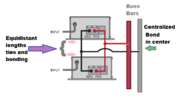
Bring out the copper and aluminum bar terminal systems...

Center-Fed FEED
1645532716528.png

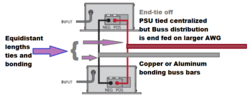
Then there are types of end-fed FEEDER systems...

1645532852635.png
My concern?

Develop a method using either the wiring harness itself - or take them apart and give them a once (or twice) go-over to remove all doubt that the system is feeding from their own systems correctly and with the LEAST AMOUNT OF VOTLAGE DROP - I am referring to possible disassembly and reassembly of these PSU units to verify their internals are correctly sensing loads - meaning that the ties from main PCB of the PSU to the buss terminals and the output and the sense return all point are correctly soldered and no issues can be made against improper assembly - you have two - so use one for a template for the other.

When you see these results - from your post. I can't help but wonder if there are bonding or soldering or other connection issues even an adjustable trimmer fault - between both; makes the electrons sourced from one - affect the performance of another to such a large degree,

 
Surprised to know why you have not tried that yet?

How are you determining this "Draw" condition?

Various combinations of PSU "arrangements" always puts you back to a "square one" - use the Buss-distribution system.

But there are ways to accommodate the system when things can not always be equal.

Bring out the copper and aluminum bar terminal systems...

Center-Fed FEED
View attachment 57549

Then there are types of end-fed FEEDER systems...

My concern?

Develop a method using either the wiring harness itself - or take them apart and give them a once (or twice) go-over to remove all doubt that the system is feeding from their own systems correctly and with the LEAST AMOUNT OF VOTLAGE DROP - I am referring to possible disassembly and reassembly of these PSU units to verify their internals are correctly sensing loads - meaning that the ties from main PCB of the PSU to the buss terminals and the output and the sense return all point are correctly soldered and no issues can be made against improper assembly - you have two - so use one for a template for the other.

When you see these results - from your post. I can't help but wonder if there are bonding or soldering or other connection issues even an adjustable trimmer fault - between both; makes the electrons sourced from one - affect the performance of another to such a large degree,
What I use is a clamp-on meter that senses current draw. I'm thinking the tiny amount of resistance in the leads connecting the two psus is enough to force the bottom one into being the master. I'm going to try moving one lead to the other psu today. I haven't tried it yet because they are rather difficult to access, being on a high shelf. Each PSU is outputting 14.41 volts individually. I CAN use one or the other and both perform well under heavy load. This is what makes me think the 6ga jumpers are just enough resistance to influence the sum output current.
To load 2 PSU equally in parallel you need current sharing circuit.
Yes, these Megawatt 700-12 PSUs are already built for ganging, and according to "John", should balance themselves.
 
  • Like
Reactions: Handy Andy
This is what makes me think the 6ga jumpers are just enough resistance to influence the sum output current.

Here where I stumble on this.

I just don't know how many amps were "in demand" when you did this difference test. Not a big deal but it made you stop and ask, hey I only got this (14A) out of one - the other took the brunt.

To see one at 14A the other at ??? and I still don't know the final sum of that draw - that's where I was stuck. So I just went ahead and posted something to help "organize" this into something workable so the differences can be seen - even duplicated to help others see the issues around the pull on one has the affect on the other.

In a previous thread others suggested diodes - another good trick but again leaves us in a set of predicaments finding a good diode to handle the draw on larger amp power supplies gets a little $$$ let alone that drop across the junction may be only 0.7V but to some that's the critical part. They ask "Why do I want to go thru with all of this?" when the instructions say they can be ganged together in either series or parallel and just keep the connections as equal in all aspects as possible.

What you presented was something I'd like to delve into more - but to do that requires just some more of "when I did this - I got that - then I did that and it did this"

It's where I'd like to see if any of these suggestions being made by everyone in the thread, was even able to work out for the better in your situation.
 
  • Like
Reactions: Greg T
Here where I stumble on this.

I just don't know how many amps were "in demand" when you did this difference test. Not a big deal but it made you stop and ask, hey I only got this (14A) out of one - the other took the brunt.

To see one at 14A the other at ??? and I still don't know the final sum of that draw - that's where I was stuck. So I just went ahead and posted something to help "organize" this into something workable so the differences can be seen - even duplicated to help others see the issues around the pull on one has the affect on the other.

In a previous thread others suggested diodes - another good trick but again leaves us in a set of predicaments finding a good diode to handle the draw on larger amp power supplies gets a little $$$ let alone that drop across the junction may be only 0.7V but to some that's the critical part. They ask "Why do I want to go thru with all of this?" when the instructions say they can be ganged together in either series or parallel and just keep the connections as equal in all aspects as possible.

What you presented was something I'd like to delve into more - but to do that requires just some more of "when I did this - I got that - then I did that and it did this"

It's where I'd like to see if any of these suggestions being made by everyone in the thread, was even able to work out for the better in your situation.
I do have an ammeter connected to the total output. This is not a steady pull as I was using my Texas Star for the load. BUT, the load was showing about 55A . So, I took the clamp-on out and checked them individually. YES, the meter fluctuated a bit, but was steady enough to expose the imbalance between the two. One showed 14A +or- while the other was about 40A +or-. Had they been within a few amps I would have still suffered the OCD anxiety, but not nearly enough to do something about it.

The thought of diodes had crossed my mind, and I can lay my hands on plenty of 75A diodes, but I'm trying to dismiss it on the basis that these things are meant to gang and should share the load, IF properly connected. This is telling me that I am not doing something correctly and that's what bothers me. LOL. I AM going to the basement to try connecting one lead to the top one, and one to the bottom. Somehow in my mind, this SHOULD work.
 
  • Like
Reactions: Handy Andy
AHA!!! Problem solved!! I split the load with positive on the top and negative on the bottom. Boom! 56A total and 28A on one. Looks dead nuts! Now, the question is; would this work for PSU that are not designed to gang? I think quite possibly!
 
Wow, sounds like a mating ritual ... sort of... (*ahemn*)

I'd just like to keep posted on the progress of this as it develops.
Well, rather than powering a remote buss, this is a more compact connection. Would be interesting to have someone try this with two psu not designed to stack.
 

dxChat
Help Users
  • No one is chatting at the moment.
  • @ heartbreaker3473:
    Hello gentlemen and Ladies. I have the dreaded RCI-2990 receive issue where my radio gets distorted when people get close to my location. I found the C90 Capacitor, but I can not for the life of me find the C89 capacitor. Can or does anyone have a picture of the exact location of C89 ? Thank you in advance, Wes
  • @ AudioShockwav:
    Wes, it's better if you start a thread on the main forum, more people are going to see your question.
  • @ heartbreaker3473:
    Okay, sorry, will put in a forum
  • @ heartbreaker3473:
    I put it in the general disscution help area and started a new thread. Thank you for letting me know.