• You can now help support WorldwideDX when you shop on Amazon at no additional cost to you! Simply follow this Shop on Amazon link first and a portion of any purchase is sent to WorldwideDX to help with site costs.
  • A Winner has been selected for the 2025 Radioddity Cyber Monday giveaway! Click Here to see who won!

RCI-2950 Gen 2 Memory Cap location ?

I have never tried to analyze this computer board. The presence of the EEROM puzzles me. The factory service folks told us in 1995 that the cap was good to retain data for a week. If the EE were used for that, it wouldn't matter if the capacitor ran down.

I think the "update EE while the cap bleeds off" might make more sense. Hadn't considered that scenario.

Somebody (else) with time on their hands should hook up some logic analyzer hardware and peruse what it does in detail.

Inquiring minds want to know.

73
 
  • Like
Reactions: brandon7861
All you can do is try replacing the cap(s). There are two, one before the voltage regulator and one after it. It is most likely the one after the regulator.

The mystery of what that EEPROM is doing, or how it stores the channel info, has not been sorted out. Does it write to the EE periodically or does it only write on power-down events? Nobody knows because nobody has put a scope to that chip yet. I would love to, but I don't have any RCI radios. The datasheet on the EE says the endurance is 1M cycles, it seems unlikely that it would be cooked. I would, however, assume the rom on the micro is programmed to only use one address on the EE for the channel data, so it could be cooked depending on how often it writes, but again, nobody knows for sure.

If you have a scope, take a look at that data line on the EE as you operate and power cycle the radio and let us know what you see :). Repetitious writes, or only on power cycle. Digikey does have the EE in stock, but the next question becomes whether or not it stores other data the micro reads each time it powers up, or if it only stores channel data. That will determine if you can simply swap out the EE or if it will require data transfer from the good blocks. I hope you have a 'scope!

EDIT: Thinking about the 1M write cycle endurance, lets say it writes every second. Thats 12 days to kill the eeprom address, so it is obviously not writing that often. Writing once a minute would become obvious over time when changing a channel and quickly turning it off. There would be reports of the channel coming back different in that case. So what remains? I think it writes on power-down and it is the charge in the cap that permits the micro and EEPROM to stay active long enough to get the job done, and in that case, a cap swap would fix it. Given there have been successful reports of cap swaps fixing this, I would tend to think that is the problem.
 
Last edited:
Home now, looking at the CPU schematic again. I am going to think out loud for a minute.

Something interesting is happening with that second shift register and the micro. U605 pins 5-8 go into a nasty resistor network, presumably turning 4 bits of digital into a programmable DC voltage. The output from it is fed into the micro Vref pin. The micro uses that pin with the comp(arator) pin to perform some programmed function.

Two things stand out here.

1) The comparator input comes from the main regulator output, but before the filter cap and isolated from it via diode. If the regulator loses power, this line goes low before the filter cap drains turning off the micro or shift registers and EEPROM. The 5v from the regulator, dropped by the diode, and passed through R629/R630 results in roughly 3.56v on the comp pin that goes away instantly on power loss.

2) With a 5v supply on the shift register, that resistor network could never output 3.56v even it all pins were high. It doesn’t take matricies and nodal circuit analysis to see that R616/R615, even if given the supply voltage of 5v, would only output 3.37v, and even that is impossible given the rest of the resistors. In other words, Vref is always lower than the comp line from the regulator.

So, we have a programmable reference voltage that gets compared against Vcomp which disappears fast upon power-down. Since this voltage disappears before the cap drains, I assume this comparator input triggers the write sequence when the power is turned off, and that cap (C604) keeps the chips hot long enough to finish that split-second write operation to the EEPROM.

This is, of course, mostly speculation. I set out to see if the circuitry supported power-off detection, and from what I see, I believe it does.

Just swap the cap, I'd bet it fixes it.

Edit: this might support NOT increasing the value of the pre-regulator cap. Increase the post-regulator cap all you want though.

 
Last edited:
  • Like
Reactions: TM86 and Cable Guy
Home now, looking at the CPU schematic again. I am going to think out loud for a minute.

Something interesting is happening with that second shift register and the micro. U605 pins 5-8 go into a nasty resistor network, presumably turning 4 bits of digital into a programmable DC voltage. The output from it is fed into the micro Vref pin. The micro uses that pin with the comp(arator) pin to perform some programmed function.

Two things stand out here.

1) The comparator input comes from the main regulator output, but before the filter cap and isolated from it via diode. If the regulator loses power, this line goes low before the filter cap drains turning off the micro or shift registers and EEPROM. The 5v from the regulator, dropped by the diode, and passed through R629/R630 results in roughly 3.56v on the comp pin that goes away instantly on power loss.

2) With a 5v supply on the shift register, that resistor network could never output 3.56v even it all pins were high. It doesn’t take matricies and nodal circuit analysis to see that R616/R615, even if given the supply voltage of 5v, would only output 3.37v, and even that is impossible given the rest of the resistors. In other words, Vref is always lower than the comp line from the regulator.

So, we have a programmable reference voltage that gets compared against Vcomp which disappears fast upon power-down. Since this voltage disappears before the cap drains, I assume this comparator input triggers the write sequence when the power is turned off, and that cap (C604) keeps the chips hot long enough to finish that split-second write operation to the EEPROM.

This is, of course, mostly speculation. I set out to see if the circuitry supported power-off detection, and from what I see, I believe it does.

Just swap the cap, I'd bet it fixes it.

Edit: this might support NOT increasing the value of the pre-regulator cap. Increase the post-regulator cap all you want though.
Looks like I will have to live with it. Don't have a scope. My radio is a RCI 2995 DX so I think I'm in the wrong forum. Anyhow thanks for chiming in.
 
Looks like I will have to live with it. Don't have a scope. My radio is a RCI 2995 DX so I think I'm in the wrong forum. Anyhow thanks for chiming in.
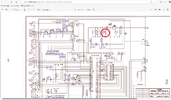
I was looking at the schematic for the RCI 2995 DX. I probably rambled on more than you needed me to because I continued on about how it might save the memory, but in all that rambling, I think all you need to do is swap one electrolytic cap on the CPU board, no scope necessary for that, It's this cap:
rci.png
 
I was looking at the schematic for the RCI 2995 DX. I probably rambled on more than you needed me to because I continued on about how it might save the memory, but in all that rambling, I think all you need to do is swap one electrolytic cap on the CPU board, no scope necessary for that, It's this cap:
View attachment 72092
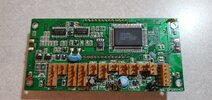
thanks so much brandon, I have already changed out 2 electrolytic caps on that display board. Didn't change anything. The 2 originals I pulled off were good. I put back in the same uf but a little higher on max voltage. No change. Should I maybe put in a higher uf cap?
 

Attachments

  • 20241018_172501.jpg
    20241018_172501.jpg
    521.7 KB · Views: 4
thanks so much brandon, I have already changed out 2 electrolytic caps on that display board. Didn't change anything. The 2 originals I pulled off were good. I put back in the same uf but a little higher on max voltage. No change. Should I maybe put in a higher uf cap?
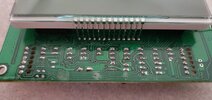
I don't see a C604 cap on the display pcb that I have, as the schematic shows.
 

Attachments

  • 20241018_165843.jpg
    20241018_165843.jpg
    1.1 MB · Views: 6
If you put in good caps, it may be something else wrong. I am assuming they only silk screened C4 and C19 instead of C604 and C619. And is there another chip on the back of the board? I don't see the LED driver on that one.

Since it works when plugged in, I assume the 5v regulator is good. The two diodes just north of the regulator, one is glass and the other is a smaller plastic one. Check the smaller plastic one with a DMM on the diode setting.

With good caps and no scope, I am grasping at straws here. You may be up the creek on this one without any test equipment.
 
Now that I'm thinking about it, check both of those diodes. If the small one opened or the bigger glass one shorted.
 
thanks Brandon for your help. Can I test those diodes in the circuit or do I have to remove them? Yes used Nichicon caps when I replaced C4 and C19
I think testing in circuit would be just fine. Without experience with surface mount components, do not remove them.
 
The stress of taking one loose won't be kind to it. And the thremal stress of putting it back might damage a part that had been perfectly okay.

And if you have spare stock of every SMT part on hand, no big deal.

73
In that situation, if testing in circuit didn't work out, I would prefer to slice a trace and bridge it when done testing.
 

dxChat
Help Users
  • No one is chatting at the moment.