
• You can now help support WorldwideDX when you shop on Amazon at no additional cost to you! Simply follow this Shop on Amazon link first and a portion of any purchase is sent to WorldwideDX to help with site costs.
  • A Winner has been selected for the 2025 Radioddity Cyber Monday giveaway! Click Here to see who won!

TRC-451 dead no RX

codecxbox

Active Member
Jul 28, 2021
124
51
38
Last year, somebody left on my porch a TRC-451..with a paper note saying "for you"..hopefully wasnt a death note since Im still alive..
K, I just left there around until yesterday..opened it up, of course driver and final were removed, but the radio seems pretty much intact..so put a 10m ant, no signal..pulled out my TinySA on the antenna connector with a 27.025M AM modulated to 1k, no signal. no AM or SSB. so I made a direct coiled probe and setup the TinySA to 10.7 and kind of moved the probe around T14 to T17 and I got signal..so then I was probaby a UmD 2824 pll problem..so I checked the binary inputs of the PLL and there is no 5 volts,according to the service manual, on any of the PLL binary inputs..
Bad PLL? If I remove the PLL, would I see 5 volts on the channel selector pins? channel display seems ok, when I turn the channel knob, it goes from 1 to 40..
 

Id have to go see where I tapped under the board for 5v when I unlocked the clarifier, but are you getting 5v on any of the pins on the PLL? There should at least be the 1 pin that gets 5v for the chip. If there is nothing there, then maybe something is going on with the 5v regulator. Do any of the transistors feel extremely hot when you power on?
 
  • Like
Reactions: codecxbox
Id have to go see where I tapped under the board for 5v when I unlocked the clarifier, but are you getting 5v on any of the pins on the PLL? There should at least be the 1 pin that gets 5v for the chip. If there is nothing there, then maybe something is going on with the 5v regulator. Do any of the transistors feel extremely hot when you power on?
not that I noticed..I was seeing the ps amp meter and dont see any wierd amp consumption..like less than 0.5A..also touching aroung with my finger, no hot spots..well the audio chip is kind of warm, but I think its normal
 
Id have to go see where I tapped under the board for 5v when I unlocked the clarifier, but are you getting 5v on any of the pins on the PLL? There should at least be the 1 pin that gets 5v for the chip. If there is nothing there, then maybe something is going on with the 5v regulator. Do any of the transistors feel extremely hot when you power on?
and there is no 5v at the PLL pin 1
 
bit there is 5v at the PLL Vdd and 0 at Vss pins
I had my thoughts mixed up. Of course the clarifier's voltage will be from an 8v source and not 5v. :P Different then that of the PLL. Hoping its not some kind of a capacitor issue or if the previous person messed with the tuning cans.
 
  • Like
Reactions: codecxbox
I had my thoughts mixed up. Of course the clarifier's voltage will be from an 8v source and not 5v. :P Different then that of the PLL. Hoping its not some kind of a capacitor issue or if the previous person messed with the tuning cans.
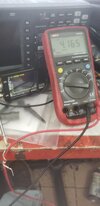
will replace caps just for
I had my thoughts mixed up. Of course the clarifier's voltage will be from an 8v source and not 5v. :P Different then that of the PLL. Hoping its not some kind of a capacitor issue or if the previous person messed with the tuning cans.
this radio seems untouched..I will replace all caps Thursday
I had my thoughts mixed up. Of course the clarifier's voltage will be from an 8v source and not 5v. :P Different then that of the PLL. Hoping its not some kind of a capacitor issue or if the previous person messed with the tuning cans.
 
  • Like
Reactions: doffo
You might want to check if you have the 10.240 MHz clock signal into the PLL on pins 12 and 13. If that's not present then pin 15 on the PLL will go low, which will kill the +5V to the channel selector via D26.

Pin 15 is the lock detector output, and you won't get lock without a reference signal to lock to.

If you have the 10.240 MHz signal and pin 15 is still low, then it's time to check if the 1/2 R signal is present on pin 10. Should be 5.12 MHz. This gets tripled to be your loop mixer signal at 15.360 MHz. But if it's not there, then that won't happen. If it is there, then time to check the VCO and loop mixer.

Your VCO is TR20, with an assist from the varactor diode D25. It should be generating between 16.270 MHz (ch 1) to 16.710 MHz (Ch 40). Your loop downmix happens on TR19. It pushes 0.91 MHz (Ch 1) to 1.35 MHz (Ch 40) to pin 22 on the PLL. If either of these aren't working then the PLL won' be able to lock and pin 15 will go low.

Schematic if you don't already have one:

Also, a quick and dirty check would be to pull D26 and see if you get the +5V you expect to pins 1 to 6 on the PLL. Then it's time to look into if not, why not?
 
  • Like
Reactions: codecxbox and doffo
You might want to check if you have the 10.240 MHz clock signal into the PLL on pins 12 and 13. If that's not present then pin 15 on the PLL will go low, which will kill the +5V to the channel selector via D26.

Pin 15 is the lock detector output, and you won't get lock without a reference signal to lock to.

If you have the 10.240 MHz signal and pin 15 is still low, then it's time to check if the 1/2 R signal is present on pin 10. Should be 5.12 MHz. This gets tripled to be your loop mixer signal at 15.360 MHz. But if it's not there, then that won't happen. If it is there, then time to check the VCO and loop mixer.

Your VCO is TR20, with an assist from the varactor diode D25. It should be generating between 16.270 MHz (ch 1) to 16.710 MHz (Ch 40). Your loop downmix happens on TR19. It pushes 0.91 MHz (Ch 1) to 1.35 MHz (Ch 40) to pin 22 on the PLL. If either of these aren't working then the PLL won' be able to lock and pin 15 will go low.

Schematic if you don't already have one:

Also, a quick and dirty check would be to pull D26 and see if you get the +5V you expect to pins 1 to 6 on the PLL. Then it's time to look into if not, why not?

You might want to check if you have the 10.240 MHz clock signal into the PLL on pins 12 and 13. If that's not present then pin 15 on the PLL will go low, which will kill the +5V to the channel selector via D26.

Pin 15 is the lock detector output, and you won't get lock without a reference signal to lock to.

If you have the 10.240 MHz signal and pin 15 is still low, then it's time to check if the 1/2 R signal is present on pin 10. Should be 5.12 MHz. This gets tripled to be your loop mixer signal at 15.360 MHz. But if it's not there, then that won't happen. If it is there, then time to check the VCO and loop mixer.

Your VCO is TR20, with an assist from the varactor diode D25. It should be generating between 16.270 MHz (ch 1) to 16.710 MHz (Ch 40). Your loop downmix happens on TR19. It pushes 0.91 MHz (Ch 1) to 1.35 MHz (Ch 40) to pin 22 on the PLL. If either of these aren't working then the PLL won' be able to lock and pin 15 will go low.

Schematic if you don't already have one:

Also, a quick and dirty check would be to pull D26 and see if you get the +5V you expect to pins 1 to 6 on the PLL. Then it's time to look into if not, why not?
thks..well, there is 5v at pin 11 of the pll. but think its not a pll problem after..reading the service manual and probing for correct voltages at each transistor, the RF amp stage is dead. TR 12, 13, 1, and those around are not getting voltage at their collectors. also noticed that the green pnp voltage regulator stays at 8.5 volts at its collector, regardless if I switch from AM to SSB and back..service manuals states that I should be seeing 5.5 at AM and 13.2 at SSB..
so what should I look for?
 
so how or not it would be to apply 8v to the circuit trace that supplies voltages to the tuning coils on that area?
 
so how or not it would be to apply 8v to the circuit trace that supplies voltages to the tuning coils on that area?
On the schematic if you follow the traces you'll find that the collectors of TR12 and TR13 are tied to TR31, which in turn is connected to the 8 volt regulator. So if TR31 isn't doing it's job and not switching 8 V from it's collector through to it's emitter when the radio is in receive, that would do it. Or some other component that gets it's 8 V through the same transistor could be shorted, which would kill everything on that 8V line.

Also, the base on TR31 should be low when in receive, because it goes through R177 and is then grounded through the PTT switch on the microphone. You can simulate a failure of this part of the circuit with a working radio if you have one. Unplug the mic, turn it on, and check the voltages.

TR1 is part of the noise blanker circuit, so really not necessary to worry about it right now. I suspect it will return to life once the problem with TR12/13 is sorted. And if I'm wrong, not like it would be the first time.

What I think you're talking about with the "green pnp voltage regulator" is TR44. To me this symptom sounds like a problem with the mode switching between SSB and AM. Going from the mode switch AM setting a voltage high goes to, among other things, D56, which then pulls the emitter of TR37 high, killing the ALC circuit. Which you don't need anyways in AM. That voltage then goes to VR10, which is where you set your carrier level on AM. That goes to the base of TR42, which then feeds the base of TR43, which then feeds the base of TR44. So, if any of those are failed, or if VR10 is cranked all the way to one side, that may explain what you're seeing there.

And never rule out bad soldering. Cold solder joints or blob job soldering can wreak havoc in a circuit. Or just some idiot cutting a trace that they shouldn't have. I only did that once, BTW.
 
thks! recovered voltage by your suggestion. mic connector was corroded..now I have RX. but we return to the pll issue. ok. I have 10.240/10.245 USB/10.238 LSB pin 12 at 2.85V AC. I have 16.170-16.550 at TR20 collector at 8.2V DC (I can vary that 16Mhz frecuency If I turn up or down the L14 slug. There is no signal at all on pin 10. Pin 15 is at 8.3V DC. and no DC voltage on the 6 channel selector pll pins.
 
There is no signal at all on pin 10.
That's kind of a problem in and of itself. On the upd2824 pin 10 is an output. As long as the chip has power, ground, and an input on pin 12, there should be a signal at pin 10 that's half the frequency of whatever is coming in on pin 12.

No signal there means either an internal fault in the chip, or an external component shorting to ground. The part that's connected to pin 10, C72, is a small cap to couple the 5.12 MHz into the tripler coil so I'm thinking it's probably not shorted to ground. But, weirder things have happened.
 

dxChat
Help Users
  • No one is chatting at the moment.