• You can now help support WorldwideDX when you shop on Amazon at no additional cost to you! Simply follow this Shop on Amazon link first and a portion of any purchase is sent to WorldwideDX to help with site costs.

TRC-57 restoration

They are not .47pF, they are 47pF. The factory schematic shows C80 and C81 as 39-68pF, which makes sense as under a half a pF of tank would be impractical.

There are large SMD parts like 2512's, but I think a compromise between being able to work with them and being able to easily fit them would be 1206.

A fine soldering iron tip, good magnifying glasses and .015" solder is the way to go. This little helper is how I got started soldering SMD parts.
Screenshot_20260108_120653_Cx File Explorer.jpg
edit: and pick up a roll of MG chemicals #453 fine solder wick. If you goof and have to try again, that little helper tool is useless with a blob of solder under the part. They will go on all crooked and not flush with the board. Always start with bare tinned pads.

edit 2: And if you are like me and keep your fingernails trimmed short, it helps to leave the nail on your index finger a little longer. That magnetic helper isn't always possible to use so you will find yourself trying to hold them down with your fingernail while tacking one side. A little fingernail there keeps you from getting burned.
 
Last edited:
  • Like
Reactions: Shadetree Mechanic
At work now, but I think I was driving the active filter wrong. I don't think it is seeing PWM.

IC6 datasheet says it's a phase-frequency detector (type-2, goes up and down), and looking at the factory schematic, the output is already filtered some.

I am now under the assumption that the signal coming from C322 is a small DC value with some ripple that the loop filter smooths and amplifies. I will try to drive it differently tonight with a smaller DC value going in.

The 10kHz PWM signal that I had tried led to some serious nonlinearity in the VCO tuning voltage that clearly took the active filter from cutoff, through the linear region and into saturation. Maybe if I feed it only enough DC to keep it in the linear region...

It's tricky not knowing exactly what the radio is telling it.
 
I think I have it close enough if you want to give it a try.

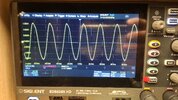
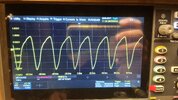
The trim cap is the coupling of the tank to the gate. Too low, it will stop oscillating. Too high and it distorts the waveform at the drain a little. Not bad, seen VCO's worse, so I think it will be fine. Adjusting the tap point to about 20% makes it pretty nice, but I have no idea where your coils tap is so you'll have to just try it and see what happens.
20260110_013406.jpg
The top is at the source connection, the bottom is the drain. Ignore the frequency being way too high. I got tired of the slug holder sliding out of the coil and left it out, but the waveforms are about the same with the slug in.
20260110_013900.jpg
20260110_013808.jpg
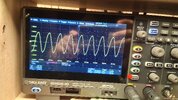
edit: for example, this is the drain when I move the tap down one.
20260110_014742.jpg
 
Last edited:
I'm willing to give it a shot. It's already working better than what I have now.
DM me the address and I will get it sent off Monday before work. I will send both the working one and the one that I originally started with so you can try old jfets you might have in the original circuit. Maybe I should put some little pin sockets on those pads for the fet.
 
Since you are also making one, figure I could mention what I changed.

I added a 220ohm resistor between the jfet source and the coil tap and bypassed it by stacking a 100nF cap on top of it. The gate to ground resistance was changed to 24k (the extra load helps offset the higher gain and cleans it up), added a 4148 from gate to ground, and from there a 3-15pF trimmer to adjust the tank-gate coupling (which also had a significant affect on waveform and startup reliability). The cap in the sams that says 40nF, I used 100 because thats what I had.

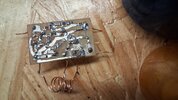
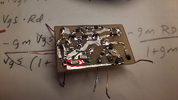
If you need to change the frequency to suit the coil, you can snap off this 47pF and tack on a through hole in its place (just don't lose the wire via on the right side when you solder it on). Smaller cap raises frequency, larger cap lowers it. The varactor is that tiny black one directly above it. Ill swap out those beat up leads too, they got a little roughed up in testing.
1768076986262.png
 
Since you are also making one, figure I could mention what I changed.

I added a 220ohm resistor between the jfet source and the coil tap and bypassed it by stacking a 100nF cap on top of it. The gate to ground resistance was changed to 24k (the extra load helps offset the higher gain and cleans it up), added a 4148 from gate to ground, and from there a 3-15pF trimmer to adjust the tank-gate coupling (which also had a significant affect on waveform and startup reliability). The cap in the sams that says 40nF, I used 100 because thats what I had.

If you need to change the frequency to suit the coil, you can snap off this 47pF and tack on a through hole in its place (just don't lose the wire via on the right side when you solder it on). Smaller cap raises frequency, larger cap lowers it. The varactor is that tiny black one directly above it. Ill swap out those beat up leads too, they got a little roughed up in testing.
View attachment 75618
You, sir, are a rock star!
 
Received the three VCO boards today. Of course I couldn't wait and threw the one with the adjustable cap in there. The good news is that it receives and transmits. The bad news is it's only on channel 1, no matter what the channel selector is set to. So, obviously, I need to look around a bit more.

I will say, though, that being able to even get this far is a huge improvement. I'll take a working VCO over a dead one any day.
 
Does the loop lock or was it necessary to carefully adjust the VCO tank until it worked on ch1? The C322 signal should be hovering around three diode drops above ground.
 
Carefully adjust the tank. Been working on something else pretty much all day so I'll have to get back to you on what the signal at C322 looks like.
 
Could be that the VCO amplitude is not high enough for the divider to register.
I think you may be right. I took a look at what was coming in from the VCO/loop mixer to the divider, about .4 Volt. Running through the synthesizer alignment steps didn't seem to help much.
 
looks like the 74162 counters need 2v minimum for signal inputs. Can you take a look at TP4 (counter board) and see what you have there?

We could try to get more out of the VCO by tacking on a larger output cap across that 10pF cap in the corner or we could try changing the feedback on TR15, the amplifier that drives the counter ICs
 
Last edited:

dxChat
Help Users
  • No one is chatting at the moment.
  • @ 357:
    holy man no activity or what?
  • dxBot:
    357 has left the room.
  • @ Hambones amps:
    Does anyone know if you can replace the 2290 in a galaxy dx 93t twin turbine with a 2sc2879 red dot? If so, what would have to be tuned?