• You can now help support WorldwideDX when you shop on Amazon at no additional cost to you! Simply follow this Shop on Amazon link first and a portion of any purchase is sent to WorldwideDX to help with site costs.

TRC-57 restoration

Looking into the amp. I've got a nice 0 to 4.5 V or so at TP4. I went back and compared the VCO output to the loop downmix signal for the loop mixer, both are hitting their respective gates at about .4 V, so that may acceptable since TR15 is doing it's job.

I decided to check another scenario. What if the new VCO is good and one of the dividers or the phase comparator is the problem now?

To test this, I tweaked the VCO to get as close to 19.1675 as I could (Channel 13, USB, clarifier centered in the alignment procedure). I checked to make sure the fixed divider looked good, and it's putting out a 10kHz square wave. I then checked the programmable divider and it's putting out a high signal with negative spikes at about 8 kHz. Yeah, that's a problem.

So now I get to do math and take readings to figure out if:
1. All of my oscillators are doing their thing at the correct frequencies.
2. All of my mixers are outputting the proper signals.
3. All of my programmable divider inputs are correct.
4. My programmable divider output is correct for the given inputs.

Until I get the programmable divider output at least close to the fixed divider the loop will never lock. Kind of important in a PLL circuit, last I checked.
 
I assume that was a typo and that you meant ch1 USB, not 13USB.

IC 10 and 11 are cascaded synchronous counters. The service manual shows the divider logic for both chips.

With the VCO set to 19.1875, the down mix should be at 700kHz. You should see 700kHz coming out of the (low-pass filtered) amplifier TR15 (at TP4) , 70kHz coming out of pin 15 of IC10 and 10kHz coming out of IC11 (pulses, not square waves).
 
Last edited:
  • Like
Reactions: Cable Guy
No, I set it to 13 because I skipped lines while trying to tweak stuff. Helps if I would pay attention. Set it to 1, OK, much closer to 10kHz on the pulses coming out of pin 15 of IC 11 now. As in the scope's "frequency counter" feature occasionally flashes 10 kHz and hovers pretty close to it most of the time now.

Another thing that threw me off is that while the N-codes work, they're a little confusing until you see what they did there. Take the BCD number of the pins set to logic 1, add them all up, then subtract that number from 100. That's the N-code.

So, for instance, on channel 23 only pin 3 of IC 10 is a logic high. That's "1" in BCD. Subtract that from 100, your N-code is 99. Likewise, for channel 1, pins 3 and 4 of IC 11 are a logic high. That's "30" in BCD. Subtract from 100, your N-code is 70.

Not all that complicated, really. Just looks weird as hell until it clicks. I'm sure you already figured that out, but it might help somebody else some day.

Anyways, at this point It looks like the dividers are dividing as they should. The phase detector output changes the further you take the dividers from the frequency the VCO is set to, so I'll call that working as well. Which points back to the VCO possibly not taking direction from the PD.
 
Yea, that binary threw me off too, until I realized that only the initial cycle of IC10 is starting at the preset. For the remaining cycles of IC10, the count is starting from zero, not the preset. Once IC11 rolls over, the presets are loaded again.

I didn't notice the "LOAD" wire.

edit to add
N = -A - 10B + 100
A is IC10 input
B is IC2 input
 
Last edited:
I remember the voltage range of the input being quite narrow. Those three transistors on the VCO have their Vbe junctions in series, so the biggest varactor swing happens with about 1.6v from the PD. I imagine if it is too far off that it wouldn't find the window.

If you set it to ch1 AM RX and tune the slug for 19.165, what voltage do you have on TP3 (the varactor voltage)?
 
Better yet, use an external power supply and drive TP3 with 2.5v and see what frequency you get with the slug in a good looking spot. That frequency will tell us what we need to do to the capacitors to get it in range (if thats the issue).

edit
feed that 2.5v into both TP3 and the input from the PD. Applying 2.5v to the input ensures the output to TP3 is low. This will prevent the internal voltage from going above the 2.5v you inject. After that, you'll know the varactor is at 2.5v and we can calculate some stuff.
 
Last edited:
The idea is that if we know the voltage, we know the capacitance, and if we know the capacitance and frequency at that capacitance, we know the inductance. If we know the inductance, we can calcuate the capacitance we need at the frequency we expect and see if your VCO caps are appropriate.

For that, you need to tie both the top VCO pins to 2.5v, reasonably position the slug and note the frequency. Dont worry about how far off that frequency is, just see what it is where the slug looks good at 2.5v.

EDIT
My bad, not the top two, its the top right corner and the middle left pin from my picture
Screenshot from 2026-01-25 00-07-04.png
 
Last edited:
I can do the 2.5 V feed, I just need to build/buy a supply to deliver it. Perfect excuse to acquire an adjustable bench supply, no?

I'll try tuning for 19.165 and measuring at TP3 later tonight. If nothing else it's a backup plan that I can implement quickly.
 
With the change in transistor/varactor, it might be necessary to change one of those capacitors. Maybe the older jfet had more capacitance that my circuit replication didn't account for, or maybe my varactor is a little different than the original.

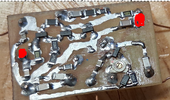
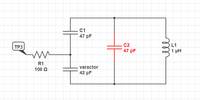
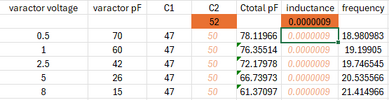
I put together a spreadsheet to illustrate (what I suspect is) the problem. Consider the tank circuit (and that red capacitor I mentioned earlier that could be snapped off/changed):
1769467116080.png
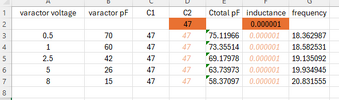
If we look up the capacitance/voltage curve for the BB175x varactor I used, we can see where this circuit is resonant at various varactor voltages (assuming 1uH for now just to illustrate).
1769467273610.png
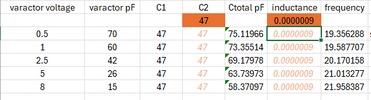
Looks like it would be in range. However, that inductor value was a guess. What if it peaks at 0.9uH and won't go higher?
1769467552532.png
You could probably get it on the right frequency with the varactor at 0v with careful slug adjustment, but no amount of varactor voltage will get it to lock because it would shift it the further in the wrong direction.

But what if we swap that red 47pF cap with 52pF. Just a little more capacitance puts it right back in the varactors range:
1769467766817.png


I figured that instead of trying to understand what is happening by guessing what the varactor capacitance is at its voltage limits, we could just set it to a known capacitance and see where it oscillates at. That will tell us the inductance and also the capacitance needed to put the desired frequency inside the varactor range. Or at least get a good idea which way/how much to go.

The idea I had was to set the slug mid adjustment (definitely not peaked) and then figure out where the capacitance should be. Once we get the capacitance close, we can then tweak the slug like normal.
 
Last edited:
And it doesn't have to be exactly 2.5v, just something I can look up on the chart to see if we are even remotely close. 3.2v would work too, so if you have a AA battery holder, thats fine.

I had ordered a Matrix power supply, but I had to cancel it. The listing said 4 in stock and ships from amazon. A week later, I get an updated delivery date of 2 months out. Clearly, China hadn't even built it yet and I didn't want to play that game.
 

dxChat
Help Users
  • No one is chatting at the moment.
  • @ 357:
    holy man no activity or what?
  • dxBot:
    357 has left the room.
  • @ Hambones amps:
    Does anyone know if you can replace the 2290 in a galaxy dx 93t twin turbine with a 2sc2879 red dot? If so, what would have to be tuned?